Sri Lankan Christmas Cake : Part 1 – a bit of spicy history
Source:Annakwiecinska
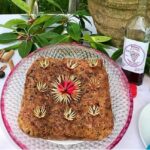
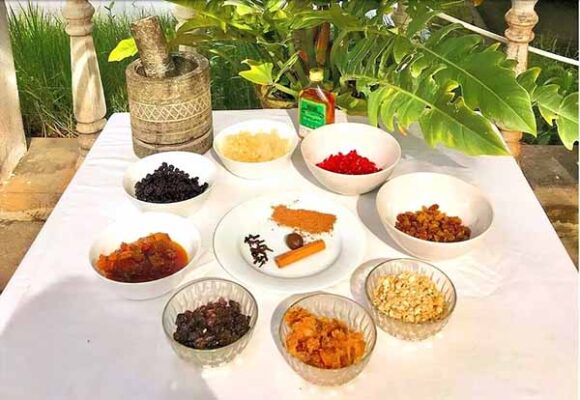
Last weekend, here in Sri Lanka, I baked a Christmas cake. Noteworthy for four reasons: it’s the first time, it’s absolutely delicious, it’s flourless and I made my own spice mix using Sri Lanka’s renowned produce.
The recipe follows at the end, so let me introduce its star ingredient …
WHO AM I?
For three centuries the island of Ceylon was the epicentre of a global battle for domination of me, one of the most costly goods on the planet.
Prized more highly than gold in the ancient world, I was one of the world’s first-traded spices.
I was first mentioned by the Greeks in a C.7th BC poem by Sappho; an Apollonian temple bears my name inscribed in a list of gifts, and the Roman emperor Nero, in an ostentatious display of contrition, spent several lifetimes of working men’s wages to scent the fires of his second wife’s funeral pyre with my revered perfume.
My acquisition was an enterprise rivalling the labours of Hercules. Men were said to brave swamps ‘at the end of the world’, forge serpent-infested canyons and lure giant birds to gorge on chunks of oxen, only to have their massive nests tumble from insurmountable peaks when they returned to their mountaintop lairs, fat and heavy. What fell to ground was collected and brought to the Red Sea where Arab traders could demand what they wanted for me, a mythic substance essential to embalmers, anointers and preservers of meat.
In the C.1st AD Pliny the Elder opined my source as Ethiopia, already a place of legendary mystery, and for another 1100 years Venetian traders, who owned the monopoly on my European trade from the port of Alexandria, did nothing to disavow these gilt-edged fictions - although interestingly, Marco Polo remained quiet on the subject, despite the fact that ‘kwai’, my oriental cousin, had been mentioned in Chinese medicinal texts since 2800 BC.
When the Mamluk sultans assumed power in Cairo 1250, and the Ottomans only 49 years later in Constantinople, the Mediterranean seaways were disrupted, and the Arabs’ best-kept secret became even more exorbitant.
Having controlled my trade for millennia, and being, at the time, the world’s best cartographers, it’s not surprising that it was an Arab geographer, Zakariya al-Qazwini, who first mentioned that I grew on the island known as ‘Serendib’. The year was 1270 and 22 years later this was repeated in a letter by the Archbishop of Peking, Giovanni de Montecorvino, a Franciscan explorer statesman who founded the earliest Catholic missions in India and China.
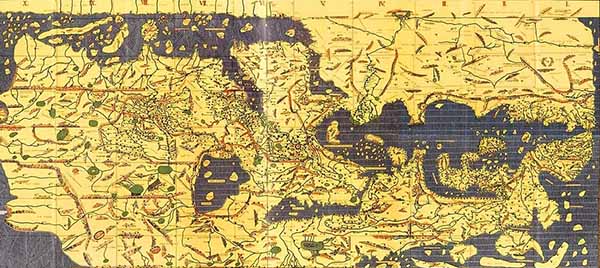
Modern cartographic conventions are reversed in the map above – it’s ‘upside down’ – but the most comprehensive map of its day shows how prominently the island of Ceylon, then known as ‘Serendib’, featured in world knowledge – the tiny teadrop isle is almost half the size of India!
But it would be another 200 years before Europeans, now really struggling to meet demand, felt compelled to seek me out for themselves.
Disappointing Queen Isabella, sitting up there in Grenada’s Alhambra, both Christopher Columbus and Gonzalo Pizarro failed to find me in the New World, while her greatest rivals, Portugal, who’d been exploring the Arabian sea, finally discovered me in Ceylon around 1518.
Wasting no time to control their fragrant quarry, the Portuguese conquered Ceylon’s coastal kingdom of Kotto, enslaving the population who would enrich Portugal over the next century. Meanwhile, Ferdinand Magellan continued Spain’s search, his efforts somewhat rewarded with a sturdy relative of mine in the Philippines.
But it was the teardrop isle between the Arabian Sea and Indian Ocean that commanded the great trading empires’ attention.
“The shores of the island are full of it,” a Dutch captain reported, “and it is the best in all the Orient. When one is downwind of the island, one can still smell it eight leagues out to sea.”
Only 20 years after establishing their own trading post in 1638 and quickly taking control of Portugal’s ‘manufactories’ in 1640, the Dutch, allied with the central Ceylonese kingdom of Kandy, overthrew the Portuguese in 1658. However, if the Kandyans thought they’d just scored a victory, they were very mistaken.
The Dutch defeated the Portuguese but held the kingdom in their debt for their military services, so once again Ceylon was occupied by European traders – this time for 150 years.
The Kandyan kingdom, solitary and isolated in the mountainous centre of the island and surrounded by opportunistic colonists, cleverly held onto provincial power, and learning from bitter experience, used it to parry with the Dutch government for protection from foreign invasion in return for land rights.
I became the jewel in the Dutch East India’s crown, their most lucrative export.
They systematised the harvesting of these wild perennials of the laurel family that flourished between upcountry and coast, eventually beginning cultivation, including 289 acres in 1789, just 3 km south east of Colombo.
But time was running out for my luxury status; by the early 1800s despite my unique qualities, other species were being exported from China and SE Asia, and when Britain wrested control of Ceylon – Kandyan kingdom and all – in 1796, they already had massive plantations in Kerala on India’s SW coast, and besides, tea and rubber were the now the world’s products du jour.
… and those 289 hectares near to Colombo? They became the city’s elite residential precinct, a by-word for privilege and cosmopolitan style.
Cinnamon Gardens.
More likely than not, that sprinkle of aromatic powder on your cappuccino is the grounds of the thick curls of bark peeled from the felled trees of Cinnamomom cassia, native to China, now widely cultivated in Vietnam and Indonesia where it’s known as ‘Kayu manis’, sweet wood.
Much cheaper and more widely available, its stronger aroma is matched by a coarser texture when ground, darker colour and a spicier flavour– it bears only passing resemblance to Cinnamomum verum, ‘true Cinnamon’, or ‘Ceylon Cinnamon’ which originated in Sri Lanka, and today’s world production is still produced mainly on the island, with the other 10% from Seychelles and Madagascar.
Cinnamomum verum and Cinnamomum cassia are totally different spices. The major difference is the coumarin content of each spice. C. verum contains ultra-low coumarin content compared to cassia and its varieties: True Cinnamon (~0.004% coumarin) and Cassia (~ 5% of coumarin). Why is this important ?
In 2006, Germany’s Federal Institute for Risk Assessment warned against regular usage of cassia, due to its higher coumarin content, which is linked to kidney and liver health, whereas Ceylon Cinnamon has many purported health benefits, and a surprising amount of nutrition
So as you shop for the ingredients for this Sri Lankan Christmas cake, it’s an opportunity to watch out for the distinctive quills of Sri Lankan Cinnamon, and very much worth the effort to find the real thing.
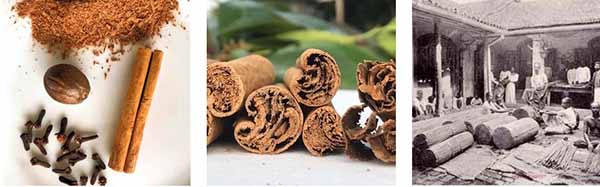
Chinese Cinnamon is a single, thick, curled layer of reddish bark, but notice how in cross-section Ceylon cinnamon quills are made of many layers of crumbly, paper-thin bark in about 8 cm lengths, rolled into cylinders about 1 cm in diameter
Sometimes quills up to 1m in length can be found here in Sri Lanka – seen in this early 1800s photo.
The color of true cinnamon is a uniform light brown to pale tan. The fragrance is sweet, perfumed, warm and pleasantly woody with no trace of bitterness or dominating pungency.
It’s best to buy the quills and grind as you require rather than powder, as what’s inside can be less than the quality stated on the packet.
The three spices above: cloves, nutmeg and cinnamon are the three warming spice ingredients for my Sri Lankan Christmas Cake whose recipe is HERE.
Happy Cooking!
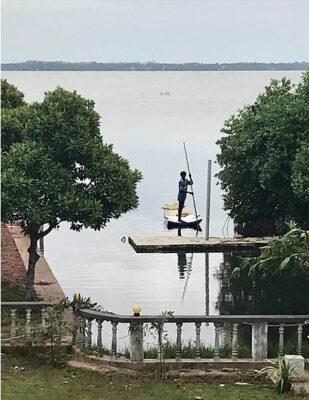
and a safe and Happy Christmas from lakeside Negombo, Sri Lanka
xx Anna
(and do let me know how your cake turns out … )