Tokyo Cement Company (Lanka) PLC has reached a significant environmental milestone, with 100,000 mangrove saplings planted along Sri Lanka’s coastline through a long-running restoration programme conducted in partnership with the Sri Lanka Navy and local fishing communities.
The achievement, reported in connection with World Environment Day, represents more than a substantial planting figure. It reflects the value of sustained environmental work, in which corporate responsibility, public institutions and coastal communities have been brought together to rehabilitate an ecosystem that is instrumental to shoreline stability, marine biodiversity and the livelihoods of people living near the sea.
The project was initiated in 2012, when Tokyo Cement began developing a mangrove restoration programme in and around its operational base at China Bay, Trincomalee. From its early stages, the initiative was shaped through collaboration with the Sri Lanka Navy and fishing communities from nearby villages, creating a practical partnership between industry, national service and local knowledge.
A long-term commitment to coastal restoration
Mangroves are among the most valuable coastal ecosystems in the world, although their importance is not always immediately visible. Growing in the intertidal zone where land meets the sea, mangrove trees are adapted to saline conditions and form dense networks of roots that help bind coastal soils, slow water movement and create sheltered habitats for numerous forms of life.
For Sri Lanka, an island nation with an extensive coastline, the restoration of mangrove habitats has particular environmental and social importance. Mangrove belts can help strengthen the natural resilience of coastal areas, while their root systems assist in reducing the effects of shoreline erosion. They also provide breeding and nursery grounds for fish, crustaceans and other small marine organisms, thereby supporting the wider ecological foundation on which coastal fisheries depend.
Tokyo Cement’s official mangrove reforestation programme describes the project as an effort to rehabilitate mangrove habitats and encourage the recovery of native coastal vegetation. The programme has been developed through a continuing process of cultivation, planting and habitat restoration rather than as a single short-term campaign.
That continuity is particularly important in environmental work. A tree-planting event may attract public attention on one day, but the cultivation of healthy coastal habitat requires planning, suitable seedlings, local participation and long-term care. The 100,000-sapling milestone therefore demonstrates the value of a project that has been maintained across more than a decade.

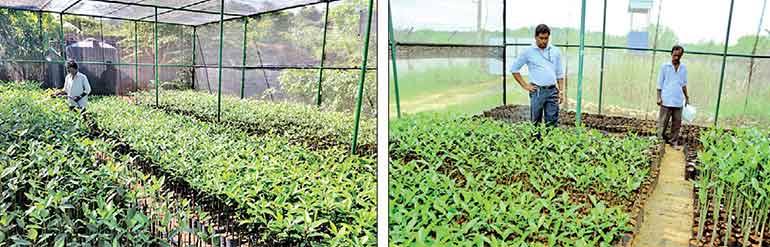
The China Bay nursery
A nursery was established within the Tokyo Cement factory premises at China Bay to provide a reliable supply of young mangrove plants for the restoration programme. According to the Daily FT report, the nursery produces approximately 7,500 saplings annually, helping to sustain the project’s ongoing planting activity.
The nursery is an important component of the initiative because it places cultivation at the centre of restoration. Instead of relying solely on occasional external supplies, the programme has developed an internal capacity to raise young plants and prepare them for replanting in suitable coastal environments.
Such a process also supports a more considered approach to ecological rehabilitation. Mangrove restoration is most effective when planting is aligned with the natural conditions of the habitat, including the character of the shoreline, tidal movement and the composition of native vegetation. The project’s stated emphasis on restoring mangrove habitats with appropriate native plants provides a stronger foundation than indiscriminate planting.
The nursery also creates a visible educational example of how industrial premises can accommodate environmental initiatives. A factory site, traditionally associated with manufacturing and logistics, can consequently serve an additional purpose as a place where ecological knowledge, plant cultivation and conservation practice are brought together.
Partnership with the Sri Lanka Navy
The Sri Lanka Navy has played a central role in the implementation of the mangrove planting programme. Its participation has enabled saplings cultivated through the project to be replanted across coastal areas, extending the reach of the initiative beyond the immediate surroundings of the China Bay facility.
This partnership illustrates how environmental protection can benefit from institutional cooperation. The Navy contributes organisational capacity and coastal experience, while Tokyo Cement supports the cultivation and availability of mangrove saplings. Local fishing communities, meanwhile, form an essential part of the social and practical environment in which the restoration work takes place.
The participation of fishing communities is especially meaningful because coastal residents experience the condition of marine and shoreline ecosystems directly. Their daily relationship with the sea provides an important perspective on the value of mangrove habitats, while their involvement helps ensure that restoration is connected to the needs and realities of local communities.
Through this cooperative model, the project has become an example of shared responsibility. Environmental conservation is not treated as the duty of one institution alone; instead, it is advanced through a combination of business leadership, public-sector involvement and community participation.

Supporting biodiversity and coastal livelihoods
Mangrove environments are replete with ecological connections. Their branches and roots provide shelter for young fish, invertebrates and other small organisms, while the surrounding vegetation can support birds, reptiles, amphibians and other wildlife. The habitats are therefore important not only as collections of trees, but as living coastal systems in which multiple species interact.
The benefits extend into human communities. Coastal fisheries depend upon productive marine environments, and mangrove areas can contribute to the conditions required for fish and crustaceans to develop. Mangroves can also enhance the scenic character of coastal locations, creating opportunities for responsible tourism and environmental education when such areas are managed carefully.
For communities whose livelihoods are linked to fishing and other coastal activities, the protection of these natural environments is consequently a matter of economic as well as ecological significance. A healthier shoreline can support a healthier marine environment, while the restoration of native vegetation can help preserve the character of coastal areas for future generations.
The planting of 100,000 saplings should therefore be understood as an investment in interconnected benefits. Each sapling forms part of a broader effort to rebuild habitat, improve coastal resilience and encourage greater public recognition of the importance of mangrove ecosystems.
Environmental responsibility with practical results
Tokyo Cement’s mangrove programme demonstrates how corporate environmental responsibility can move beyond broad statements and produce measurable, long-term activity. The company’s work has combined nursery development, partnerships and field planting, creating a practical framework that can continue to support restoration.
The achievement also presents a constructive model for other organisations. Businesses operating near sensitive environments possess an opportunity to contribute directly to the protection of those surroundings, particularly when projects are planned in consultation with relevant authorities and local communities.
The partnership between Tokyo Cement, the Sri Lanka Navy and fishing communities is valuable because it brings together different forms of capability. Corporate resources, institutional coordination and community participation have been aligned around a shared environmental objective, producing an initiative with significance well beyond the boundaries of any one organisation.
For the global Sri Lankan community, such projects offer an encouraging reminder that national progress can be advanced through patient, collaborative work. Environmental achievements may not always produce immediate headlines, but their influence can become increasingly visible as restored habitats mature, shorelines gain greater natural protection and communities benefit from healthier coastal ecosystems.
The 100,000-mangrove milestone is consequently both an accomplishment and an invitation to continue. It highlights what sustained cooperation can achieve while reinforcing the need for further investment in the conservation of Sri Lanka’s coastal environment.
As the China Bay nursery continues to produce new saplings and the restoration programme develops through its partnerships, Tokyo Cement’s initiative provides a hopeful example of environmental stewardship in practice: carefully cultivated, locally supported and directed towards the long-term wellbeing of Sri Lanka’s coast.
Sources:
- https://www.ft.lk/sports/Tokyo-Cement-marks-World-Environment-Day-with-100-000-mangroves-for-greener-Sri-Lanka/23-793354
This article was written based on the source https://www.ft.lk/sports/Tokyo-Cement-marks-World-Environment-Day-with-100-000-mangroves-for-greener-Sri-Lanka/23-793354, kindly email us at info@eLanka.com.au if any information needs to be corrected. - https://tokyocement.com/mangrove-reforestation/
Additional project information was obtained from https://tokyocement.com/mangrove-reforestation/.
(adsbygoogle = window.adsbygoogle || []).push({});
At eLanka, we respect the rights of creators. If we have used an image you own and you’d like it removed, please email us at info@elanka.com.au and we’ll handle it promptly.