Unwrapping a fascinating tale through the ages-by Renuka Sadanandan
Source:Sundaytimes
The Mahavamsa records that Kuveni was spinning thread when Vijaya arrived circa 543 B.C. It is detailed that their marriage ceremony was conducted in a tent with ceiling cloths (udaviyan), a tradition still practised today as seen in the uduviyan (canopy) that is placed above the relic casket during the annual Kandy perahera.
In another century (early 20th), when Ethel Coomaraswamy, wife of the legendary Ananda Coomaraswamy, a skilled weaver in her own right is in Kandy, a visit by an ex-Arachchi carrying with him a large, decorative, embroidered betel bag, inspires her to research into Sinhalese embroidery.
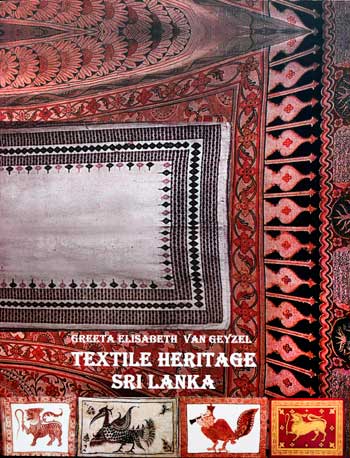
That textiles have figured in the island’s 3,000-year history, we have some idea of but the extent of their development over the centuries, as seen in literary sources, paintings, sculpture and archaeological evidence, is not known to many. The National Trust of Sri Lanka’s latest release – a soft cover coffee table book ‘Textile Heritage Sri Lanka’ unwraps a fascinating tale of the many strands of textile development in the island.
The author Greeta E. Van Geyzel notes that it took her long years to complete her task of recording the dyeing, weaving, embroidery and other techniques practised in the country based on specimens stored in the National Museum of Sri Lanka. It was at the request of Dr. Roland Silva, eminent archaeologist and founder member of the Trust, that she expanded her original research of the Museum collection which has culminated in this book, released just this week.
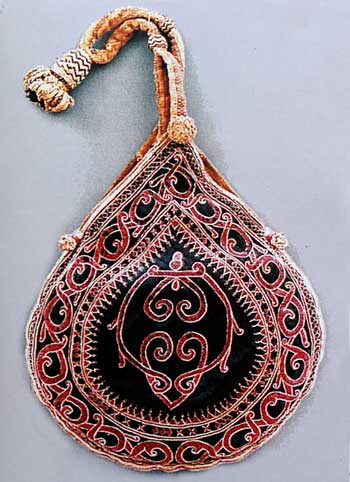
A beautifully embroidered betel bag
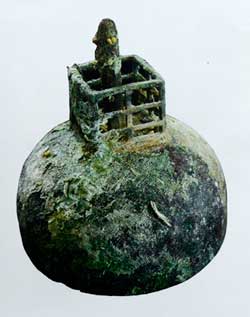
As the author reveals, the examples of the antiquity of textile production in this island are many. One of the most intriguing is of the fragments of cloth wrapped around the miniature stupas made of crystal and bronze discovered in the relic chamber of Dalivala Kotavehera near Rambukkana. These were unearthed in 2002 by Nimal Perera of the Department of Archaeology. Samples sent to Australia were found to date back to the 2nd century BC. They are believed to be an example of the classical period of the Silk Route “when Chinese silk was brought to India, Persia and Rome”.
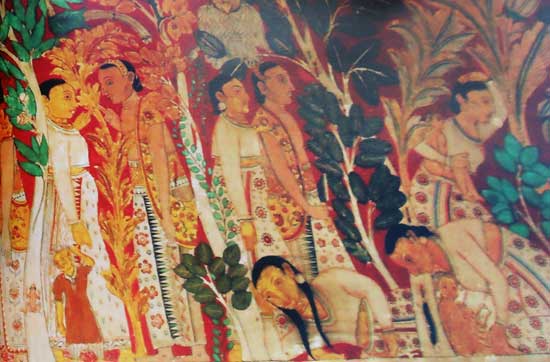
Even the famed Sigiriya frescoes offer evidence of how developed textiles were in ancient times. The Apsaras or celestial nymphs of the paintings are depicted wearing a garment below their waists and transparent blouses. In ancient times, women do not seem to have worn drapery above their waist, the author writes, drawing a comparison to the famed bronze image of Tara belonging to the late Anuradhapura period.
With many such examples, she traces the customs and evolution of clothing over the different periods in history. Cotton was a major crop during the Dambadeniya period, Sivurudeniya in Kurunegala being the place where King Parakramabahu employed weavers to make robes for Buddhist monks. The advent of Indian master weavers skilled in weaving fine gold cloths at the request of King Vijayabahu III also during the Dambadeniya period was indicative of the development of the local textile industry and some of the words used like ‘nul’ (yarn) in both Sinhala and Tamil reflect the ties the island had with other countries and south India in particular.
In addition to the history, chapters in the book look at the traditional process of textile weaving, Dumbara weaving, and the art of traditional flag production among others.
The book also provides a solid introduction into the technical aspects of production in the chapter on the traditional machinery used. Cotton, having been grown in the country from earliest times, early implements were the hand manipulated carding bow, sliver bench, carding bench and charkra for winding the cotton as yarn spindles (idda) and the spinning wheel. The traditional pit loom we are told, was used not only in Sri Lanka but also in other countries like India and Myanmar.
Also of interest are the dyes – “During the ancient period, the art of dyeing was well understood in ancient times and painting were well understood as was that of weaving.” The book records that in those days, cloth painted with dyes were used mainly for religious purposes such as seen in the pethikada based on Jataka stories: natural dyes of yellow, green, red and black were used: patangi or corakaha (red), aralu or bulu (black), venivalgata and saffron (yellow) and lunumidella or araliya (green). Even during the 17th-19th century, dyes were made from fruits and roots such as the Chaya root for red, Indigo nilavariya for blue and kos for yellow.
Jak was, and is still used, the yellow being obtained by boiling the roots of the tree for the dyeing of monks’ robes.
Chapter 5 is devoted to Dumbara Weaving and the book records with appreciation that weavers and craftsmen following the traditional craftsmanship of bygone eras still reside in the Kandyan region, passing on their skills to the present generation. “The only traditional weaving system that survived and can be studied is the pit loom system. The Dumbara weaver’s distinctive motifs such as the katurumala, panapiyuma and domba mala are all achieved by the insertion of thin sticks which are used to turn and twist the thread into the required design.” The designs used from animal to floral are also described, including how they have been modified for contemporary use.
Flags have been the subject of much interest and the chapter on ‘Art of Traditional Flag Productions’ not only depicts ancient flag designs but clearly traces how they are regarded as significant symbols of a nation.
In Chapter 7 – ‘Textile Products for Specialised Use’ we see the betel bags that so intrigued Ethel Coomaraswamy as well as the Diya Kacciya (bathing cloth) used by ancient Kandyans (which also had its use as undergarments for sentries and wrestlers), coverlets and tablecloths. A section also covers Somana- the fabric with floral designs favoured by the aristocracy that also had geometrical shapes such as triangles and spirals and wavy lined motifs known as Parang rusak and commonly featured two birds, the Garuda (the mystic eagle) and the phoenix. Some of these cloths are still in the guardianship of some temples and in the possession of old families, the author writes.
A beautifully embroidered betel bag
The book’s concluding chapter touches briefly on the revival of textile production in the country at the latter stages of colonial rule, thanks initially to the efforts of Anagarika Dharmapala and Advin Hewawitharana, and the subsequent establishment of government-owned textile mills such as the Veyangoda and Thulhiriya mills, as well as significant efforts to upgrade the batik and handloom industries.
With many photographs well amplifying the text, the book is a most illuminating read.
‘Textile Heritage Sri Lanka’ is available at the National Trust at Rs. 6,000. It is also being sold at Vijitha Yapa, Barefoot and Sarasavi bookshops.