Washington is preparing to conclude its involvement in the 2026 West Asia conflict-by Harold Gunatillake

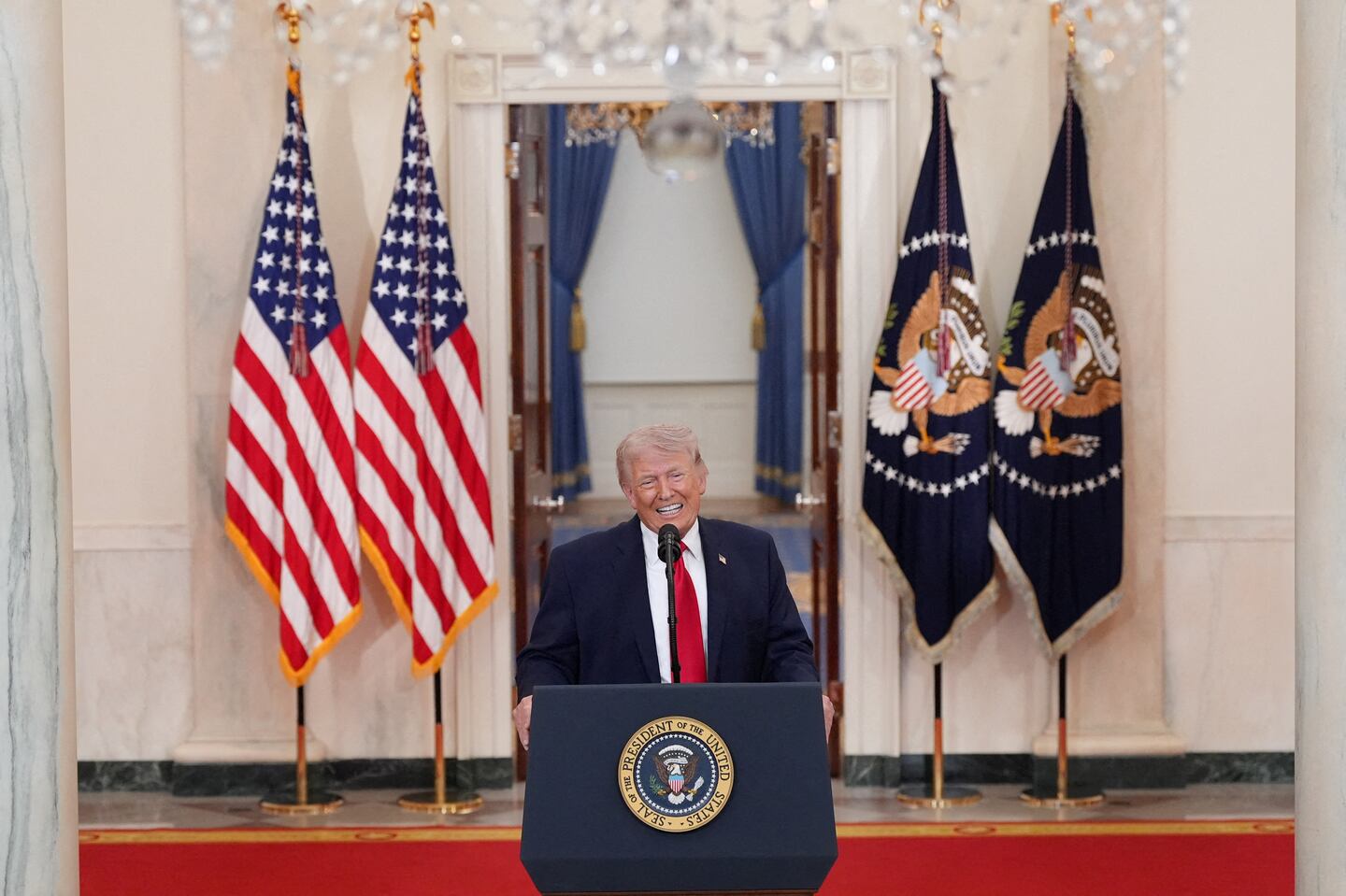
Image Source:Thedailybeast
- United States President Donald Trump announced during a primetime televised address from the White House that his primary objectives concerning Iran are approaching their completion.
- The approximately 20-minute speech additionally urged allies to ‘develop the resolve’ to safeguard shipping through the Strait of Hormuz, contending that the United States does not ‘require it.”
- After the speech, global oil prices rose to $105 a barrel
- Earlier, the president stated that he is contemplating withdrawing the United States from NATO due to what he describes as inadequate assistance in the Middle East; however, legislation enacted in 2023 indicates that such a decision would not be straightforward.
- Meanwhile, Iran’s Ministry of Foreign Affairs reports that Trump’s assertion regarding Iran’s request for a ceasefire is “false and baseless,” according to Iranian state media.
- The President of the United States stated that Iran’s “new regime president” had made the request; however, he did not specify whom he was referring
President Donald Trump stated on March 27th that U.S. military operations in Iran may conclude within “two to three weeks,” providing the most explicit indication to date that Washington is
preparing to conclude its involvement in the 2026 West Asia conflict.
Speaking from the Oval Office, the President stated that “Operation Epic Fury”—the U.S.-led campaign initiated on February 28—is progressing at a faster rate than initially expected, and that American forces may commence their withdrawal “very soon.”
The remarks signify a notable shift in tone compared to earlier statements made by senior administration officials, who had emphasised that the operation would persist until Iran’s missile capabilities, naval assets, and support networks for regional proxy groups were markedly diminished.
U.S. officials have characterised Operation Epic Fury as a specific initiative intended to diminish Iran’s capacity to threaten American forces and regional allies. The Pentagon has documented strikes on missile production facilities, naval installations, and command centres across various Iranian provinces.
Although the administration has not provided comprehensive assessments concerning the extent of damage incurred on the battlefield, defence officials have stated that the campaign has “met or exceeded” several preliminary objectives. Independent verification of the scope of damage within Iran remains limited.
Iranian authorities have condemned the operation and accused the United States of escalating regional tensions. Tehran has not publicly commented on Trump’s latest timeline, and it remains unclear how Iranian leadership will respond to a potential U.S. drawdown.
Israel, which has carried out its own military operations during the conflict—including actions targeting senior Iranian military officials—has not issued an immediate response to the President’s remarks.
Governments across Europe and Asia have prudently welcomed the prospect of de-escalation, whilst urging all involved parties to refrain from actions that might incite renewed hostilities.
No Certain Path Ahead
Notwithstanding the President’s proposed timeline, U.S. officials have not verified the existence of a formal withdrawal plan.
Analysts note that even if substantial U.S. operations are scaled back, the overall regional situation remains unstable, with the possibility of retaliatory attacks or renewed proxy engagements.
The White House has not indicated whether diplomatic channels with Iran will be pursued following the military phase of the operation.
The present state of the United States-Iran relationship is characterised by tension, with both nations involved in indirect negotiations to prevent military escalation.
Iran’s President, Masoud Pezeshklan, has articulated a willingness to engage in dialogue and has expressed that Iran bears no hostility towards ordinary Americans.
Nevertheless, the country’s Supreme Leader, Mojtaba Khamenei, wields significant authority, and it remains uncertain whether Pezeshkian’s correspondence has obtained his endorsement.
The United States and Iran have participated in diplomatic negotiations, with Muscat, the capital of Oman, serving as the venue for indirect nuclear discussions in February. The United States has articulated three primary requirements: a permanent halt to uranium enrichment activities, rigorous limitations on Iran’s ballistic missile program, and the cessation of support for regional proxy groups. Nevertheless, Iran is unlikely to yield on these demands, citing national security considerations.
The situation is further complicated by recent military actions, including US and Israeli strikes on Iranian targets, which have resulted in the death of several Iranian leaders. Iran has responded with missile and drone attacks on US and Israeli assets.
United States President Donald Trump has expressed optimism about reaching an agreement, indicating that Iran is “seriously engaging” in discussions with the United States. Nonetheless, Iran’s Foreign Ministry has refuted claims that it requested a ceasefire, and the situation remains dynamic.
This is the current situation.