News & Community eLanka

eLanka

Thursday, 15 Oct 2026
  • Home
  • Read History
  • Articles
    • eLanka Journalists
  • Events
  • Useful links
    • Obituaries
    • Seeking to Contact
    • eLanka Newsletters
    • Weekly Events and Advertisements
    • eLanka Testimonials
    • Sri Lanka Newspapers
    • Sri Lanka TV LIVE
    • Sri Lanka Radio
    • eLanka Recepies
  • Gallery
  • Contact
Newsletter
Sri lankan news
  • eLanka Weddings
  • Property
  • eLanka Shop
  • Business Directory
eLankaeLanka
Font ResizerAa
Search
  • Home
  • Read History
  • Articles
    • eLanka Journalists
  • Events
  • Useful links
    • Obituaries
    • Seeking to Contact
    • eLanka Newsletters
    • Weekly Events and Advertisements
    • eLanka Testimonials
    • Sri Lanka Newspapers
    • Sri Lanka TV LIVE
    • Sri Lanka Radio
    • eLanka Recepies
  • Gallery
  • Contact
Follow US
© 2005 – 2026 eLanka Pty Ltd. All Rights Reserved.
Home » Goodnews Stories Srilankan Expats » Articles » Minnette de Silva (1918-1998)
Articles

Minnette de Silva (1918-1998)

eLanka admin
Last updated: October 22, 2022 2:28 pm
By
eLanka admin
ByeLanka admin
Follow:
Share
16 Min Read
SHARE
Views: 60

Minnette de Silva (1918-1998)

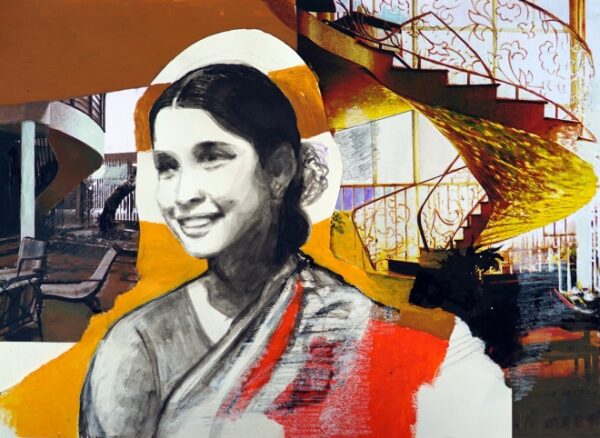
Illustration by Suweeja Kumari

Illustration by Suweeja Kumari

Source:Architectural-review

Expressive, unapologetic, and ahead of her time in ecological and participative design, the Sri Lankan architect is considered a pioneer of what she called Modern Regionalism – later to be known as Critical Regionalism

Minnette de Silva had a knack for being at the centre of things. A photograph taken at the 1947 CIAM conference in Bridgwater, Somerset, shows rows of besuited white men and the occasional woman. Among them are Le Corbusier, Maxwell Fry and Jane Drew. In the middle, seated next to Walter Gropius, is de Silva, a diminutive figure swathed in a silk sari and wearing a flower in her hair. She knew the effect she had on people, particularly men, and she used it. Not for her the anonymity of assimilation. Canny, determined and unapologetic, de Silva did more than just exploit her own exoticism. She owned it.

And for a while, it worked. When she came to England to study at London’s Architectural Association (AA), she was an anomaly. Her appearance – always in a sari, hair pinned up – fed into the Raj fantasy of the ‘Indian princess’. The Raj had yet to end in India and Ceylon, (now Sri Lanka) and would have been very much alive in the minds of the young men she studied with, as well as the older men she studied under.

It was in de Silva’s expression of herself that she made the biggest impact. Yet she could not help who she was. She would not apologise for it. Was it her fault that young men fell over themselves, offering to carry her bags and equipment at the AA? Was it her fault that everyone else dressed in drab monotones in those postwar years, making the perfect backdrop for her shimmering presence?

Riba30182

Line up of the 1947 CIAM conference in Bridgwater. Photograph courtesy of RIBA Collections

So this is the paradox: that a woman as infamous as de Silva became in London, as Sri Lanka’s first modern architect and the first Asian woman to be made an Associate of the RIBA, should be so forgotten today. That a woman as unmissable as she once had been should fall unnoticed in the bathroom of her home in her old age, before dying alone in a hospital ward.

By the time de Silva had completed her studies, she had also established links with some of the greatest minds of the 20th century. In her early days studying architecture in Bombay, her professional and social circle included the nuclear physicist Homi Bhabha (father of philosopher Homi K Bhabha) and writer Mulk Raj Anand. In Europe, that circle would expand to include Picasso, Brancusi and many others.

It was in Bombay that de Silva, together with Anand and her sister Anil, founded Marg, the seminal South Asian arts magazine, which is still in existence. Marg provided de Silva with one of her passes to Bridgwater, where she recruited subscribers to the fledgling publication. Marg was also one of the reasons why de Silva struck up conversation again with Le Corbusier in Bridgwater, after having met him the year before at his home in Paris.

Marg magazine

First issue of Marg

The Bridgwater encounter sealed their friendship, spurring decades of correspondence between the two architects. Those letters, full of humour, technical banter and yearning are, to some, evidence that they were just friends – and to others, that they were something more. Whether friends or more, they never shied away from expressing their deep affection for one another.

In a letter dated June 1949, some months after she had left London for Kandy in Sri Lanka, de Silva writes: ‘Corbu. So, so long a time without a letter. Have you forgotten altogether the little bird of the Islands … Paris seems so far away and I am very nostalgic for it all’. ‘Oiseau de l’Ile,’ writes Le Corbusier in 1952 from Chandigarh. ‘I am a crow, and crows look at flowers … with passion, but the flowers ignore them … I kiss you, Minnette, to the very tips of your fingers.’

Kandy arts centre axo

Arts Centre in Kandy, de Silva’s last project, an extension of an existing building

Pieris house

Loggia looking through to the traditional open courtyard, or meda midula, in the Pieris House

It was Le Corbusier’s letters and de Silva’s contacts back in Europe and India (the Gielguds, Oliviers, Henri Cartier-Bresson, David Lean, Mulk Raj Anand, the dancer Mrinalini Sarabhai and many others) that sustained her as she embarked on her architectural career in Sri Lanka. They were her lifeline, and Europe a kind of refuge when things got too much, although she would soon find herself fully occupied by a frenzy of work.

‘For all de Silva’s pioneering thinking and much-vaunted elegance, her reputation for being a “difficult woman” never left her’

The mistake most people make is to fall under the spell of de Silva’s exalted social life and elegant dress sense, and ignore the work she actually did. Her thinking, her ideas about regionalising modern aesthetics, were well ahead of their time. So were her forays into eco-architecture and participatory design, unnamed and unknown concepts back then.

Moving between the capital, Colombo, and her studio in Kandy, de Silva worked on numerous small villas for family friends. Her first project, the Karunaratne House (1947-51), was the earliest manifestation of her building philosophy. She may have felt cowed in the presence of Le Corbusier when she first met him, but when it came to her own designs she was not so retiring.
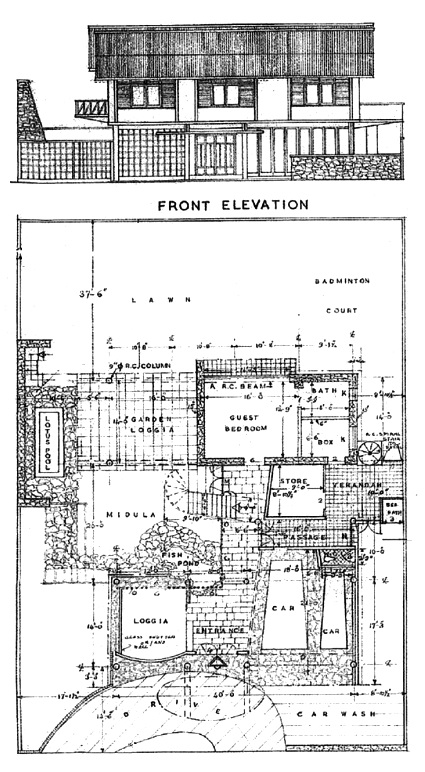
Pieris house drawings copy tc

Pieris House drawings

A Modernist at heart, de Silva nevertheless could see its limitations in an Asian context. Rather than break entirely with tradition to import a new language into her building, she saw an opportunity to both revive a waning arts and crafts industry, while modernising traditional aspects of Sri Lankan architecture. Her work was a kind of hybrid, what she called Modern Regionalism, which later came to be known as Critical Regionalism.

‘It is essential for us to absorb what we absolutely need from the modern West’, she wrote in 1950, ‘and to learn to keep the best of our own traditional forms.’ She applied this thinking to the Karunaratne House, hiring artisans to weave Dumbara mats which she used as panelling for internal doors, to fire clay tiles along ancient patterns, and commissioning celebrated local artist George Keyt to paint a mural, which she set into the length of the living-room wall.

Karunaratne house 2

Coomaraswamy Twin House in Colombo

De Silva’s first house in Colombo, built for the Pieris family, went further, incorporating the beginnings of an open courtyard into the house’s living space, an import from a previous era in Sri Lankan architecture. This meda midula would become a hallmark of many of her dwellings and would be refined and experimented upon by subsequent architects, most notably Geoffrey Bawa.

Between the late 1940s and early 1960s, de Silva designed and built dozens of homes, including her most Corbusian structure, the Senanayake flats at Gregory’s Road in Colombo. This whitewashed building still stands, its modern exterior softened by the shrubs and trees she had planted in strategic locations, at once cooling the structure while lending it gentle camouflage.

At the other extreme is de Silva’s townhouse for Mrs CF Fernando. A product of her research into low-cost housing and indigenous building methods, it incorporates rammed-earth technology. The house – still owned by Mrs Fernando and located in Colombo’s Wellawatte suburb – is a compact cube whose satinwood staircase and surrounding verandas channel cooling air across its two floors.

Flats gregory road

Senanayake flats in Colombo show the influence of Corb. Image courtesy of Three Blind Men

Biography

Key works:

Karunaratne House, Kandy, 1951
Fernando House, Colombo, 1954
Pieris House, Colombo, 1956
Senanayake housing, Colombo, 1957
Public housing, Kandy, 1958
Amarasinghe House, Colombo, 1960
Coomaraswamy Twin Houses, Colombo, 1970
Arts Centre, Kandy, 1984

Awards and honours:

Sri Lanka Institute of Architects Gold Medal, 1996

Quote:

‘I was dismissed because I am a woman. I was never taken seriously for my work’

The concise nature of the house and its relatively low cost were reflective of her thinking at the time, as she wrote in a 1955 article: ‘We must re-orientate our ideas for living comfortably in congested towns like Colombo, where we no longer have expansive acres of garden and spacious cool pillared halls.’

Perhaps her most challenging commission was the sprawling and ambitious 1958 public housing scheme in Kandy, the island’s second largest city. It was the chance de Silva had been waiting for and she seized it, consulting extensively with future householders, meeting with them and completing detailed surveys on how they lived. She then used this information to design different housing types, some of which were built by the householders themselves. Today, this kind of participatory and inclusive approach to design and construction is celebrated. De Silva did it without fanfare, always aware that the ultimate success of the scheme would be measured by how useful householders found their new living environment.

The scheme proved a success. It became a model for other housing schemes on the island, although none came close to the original. It also worked on a social level, cementing relations between Buddhists, Hindus and Muslims. As an exercise in building strong, mixed communities, it was exemplary, despite the troubles that would undo the country following independence.

Amarasinghe house detail

Detail from the Amarasinghe House

Pieris house wall detail

Limestone wall from the Pieris House in Colombo

Yet for all de Silva’s pioneering thinking and much-vaunted elegance, her reputation for being a ‘difficult woman’ never left her. Many remember her as inflexible and cantankerous, but at the time, being a woman in a male profession in a developing country was extremely difficult.

Despite de Silva’s achievements, she was never given the recognition she deserved. Instead, those accolades fell to Geoffrey Bawa, known today as Sri Lanka’s foremost modern architect and a master of Modern Regionalism. It is telling that those who remember Bawa, a recluse himself, recount his imperious commands to build a wall here or tear down a wall there with smiling admiration. His demands are seen as the work of a genius and his behaviour simply the product of that genius.

As Bawa came on the scene in the early 1960s, de Silva’s influence declined. She left for Hong Kong and London in the following decade, returning to her Kandy studio in 1979. Her last significant building was the Kandy Arts Centre, constructed in the 1980s. In its original form, it was a true synthesis of her attempts to fuse the modern with the regional. De Silva kept and restored the existing 19th-century building, expanding it in a way that would not disrupt the natural landscape.

De silva and picasso

de Silva with Picasso, American sculptor Jo Davidson and Mulk Raj Anand at the 1948 World Congress of Intellectuals for Peace

Despite the many changes made to her original vision, one thing remains. The arts centre belongs to the artisans. Their craftsmanship is evident in every corner of the building, from the balusters to the lanterns to the chairs, and the workshops where the artisans themselves can be seen creating their wares. She consistently championed them, integrating them into every project she designed in her 50-year career.

Among de Silva’s last visitors to her Kandy studio was Malkanthi Perera, daughter of Mr and Mrs Pieris, and long-time friend. Perera lives next to the two houses de Silva designed for her family in Colombo. ‘Minnette was always kind and always had time for you’, she says. ‘I shall never forget her last words to me: “I wish more people would make time and come and see me here, rather than come for my funeral.”’

De Silva died in November 1998 aged 80. Just two years earlier, the Sri Lanka Institute of Architects had awarded her its Gold Medal, more than a decade after it had done the same to Bawa. By then de Silva was financially depleted and her Kandy home was decrepit.

Riba40998

Courtesy of RIBA Collections

Today, few of her buildings survive. The Karunaratne House, her first project, is virtually derelict. Her own studio at St George’s in Kandy has long since fallen into ruin. Modest townhouses and villas like de Silva’s have been swept aside in Sri Lanka’s quest for newer, shinier and more vacuous architecture. And so de Silva, this 1940s It-girl, this queen among drab men, this pioneer of tropical Modernism, passed away virtually unremarked, her death as subtle as the buildings she designed.

This piece is featured in the AR July/August issue on AR House + Social housing – click here to purchase your copy today

TAGGED:Minnette de Silva
Share This Article
Facebook Whatsapp Whatsapp LinkedIn Email Copy Link Print
Previous Article SUNDAY CHOICE - The Parable of the Porcupine – by Charles Schokman SUNDAY CHOICE – The Parable of the Porcupine – by Charles Schokman
Next Article Sinharaja A weekend with a family in Sinharaja-By Siri Ipalawatte
FacebookLike
YoutubeSubscribe
LinkedInFollow
- Advertisement -
eLankaproperty - sell property in Sri Lanka, Sri Lanka property for sale, Sri Lanka real estate, Sri Lanka property listings, property marketplace Sri Lanka, land for sale Sri Lanka, houses for sale Sri Lanka, apartments for sale Sri Lanka, commercial property Sri Lanka, luxury villas Sri Lanka, Sri Lankan property investment, buy property in Sri Lanka, Colombo property for sale, beachfront property Sri Lanka, development land Sri Lanka, investment property Sri Lanka, property advertising Sri Lanka, real estate agents Sri Lanka, property brokers Sri Lanka, overseas Sri Lankan property buyers, Sri Lanka property website, list property online Sri Lanka, affordable property listings Sri Lanka, Sri Lanka homes for sale, Sri Lanka land investment, property developers Sri Lanka, real estate marketplace Sri Lanka, Sri Lanka commercial real estate, sell land in Sri Lanka, sell house in Sri Lanka, Sri Lanka property portal, global property marketplace Sri Lanka, Sri Lankan real estate investment, property management Sri Lanka, buy land Sri Lanka, residential property Sri Lanka, holiday homes Sri Lanka, Sri Lanka investment opportunities, real estate advertising Sri Lanka, eLankaProperty
- Advertisement -
ALTAIR
- Advertisement -
Ad image
eLanka Wedding
Most Read
Shemara Wikramanayake: Sri Lankan Roots to Macquarie CEO

Shemara Wikramanayake: From Sri Lankan Beginnings to Leading Macquarie Group on the Global Stage

Navi Pillay Honoured

Navi Pillay Honoured: A Legacy of Peace, Justice and Human Rights

Sandika Hemakumari

Sandika Hemakumari to Captain Sri Lanka’s Women’s Sevens Squad at the Colombo Leg of the Asia Rugby Sevens Series

Sri Lankan junior tennis players

Three Sri Lankan Girls Reach the ATF Under-16 Quarter-Finals in Colombo

Otherland Galle Opens on Sri Lanka’s Southern Coast With a Locally Built Approach to Hospitality AI-generated illustration based on source material. No authentic photograph of the Otherland Galle property is embedded in this article. Otherland Hotels opened its first property, Otherland Galle, on 12 October 2026, introducing a 66-key lifestyle hotel that brings together accommodation, dining, music and locally curated experiences on Sri Lanka’s southern coast. The opening adds a new hospitality concept to a region known for its beaches, historic Galle Fort and established surf culture, with the hotel’s programme designed to encourage visitors to engage with the wider destination as well as the property. Located on Matara Road, Otherland Galle is approximately 400 metres from Dewata Beach and 2.8 kilometres from Galle Fort, the UNESCO World Heritage Site. The hotel draws on the area’s culinary traditions, creative communities and coastal way of life, positioning local experiences as a central part of its offer rather than an optional addition to a conventional hotel stay. Founded by Rishi Sreedharan, Samarth Gowda and Emanuel Siddhartha in partnership with Beryll Group, Otherland Hotels is built around the philosophy “Never the Same Twice”. Its approach combines private rooms and suites with shared accommodation and communal spaces intended for different kinds of travellers, from couples and groups of friends to solo visitors and culturally curious guests. The co-founders, pictured from left: Emanuel Siddhartha, Rishi Sreedharan and Samarth Gowda. Source photograph: Lanka Business News. A design-led mix of rooms and shared spaces Designed by Studio Camarada, led by Andre Camara, the hotel has been arranged as a series of interconnected spaces rather than a conventional sequence of corridors and separate facilities. Its interiors draw on the colours and materials of the southern coast, including sandy neutrals, ocean blues and earthy tones, alongside rattan, ash, hand-tufted textiles and marble finishes. The 66-key accommodation comprises 24 Ocean Rooms, 25 Terra Rooms, 12 suites and five dormitories. Room sizes range from 27 square metres to the 70-square-metre Patio Suite, while the property also includes rooms designed for guests with disabilities. The mix offers a range of accommodation formats within one property, including shared dormitory options alongside private rooms and suites. At ground level, Bar-kery combines several functions: reception, coffee shop, bakery, aperitivo counter and informal co-working space. Its Vinyl Corner invites guests to browse records and choose music, giving the communal area a more participatory character. Colombo Coffee Company has developed an exclusive signature blend for the hotel. AI-generated illustrative image based on the reported design approach; it is not a photograph of Otherland Galle. The rooftop venue Creatures brings together a restaurant, cocktail bar, infinity pool and music space, with 270-degree views of the Indian Ocean. It is intended to serve as a daytime dining and swimming venue as well as an evening social space, linking the hotel’s food and music programmes with its coastal setting. Sri Lankan flavours, music and a sense of place The food programme is led by Chef Rajeev Kumar and draws on Sri Lankan culinary traditions, alongside international influences and contemporary techniques. Dishes listed for the menu include King Coconut Ceviche, Yellowfin Tuna Tataki, Lankan Fish Cutlets and Devilled Pork Ribs glazed with kithul treacle. A Watalappam Brûlée brings a familiar Sri Lankan dessert into a contemporary format. Arijit Bose leads the cocktail programme, while Aneesha Thapa manages day-to-day operations. Music is another part of the hotel’s identity, with programming across Afro, R&B, folk, funk, jazz fusion, house, techno and electronica. The combination of food, music and shared spaces is intended to make the property relevant to both visitors and people from the surrounding area. Co-founder Samarth Gowda described the approach as one intended to make the hotel feel accessible and personal: > “Otherland Galle should feel like yours from the moment you walk in. Luxury has often come with a sense of distance, with places appearing impressive because they do not feel accessible to everyone. That is not what we are building. Everything here is designed around who you are and how you want to spend your time.” AI-generated illustration of ingredients associated with Sri Lankan culinary traditions; not a photograph of the hotel’s kitchen or menu. The Other Side: experiences created with local communities A key element of the concept is The Other Side, an experiences programme developed in collaboration with local surfers, fishermen, artisans, guides, chefs and musicians. The activities are designed to connect guests with people and places beyond the hotel, while drawing on knowledge and skills already present in the Galle region. The programme includes curry masterclasses, guided walks through Galle Fort and surf lessons at Dewata Beach. Further afield, guests can take whale-watching excursions off Mirissa or kayak through the mangroves of Koggala Lake. Rooftop sunset sessions, arrack tastings, beach cricket and tuk-tuk bar crawls are among the social activities described as part of the offer. This community-led model gives local participants a role in shaping and delivering visitor experiences, rather than presenting the area only as a backdrop for sightseeing. Its longer-term value will depend on how consistently these partnerships are sustained and how directly local contributors benefit from the activity they help create. Co-founder Rishi Sreedharan said: > “At Otherland, curiosity is the operating principle. We measure success by whether guests leave with a real sense of Galle. The surfers, fishermen, chefs and craftspeople who live here have helped build these experiences, and they are the ones bringing them to life.” AI-generated coastal illustration based on the article’s setting; it does not depict a verified view from the property. A new option for visitors to Galle The opening marks the first phase of Otherland Galle’s development. A gym, wellness centre and banquet facilities are planned for a subsequent phase. The property’s initial offer, however, is already structured around more than its room inventory: its communal areas, food and beverage venues, music programme and locally developed activities form a connected hospitality concept. For Sri Lankans abroad planning a visit home, the opening provides another option near Galle, with a programme that brings together coastal recreation, local food, heritage and community knowledge. For the Galle area, the approach places local contributors at the centre of the visitor experience. Whether the model makes a lasting contribution will be measured not only by the facilities it offers, but also by the strength and continuity of those relationships. The launch also reflects a wider interest among culturally curious travellers in experiences that extend beyond accommodation and conventional sightseeing. In Galle, where historic landmarks sit alongside a living coastal culture, the opportunity is to create hospitality that is carefully designed while remaining connected to the people and traditions that give the destination its character. Sources: Lanka Business News; Colombo Times; Hiru News Gold FM; SoulofHospitality. This article was written based on the source https://www.lankabusinessnews.com/otherland-hotels-makes-its-debut-in-galle/ and corroborated by https://colombotimes.net/otherland-hotels-makes-its-debut-in-galle/, https://hirunews.lk/goldfmnews/493932/otherland-galle-opens-with-66-rooms-introduces-dormitories-to-luxury-hotel-mix and https://www.soulofhospitality.com/business/hotel-openings/otherland-hotels-enters-sri-lanka-with-a-new-approach-to-lifestyle-hospitality, kindly email us at info@eLanka.com.au if any information needs to be corrected. Click here to receive your free copy of the eLanka Newsletter twice a week delivered directly to your inbox! At eLanka, we respect the rights of creators. If we have used an image you own and you'd like it removed, please email us at info@elanka.com.au and we’ll handle it promptly. Thanks. eLanka team eLanka Disclaimer Content published on eLanka may be created by the eLanka team, submitted by contributors or third parties, reproduced or adapted from other sources with appropriate source acknowledgement, or provided as promotional/advertising material by our clients. While eLanka takes reasonable care in preparing and publishing content, we do not warrant its completeness or accuracy. Views expressed are those of the respective authors or contributors and do not necessarily represent the views of eLanka. Third-party contributors, content providers and advertisers are responsible for the accuracy of material they supply and for ensuring they hold the necessary rights and permissions for its publication. Advertising and promotional content should not be regarded as an endorsement by eLanka of any product, service or claim.

Otherland Galle Opens on Sri Lanka’s Southern Coast With a Locally Built Approach to Hospitality

Related News
Dilmah SIAL Paris 2026
Articles

Dilmah’s Three Innovations Selected for SIAL Paris 2026 as Company Named a Top Five SIAL For Change Finalist

Sigiriya Sri Lanka
Articles

WHY WOULD A KING BUILD HIS PALACE ON TOP OF THIS ROCK?

Re-writing history – the queer-washing of prolific Sri Lankan artist George Beven  ( PART ONE ) – by   Cat Clare Wright
Articles

Re-writing history – the queer-washing of prolific Sri Lankan artist George Beven ( PART ONE ) – by Cat Clare Wright

Sash Jayasinghe – 4LANKA 1,400KM Sri Lanka Run 2027
Articles

Sash Jayasinghe’s 4LANKA: 1,400KM Around Sri Lanka – July 2027

A Vision for Culturally Inclusive Aged Care-Pearl Life Care Meets with Hornsby Shire Council
Articles

A Vision for Culturally Inclusive Aged Care: Pearl Life Care Meets with Hornsby Shire Council

  • Quick Links:
  • Articles
  • DESMOND KELLY
  • Dr Harold Gunatillake
  • English Videos
  • Sri Lanka
  • Sinhala Videos
  • Obituaries
  • eLanka Newsletters
  • Sunil Thenabadu
  • Trevine Rodrigo
  • Dr. Harold Gunatillake
  • Tamil Videos
  • Sinhala Movies
  • eLanka Newsletter
  • Photos

eLanka

Your Trusted Source for News & Community Stories: Stay connected with reliable updates, inspiring features, and breaking news. From politics and technology to culture, lifestyle, and events, eLanka brings you stories that matter — keeping you informed, engaged, and connected 24/7.
Kerrie road, Oatlands , NSW 2117 , Australia.
Email : info@eLanka.com.au / rasangivjes@gmail.com.
WhatsApp : +61402905275 / +94775882546
  • About eLanka
  • Terms & Conditions

Disclaimer:
eLanka is committed to sharing positive and community-focused stories. We do not publish or endorse political, religious, or ethnic viewpoints. The content published on eLanka, including articles and newsletters, reflects the opinions and views of the respective authors and not those of eLanka. eLanka accepts no responsibility or liability for the accuracy, completeness, or consequences of any content provided by contributors.

(c) 2005 – 2025 eLanka Pty Ltd. All Rights Reserved.