Macroeconomic Indicator – Inflation – By Dr. Gnana Sankaralingam
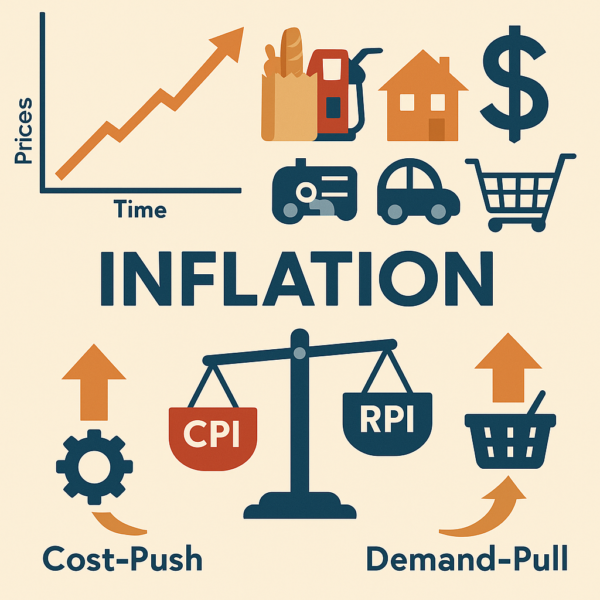
 Inflation is the sustained rise in the average price of goods and services over a period of time. Prices of some goods might rise faster than average, others more slowly and some may even fall. Inflation can also be seen as a drop in the value of money, ie purchasing power of money has fallen and fixed amount of money buys less than as before. Purchasing power is the real value of an amount of money in terms of what you could actually buy with it. Positive inflation is when the average prices of goods and services are rising and negative inflation is when the average prices of those are falling. When prices rise extremely quickly and money loses the value rapidly, it is hyperinflation. When the rate of inflation is slowing down, ie prices are rising but at a slower speed, it is called disinflation. Measurements used to calculate inflation are Retail Price Index (RPI) and Consumer Price Index (CPI).
Retail price index is calculated by carrying out two surveys. First is a survey of around 6000 households called the living cost and food survey. This is used to find out what people spend their money on. It also shows what proportion of the income is spent on these items. This is used to work out the relative weighting of each item, eg if 20% of it is spent on transport, then 20% weighting is given to that. Second survey is based on prices. It measures the changes in price of around 700 of the most commonly used goods and services, referred as “Basket of Goods”. Items are chosen based on the living cost and food survey to find out what goods in the basket change over time. This ensures that the basket always reflect what the average household might spend their money on. Price changes in the second survey are multiplied by the weightings from the first survey and converted to an index number, which is useful in making comparisons over a period of time. First year is called the base year with index number set at 100% and changes are expressed as above or below it. Thus inflation is the change to the index number, eg if it rises from 100 to 102, inflation is at 2%.
Consumer price index is calculated in a similar way to RPI, but has three main differences: some items like mortgage interest payment and council tax are excluded, using a larger sample of population and a slightly different formula. Due to these, CPI tends to be a little lower than RPI, except when interest rates are low. However both tend to follow the same long term trend. CPI is often used for international comparison. RPI and CPI are useful but have their limitations. RPI excludes all households in the top 4% of incomes. CPI covers a broader range of population but does not include some expenditures. Information given by households may not be accurate. Basket of goods changes only once a year, so it might miss some short term changes in spending habits. RPI and CPI are useful for government policy in using them to decide on increase in wages, state pensions and welfare benefits. Employers and trade unions use them as starting point in wage negotiations. Some benefits are index linked and rise automatically each year by the same percentage. They are used to measure international competitiveness of a country. If the rate of inflation measured by CPI is higher in a country than in another it trades with, then their goods become less price competitive leading to fall in exports and as goods of other one is cheaper, imports will rise.
Inflation could be caused by cost-push factors due to rising cost of inputs to production which force producers to pass on the higher costs to consumers in the form of higher prices. Rise in wages above any increase in productivity, increases cost of producing. If wages make up a large portion of the total cost of a firm, then it could lead to a significant rise in prices. Price rise could lead to further wage demand which in turn could lead to price increase and so on (wage-price spiral). Rise in cost of imported raw material due to increase in world commodity markets would cause the cost of inputs to rise. Producers in the short run, will meet the higher cost and set higher prices leading to higher domestic inflation. Also if currency of the country decreases in value, producers will have to pay more for the same imports, increasing costs. If the government raises indirect taxes, it will increase cost and in turn prices will go up and the cost of tax will be passed on to customer. Supply side policies to make labour market flexible and reduce unemployment are used to tackle it.
Inflation could also be caused by demand-pull factors which is inflation due to excessive growth in overall demand compared to supply, which lets sellers to raise prices. It can be caused by increased consumer spending due to low interest rates which encourages cheap borrowing and job security during periods of low unemployment, or if money supply (amount of money in the country) grows faster than output of goods and services which can lead to rise in prices, or to shortages as a result of demand growing rapidly when labour and resources are fully engaged leading to rise in prices and increase in costs to firms. Monetary policies (interest rates, money supply, and exchange rate) are used to tackle it.
Inflation will cause the standard of living of those in fixed income to fall. Bigger impact will be on those on low income employment or on welfare benefits. Competitiveness of a country will be reduced by inflation, as exports cost more and imports cheaper. Drop in exports and rise in imports could cause a deficit in the balance of payments and an increase in unemployment. Inflation discourages saving because the value of savings fall. This makes it more attractive to spend, before price rises further. Reluctance to save creates a shortage of funds for borrowing and investments which means that it is harder for firms to make new improvements such as buying machinery. If interest rates go up to reduce inflation, it would also reduce investment. When rate of inflation falls below 0%, it is called deflation, which is often a sign that the economy is doing badly caused by falling aggregate demand and rising unemployment. Deflation can be caused if cost of production falls and the benefit is passed on to the customer in the form of low prices, reducing profits of the producers.
Inflation could come into conflict with other macroeconomic objectives. When unemployment is reduced and the economy begins to approach full capacity, there may be labour shortage and this increase in demand for workers increases wages thereby increasing cost of production leading to increase in price and rise in inflation. Rapidly growing economy can cause large increase in price due to increase in demand leading to higher than desirable level of inflation. Low inflation has an effect on state of balance of payments, as due to low prices and increase in currency value, there may be more imports than exports.