Sharks International 2026 – Colombo hotspot for a milestone conference – By Arundathie Abeysinghe

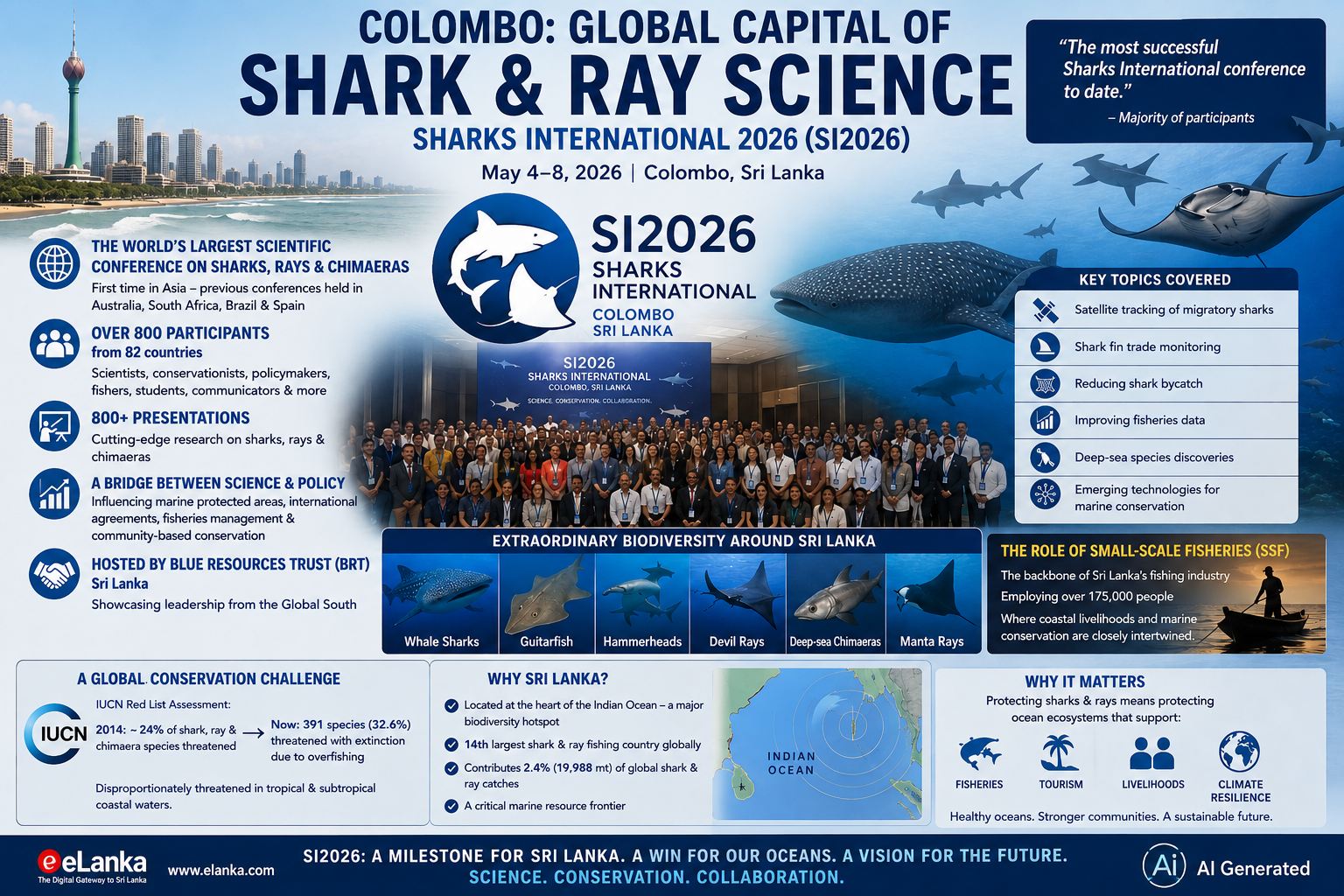
Scholars are of the view that “Colombo became the global capital of shark and ray science” as Sri Lanka hosted Sharks International 2026 (SI2026), the world’s largest scientific conference dedicated entirely to sharks, rays and chimaeras. Held from May 4-8, the event marked a milestone for marine conservation as well as for Sri Lanka itself. This was the first time the conference was held in Asia as previous conferences took place in Australia, South Africa, Brazil and Spain.
The conference showcased how a small island nation has the ability to contribute meaningfully to global marine science and policy. SI2026 emphasized the connection between science and policy. Sessions also explored how research can influence marine protected areas, international agreements, fisheries management, including community-based conservation.
The conference included discussions on a vast array of topics such as satellite tracking of migratory sharks, shark fin trade monitoring, reducing shark bycatch, improving fisheries data, deep-sea species discoveries and emerging technologies for marine conservation.
The conference also highlighted the significance of small-scale fisheries (SSF), the backbone of Sri Lanka’s fishing industry, employing over 175,000 people, a crucial topic for the island nation, where coastal livelihoods and marine conservation are closely intertwined.
The conference was hosted by the Sri Lankan conservation organisation Blue Resources Trust (BRT). Over 800 participants, including scientists, conservationists, fisheries experts, policymakers, students and environmental communicators from around the world participated at the conference. Majority of participants (who attended all previous conferences), described SI2026 as “the most successful Sharks International conference to date.”
According to Daniel Fernando, co-founder BRT, the local organising partner, there were participants from 82 countries and over 800 presentations mostly on scientific findings on sharks and rays.
Marine scientists Achala Tilakarathna and Randesh Sirimanne are of that “Sri Lanka is located at the heart of the Indian Ocean, one of the world’s most significant, yet greatly exploited regions for sharks and rays. Hence, the waters around the island host extraordinary marine biodiversity, including whale sharks, guitarfish, hammerheads, devil rays, deep-sea chimaeras and manta rays. Yet, majority of these species are threatened due to overfishing, habitat degradation as well as unsustainable trade.”
“According to the International Union for Conservation of Nature (IUCN) Red List assessment process (in 2014), sharks, rays, and chimeras, approximately 24% of species were threatened with extinction, whereas, currently, 391 (32.6%) species are threatened with extinction due to overfishing. These species are disproportionately threatened in tropical and subtropical coastal waters.”
According to senior academics Dimuth Alwis and Nilanthi Samarasekera, “over one-third of all shark and ray species are threatened due to extinction. Against this backdrop, hosting the world’s leading shark conference in Sri Lanka was symbolic as well as strategic as it shifted attention towards the Global South and regions where conservation challenges are frequently the hardest, as scientific opportunities are underrepresented.”
“As the ocean surrounding Sri Lanka is not only a resource frontier, but is part of one of the planet’s richest and most fragile marine regions, protecting sharks and rays is not simply about saving charismatic predators, instead, it is about maintaining the health of the entire ocean’s ecosystems which support fisheries, tourism, livelihoods and climate resilience”, the academics emphasized.
Sri Lanka is located at a crucial, high-biodiversity hotspot in the Indian Ocean that serves as a major, one of the world’s most significant, yet heavily exploited regions for sharks and rays, while it is also the 14th largest shark and ray fishing country globally, contributing 2.4% (19,988 mt) of global catches of this species group. Hence, Sharks International 2026 (SI2026) is a milestone for the country.
At eLanka, we respect the rights of creators. If we have used an image you own and you’d like it removed, please email us at info@elanka.com.au and we’ll handle it promptly.
Thanks.
eLanka team