Noel News

“The most dangerous lies are not the ones we’re told.
They’re the ones hidden in the fine print.”
Welcome to our August newsletter
Sadly, the news is not good. The government is still determined to push its Budget legislation through and, as you’ll read in this newsletter, it’s far worse than we ever imagined.
If you’ve been reading the newspapers, you’ll have noticed that I’ve generated a great deal of publicity about these changes. Assistant Treasurer Daniel Mulino says they are under review. Frankly, that’s cold comfort. If the legislation was so flawed that it now requires major changes, why was it rushed through Parliament in the first place?
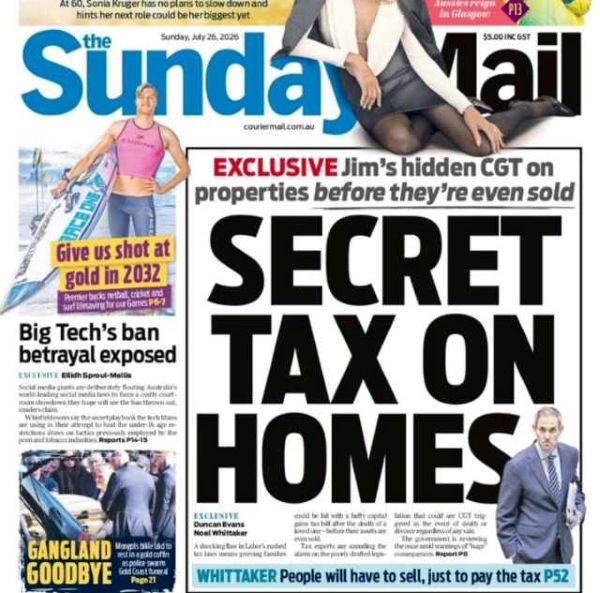
This newsletter also includes a major section on insurance bonds. Given the changes to capital gains tax, where everybody—even those with no taxable income and not receiving the Age Pension—will face a minimum 30% tax rate on post-30 June 2027 capital gains, insurance bonds could become one of the most attractive investment options available.

PODCAST
Making Money
Made Simple
with Noel Whittaker
Renowned broadcaster John Deeks and I discuss all the big topics covered in this newsletter in detail each month.
Noel’s Next Event
August 13th in Noosaville
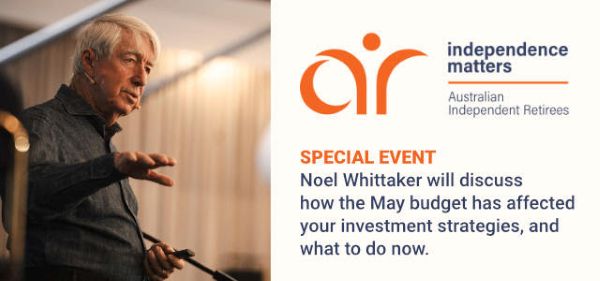
Australian Independent Retirees (AIR) Noosa Branch invites you to attend our next Special Event featuring Noel Whittaker.
TOPIC
How the May budget has affected your investment strategies, and what to do now.
WHEN
Thursday 13 August 2026
10:00am – join us for morning tea
meeting starts 10:45am
WHERE
Noosa Conference Centre at Ivory Palms
73 Hilton Tce, Noosaville
COST
No charge for AIR members/ASA members
$10 per person for visitors or join AIR for $30
BOOKINGS ESSENTIAL
Secure your place: email airnoosasecretary@gmail.
Taxing unrealized capital gains
Victoria has come up with yet another tax that should worry every property owner. It’s called the Windfall Gains Tax, and despite the name, it has nothing to do with selling your property. The tax is triggered by a rezoning that increases the value of your land on paper. That rezoning may be part of a broader government planning scheme or it may follow an application by the landowner. Either way, you may have no intention of selling, and you may not have received a single dollar, yet a tax liability arises all the same. While many landowners can defer payment until the property is eventually sold, the liability remains.
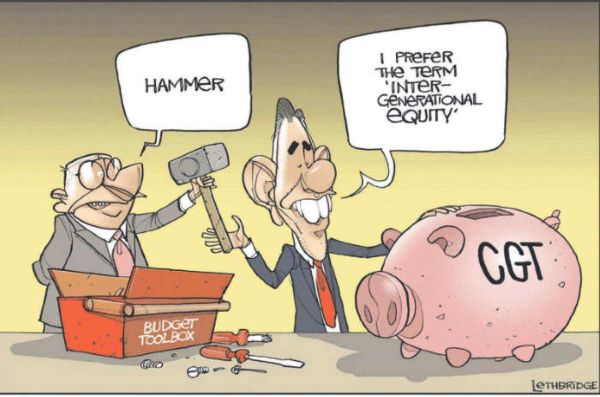
Cartoon by Johannes Leak
Imagine owning farmland on the edge of Melbourne that has been in the family for generations. A rezoning dramatically increases its value. On paper you are wealthier, but you still have no extra cash. The tax has effectively been embedded in the property and will eventually have to be paid.
It is another example of governments moving towards taxing unrealised gains rather than profits that have actually been received. Readers will remember the Federal Government’s failed attempt to tax unrealised gains in superannuation through its proposed Division 296 changes affecting balances above $3 million. That proposal may have been defeated, but the underlying principle has not gone away. Once governments accept the idea of taxing paper gains, it becomes much easier to extend it elsewhere. As I have said many times before, every new tax starts somewhere. The danger is that what begins as a Victorian tax today could become tomorrow’s national precedent.
The Death, Divorce and Disaster Tax
The email grabbed my attention immediately. Not just because of what it said, but because of who sent it. It came from one of Australia’s most respected tax experts – I’ll call him John. Although now retired, he still has one of the sharpest tax minds in the country and spends much of his time studying legislation that most of us would struggle to understand.
His message was blunt: he believes the government has quietly introduced what he describes as a “death, divorce and disaster” capital gains tax (CGT) through the Budget legislation. Both CPA Australia and the Tax Institute have made detailed submissions outlining the problem to Treasury, yet the legislation has continued unchanged. Whether Treasury has underestimated the consequences or intended this outcome, the result is the same: Australians could face CGT even though they have not sold an asset and have received no sale proceeds.
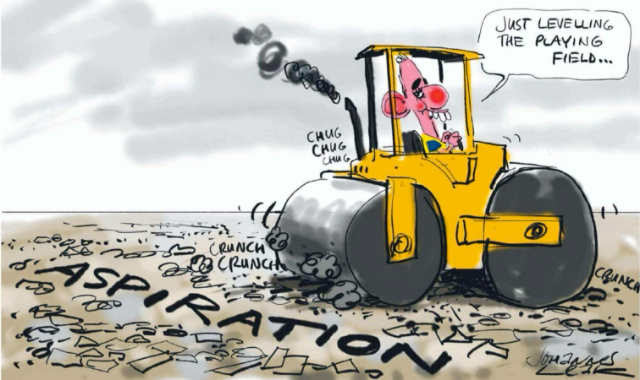
How does this happen? Until now, capital gains tax could usually be deferred when assets changed hands because of death, divorce, certain insurance payouts or small business rollovers. But from 1 July 2027, that protection is removed for capital gains that accrued before that date. This is a major change hidden in the legislation because it means CGT can become payable even though an asset has not been sold and there are no sale proceeds from which to pay the tax.
Cartoon by Johannes Leak
Here’s an example. Judge for yourself. Robin bought a home before 1 July 2027 but, at the seller’s request, agreed not to move in until after Christmas. Because he did not occupy the home as soon as practicable after settlement, part of its capital gain may remain taxable. Under the new legislation, when Robin dies, the transfer of his home to his estate, and then to his widow, can trigger tax on that deferred pre-2027 gain, even though the home has not been sold. If the estate does not have sufficient funds to pay the tax, the executor may have little choice but to sell the family home to meet the liability. Ironically, none of this would arise had the home been purchased after 30 June 2027 or had Robin died before that date.
Robin’s story is only one example. The same issue can arise on divorce, insurance claims, compulsory acquisition of property, business restructures and many other transactions that have long relied on CGT rollover relief.
The new legislation has created the tax equivalent of Schrödinger’s cat – one of science’s most famous thought experiments. Until now, unrealised capital gains sat quietly in the background. They existed but were generally not taxed until the asset changed hands. Under the new rules they appear to exist in a strange legal limbo: they are treated as having been realised in some circumstances, but not in others. Depending on what happens after 1 July 2027, those gains can suddenly spring to life and become taxable even though the asset has not been sold. This breaks a fundamental taxation principle that unrealised gains should not be taxed.
Once again, Labor has produced legislation that can tax capital gains before they have actually been realised. In some cases, that may force the sale of the asset simply to pay the tax.
The consequences will often be harsher for ordinary families than for the wealthy, even if smaller sums of money are involved. They will affect widows, people going through divorce, small business owners and anyone relying on existing rollover relief. They could also create impossible situations where a will grants someone a life tenancy over the family home: the executor may be legally obliged to preserve the home for the life tenant, yet still have to find funds to pay a CGT liability on a “gain” they haven’t gained.
Most people understand that CGT becomes due when an asset is sold. Under the new rules, however, a notional capital gain is calculated on 30 June 2027. That gain is effectively frozen, with the tax deferred until a later “realisation event”.
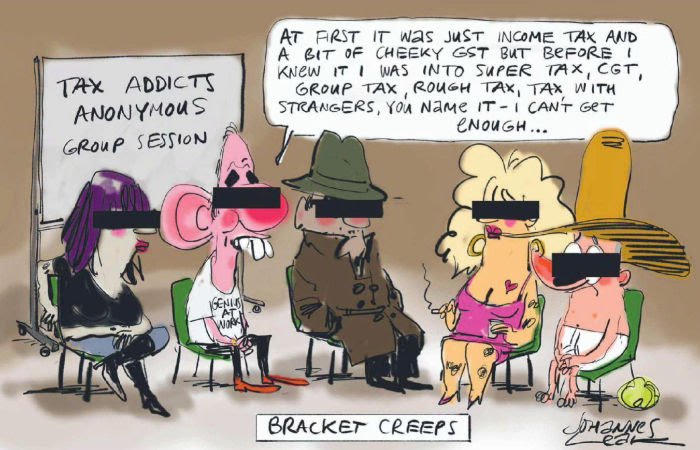
It sounds simple enough until you discover that the legislation uses extraordinarily broad language to define a “realisation event”, allowing it to trigger tax in circumstances that few people would regard as a realisation. In effect, it treats you as having sold an asset you haven’t sold, calculates a gain you never received, then waits for another event—possibly years later and unrelated to any sale—to determine when the tax becomes payable.
The family home is usually exempt from capital gains tax, but there is an important exception that could become much more significant under these new rules.
Cartoon by Johannes Leak
Take Kerry. He bought a three-hectare property in 1990 for $80,000 so he could keep a horse. He has lived there for more than 30 years, raised his family there and the property represents virtually all the family’s wealth. By 30 June 2027 the land alone will be worth $2 million.
If Kerry dies after 1 July 2027, the proposed new rules could trigger CGT on the one hectare that exceeds the two-hectare main residence exemption. Assuming he has no capital losses, the estate would still qualify for the 50% CGT discount on the gain accrued before 1 July 2027.
The calculation is sobering. The capital gain on the land is $1.92 million. After the 50% discount, the taxable gain is $960,000. One-third of that, representing the extra hectare, is $320,000. That amount is added to Kerry’s taxable income in the year of his death. Depending on the tax rates that apply, the bill could exceed $100,000, forcing the family to sell the property. The human consequences of that are disturbing.
Still worse, if Kerry dies on 30 June 2027, just one day earlier, his family would be more than $100,000 better off. No legislation should create incentives where the timing of a person’s death can alter a family’s tax bill by more than $100,000.
Robin’s and Kerry’s cases are far from unique. The legislation is so broad that it can even apply to something as personal as a deceased person’s wedding ring. If you think that’s extraordinary, wait until you see what else is buried in these provisions. We’ll uncover some of the most surprising examples next week.
From the mailbox
Question
My father has a share portfolio that originally cost $300,000 and is now worth $500,000. He dies now and leaves it all to me. Can I assume there will be no capital gains tax payable by me if I later leave it to my daughter in my will as a beneficiary? Does she inherit my father’s cost base?
Answer
Sadly no. The recent changes rushed through Parliament, have changed the rules dramatically – a death after 1 July 2027 will now trigger a realisation event on any pre-1 July 2027 capital gains. Tax will have to be paid on the capital gain accrued up to 30 June 2027 in the deceased’s date-of-death tax return. The beneficiary then takes the market value at 30 June 2027 as their cost base.
So, provided your father dies before 1 July 2027, no capital gains tax will be payable on his death and you will inherit his original cost base of $300,000. But if you then die after 1 July 2027, your estate will have to pay tax on the difference between that $300,000 cost base and the market value at 30 June 2027. Your daughter will inherit a cost base equal to the market value at 30 June 2027, but unless there are other assets in the estate, some of those shares are likely to have to be sold to pay the tax. That sale will also trigger a separate capital gains tax event on any gain that accrued after 1 July 2027.

Question
I bought a property for $500,000 ten years ago, and its value on 30 June 2027 is $900,000. I sell it two years later for $800,000. Is the $300,000 gain simply treated under the 50% capital gains tax discount, or is there some kind of apportionment?
Answer
Yes. The post-2027 loss of $100,000 reduces the pre-2027 gain of $400,000. Provided there is nothing else to take into account, there is a $300,000 capital gain entitled to the 50% discount. The post-2027 loss reduces the pre-2027 gain before the discount is applied.
The investment that sidesteps
the new tax traps
the new tax traps
The investment landscape changed dramatically on Budget night. The Government’s objective was simple: to impose a minimum 30 per cent tax rate on investment gains, regardless of a person’s income. The result is the extraordinary situation where a self-funded retiree on a modest income who does not receive the Age Pension could pay a flat 30 per cent tax on capital gains while losing the benefit of both the tax-free threshold and the 16 per cent tax bracket that normally applies to taxable income between $18,201 and $45,000.
Furthermore, as far as listed shares are concerned, the CGT indexation provisions and the treatment of capital losses have created a minefield. Already, this is causing a swing away from direct share investment towards ETFs and managed funds. Fortunately, there is one investment that sidesteps many of these problems—insurance bonds (also referred to as investment bonds). They’ve been around for a long time but have become relatively unknown because many of today’s young advisers have never heard of them, while many people who once knew them no longer understand how they work.

Why does this matter? Because for many investors the new rules mean tax efficiency has become more important than ever. Investment decisions can no longer be based solely on expected returns. The way those returns are taxed may now make the difference between a good investment and a great one, particularly for retirees and families planning across generations.
A good way to understand insurance bonds is to compare them with superannuation. In both cases, your money is invested in a range of assets that you choose, and the fund pays tax on your behalf. Consequently there is no need to include annual earnings in your tax return. Contributions to super can come from either pre-tax or after-tax dollars—contributions to insurance bonds can only come from after-tax dollars.
The key differences are that superannuation funds generally pay tax at 15 per cent, while insurance bond funds pay 30 per cent. Super contributions are limited and your money is generally locked away until you reach your preservation age, currently at least 60. The large super funds are also notorious for the time they can take to pay death benefits. In addition, there may be tax of up to 17 per cent if the taxable component of your superannuation is left to a non-dependent child, and if your super balance exceeds $3 million you may also be subject to Division 296 tax.
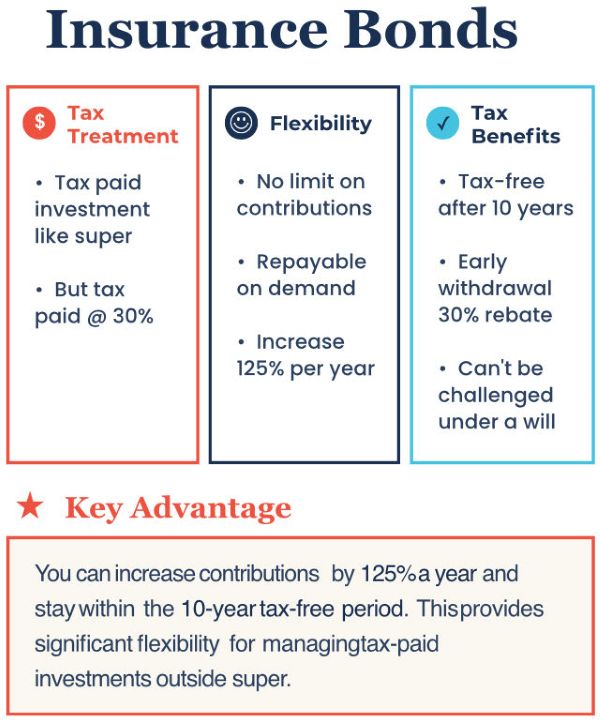
Insurance bonds avoid these issues. There are no contribution limits, your money always remains accessible and quick to access, and there is no death tax payable.
This flexibility is a major attraction. If you hold the bond for 10 years it can be redeemed tax-free. However, you can withdraw all or part of your investment whenever you wish. If you cash it in before 10 years, the profits are taxed as normal income, but you receive a 30 per cent tax rebate to recognise the tax already paid by the fund, making the investment highly tax-effective for many investors.
Suppose an investor earns $65,000 a year and cashes in a bond for $50,000 that originally cost $40,000. The tax on the $10,000 profit will be $3,250, but the rebate will be $3,000, leaving just $250 tax to pay. They also offer significant capital gains tax advantages.

CASE STUDY
Sarah is in her early 40s, single and has a family trust set up with her as the sole beneficiary which she plans on using once she establishes a family. Sarah holds down a well-paid job and is currently on the highest marginal tax rate of 47% (including the Medicare levy). Sarah has accumulated in her family trust $100,000 of assets, currently held in a short-term deposit account earning an assumed return of 5% p.a. Sarah is looking to more tax effectively manage her trust’s investment and has considered an insurance bond as an alternative. She has run the numbers to compare the after-tax outcome of her trust investing in cash directly, versus using an insurance bond that earns the same amount on a pre-tax basis. Based on the analysis, over a 10-year period, Sarah would be almost $25,000 better off on an after-tax basis.
Sarah is also quite keen on taking on more risk but still be highly tax-effective, so she looks at other investment classes and decides that she’d like to consider Generation Life’s Tax Effective Australian Share Fund option to provide her that exposure. Her analysis shows that based on her $100,000 initial investment, if she’d invested in the Generation Life insurance bond assumed as earning 9% p.a. on a pre-tax basis, she would be almost $59,000 better off on an after-tax basis over a 10-year period, compared to investing directly in an equivalent index fund strategy.
In both cases, Sarah’s after-tax returns would improve. In addition, because the earnings were held within the insurance bond structure, her personal assessable income would also reduce, meaning that her marginal tax rate would have fallen from the 47% to 39% (including Medicare levy).
Insurance bonds are also exceptionally effective estate-planning tools because they sit outside the will and generally bypass probate.

CASE STUDY
Rachel is 60 and wants to provide for her family. She has two children, Sam and Louise, who have one and three children respectively. To reflect the different family sizes, she wants Sam’s family to receive $100,000 and Louise’s $300,000. She invests $400,000 in an insurance bond, naming Sam to receive 25 per cent of the proceeds and Louise 75 per cent. Because the bond passes directly to the nominated beneficiaries, it bypasses her estate and probate.
If she later changes her mind, she can simply alter the nominations without rewriting her will. Even divorce or remarriage does not affect the nominations unless she chooses to make changes. If Rachel lives another 20 years, the $400,000 could easily grow to more than $1.3 million, helping her legacy keep pace with inflation. If the grandchildren need help with university fees or a house deposit before then, she can withdraw part or all of the investment.

CASE STUDY
Think about Harry, aged 80, re-married after a nasty divorce, who wants to leave bequests to children of both marriages. He knows there is acrimony within the family and wants to ensure his assets are distributed exactly as he intends, without costly legal disputes.
He invests $250,000 in each of five separate insurance bonds, naming a different child as the beneficiary of each. Because an insurance bond is a life policy, the proceeds are generally outside the estate and cannot normally be challenged, allowing Harry to distribute his wealth exactly as he intends.
Insurance bonds are also an excellent way for grandparents to help their grandchildren.
Most financial institutions will not accept investments in the name of a minor. If the money is held by a parent or grandparent as trustee, the income may be subject to children’s penalty tax rates of up to 66 per cent. Investing in a parent’s name can reduce family tax benefits, push them into a higher tax bracket or affect eligibility for the superannuation co-contribution. Investing in a grandparent’s name may also reduce their Age Pension as the investment grows.
Insurance bonds provide an elegant solution. After 10 years the proceeds can generally be withdrawn tax-free, but there is no obligation to do so. The investment can remain in the bond for as long as you wish. Nor are they just for wealthy investors. Most providers allow you to start with a modest investment and add to it over time.
Consider a simple example. Grandparents want to establish an investment for a grandchild with an initial contribution of $10,000. They hope to add more over time but don’t want to commit themselves to doing so. Their adviser recommends an Insurance Bond owned by the mother, with the grandchild nominated as the future owner on a specified date.
When taking out this type of policy you can nominate a date at which the policy will automatically transfer to the child.
Now comes the best part. Until the policy is transferred to the child, the parent retains complete control over the investment, including the ability to change the date of transfer. There is also no capital gains tax on the transfer.
Can you think of a better intergenerational investment? The parent retains complete control, there is no annual personal taxable income and it’s invested tax effectively. The money is available whenever it is needed. The bonds tick every box. There is no death tax, no widow’s tax, no lack of access, and they can sit outside of your estate providing certainty around asset distribution. One final advantage is that the proceeds from redeeming a bond are generally paid into your bank account within 10 working days.
And finally
What do you give the dentist of the year? A little plaque.
Why do cows have hooves instead of feet? Because they lactose.
Why do pancakes always win at baseball? They have the best batter.
I told my wife she should embrace her mistakes, then she gave me a hug.
Stop looking for the perfect match… use a lighter.
What’s the difference between ignorance and apathy? I don’t know and I don’t care.
What do you call a pony with a sore throat? A little hoarse.
Is there anything worse than when it’s raining cats and dogs? Yes! Hailing taxis.
Want to know why nurses like red crayons? Sometimes they have to draw blood.
What do you call a gnat with a sore throat? A hoarse fly.
Don’t forget to follow me on X
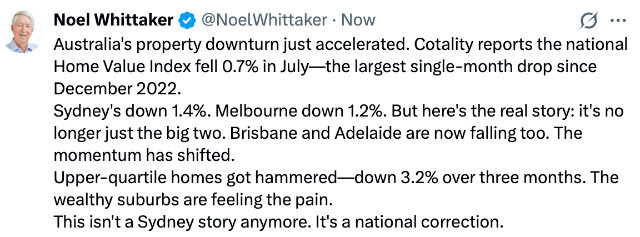
X is becoming a very powerful medium to keep you up-to-date with information. I’m now posting most days with what I see as the topic of the day. This was the one I posted last Friday – would love for you to join me. There’s no cost.

A big thank you to all you good people who read my newsletter.
If you were forwarded this newsletter by a friend and you would like to subscribe, you can do so here:
You can also find the subscription box in the footer of all website pages.
View past Noel News editionsDownload recent Noel News as a PDF

I hope you have enjoyed the latest edition of Noel News.
Thanks for all your kind comments. Please continue to send feedback through; it’s always appreciated and helps us to improve the newsletter.
And don’t forget you’ll get more regular communications from me if you follow me on X – @NoelWhittaker.
For more Noel News: