



Image Source : www.newswire.lk
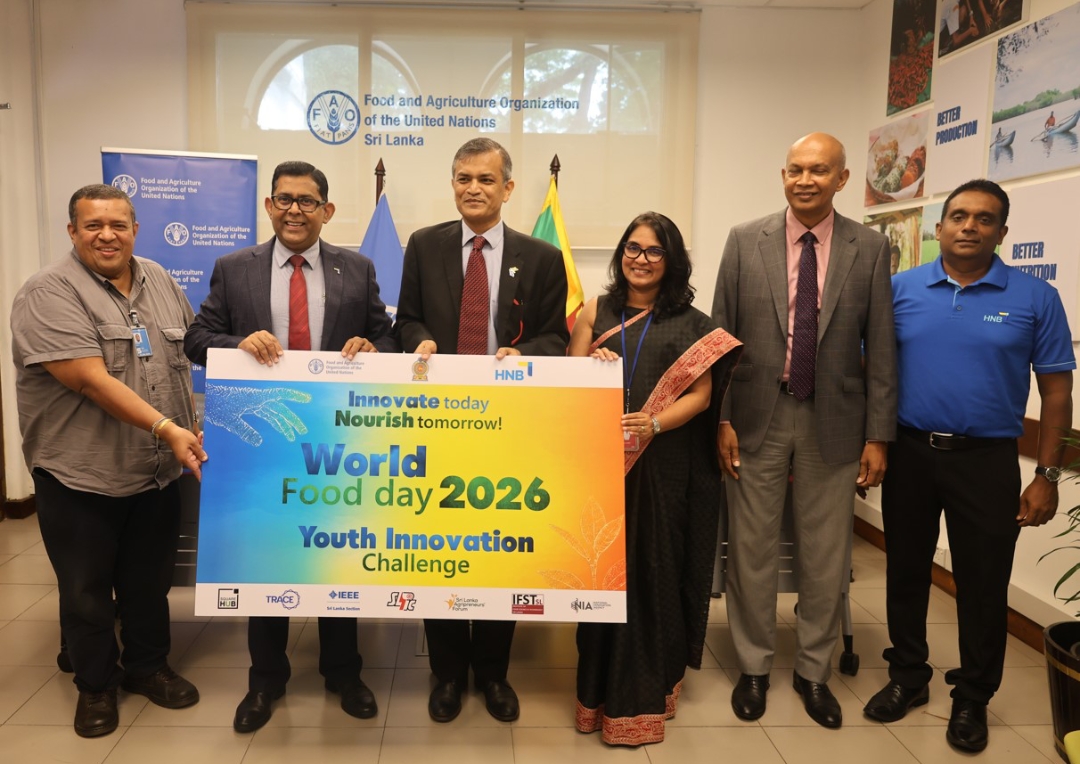
Sri Lanka’s university students have been invited to apply their knowledge, creativity and entrepreneurial ability to some of the country’s most important food and agriculture priorities through the World Food Day 2026 Youth Innovation Challenge, a nationwide initiative launched under the theme “Innovate Today – Nourish Tomorrow”.
The programme was launched in Colombo on 19 August 2026 by the Food and Agriculture Organization of the United Nations (FAO), the Ministry of Education, Higher Education and Vocational Education, and Hatton National Bank (HNB). It has been designed to bring together multidisciplinary teams from state and private universities, as well as higher education institutes, so that research and student-led ideas can be developed into practical solutions with wider value for Sri Lankan communities.
The initiative places education and innovation at the centre of the country’s agrifood future, recognising that the next generation of scientists, engineers, entrepreneurs, agricultural specialists, environmental researchers and business leaders can make an instrumental contribution to building more resilient food systems.
A national platform for practical ideas
The World Food Day 2026 Youth Innovation Challenge will focus on a broad range of areas connected to agriculture and food production, including agriculture, fisheries, livestock, environmental protection, climate resilience, food security and nutrition.
This multidisciplinary approach is significant because the agrifood sector is not defined by farming alone. It encompasses the production, harvesting, storage, processing, transportation, marketing and consumption of food, while also involving water management, environmental stewardship, technology, finance and public health.
According to the report published by Newswire, the programme will encourage teams to consider practical responses to issues such as post-harvest losses, climate-related stresses, inefficient water use, pest and disease threats, weak market linkages, fisheries spoilage and the loss of fishing gear. These areas present opportunities for students to combine academic learning with field-based understanding, creating proposals that are both innovative and grounded in the needs of producers and consumers.

The participation of students from different academic disciplines is expected to strengthen the quality of the proposals. A team combining agricultural knowledge with expertise in information technology, engineering, environmental science, business management, nutrition or design, for example, may be better positioned to develop an idea that is technically sound, commercially viable and accessible to the communities it is intended to serve.
From concept notes to prototypes
The competition will follow a structured pathway intended to move promising ideas from the early concept stage towards practical demonstration.
The first stage will be a nationwide call for concept notes, through which multidisciplinary student teams will outline the problem they intend to address, the proposed solution and the potential benefit to the agrifood sector. This opening phase is intended to ensure that students from institutions across Sri Lanka can contribute ideas, rather than limiting participation to a small number of established centres.
Approximately 25 teams will then be selected to participate in an online pitching round. At this stage, participants will have the opportunity to present their concepts, explain the evidence behind their proposals and demonstrate how their ideas could respond to a recognised need in agriculture, fisheries, livestock, environmental protection, climate resilience, food security or nutrition.
The top 10 teams will progress to the prototype development stage. These teams will receive technical and industry mentorship, enabling them to refine their concepts, test their assumptions and develop a more tangible representation of their proposed solution. Such support can be especially valuable for students, as the transition from an academic idea to a functioning prototype often requires guidance in design, budgeting, user research, safety, production and market planning.
The final teams will present their prototypes during the national World Food Day 2026 celebrations. From these finalists, the top five teams will pitch their innovations to judges and potential investors, while the top three teams will receive cash awards.
This staged pathway provides more than a competition. It establishes a progression through which ideas can be examined, improved and presented to people with the expertise and resources required to support their continued development.
Connecting education, government and industry
The challenge is supported by the Ministries of Agriculture, Livestock, Land and Irrigation; Fisheries, Aquatic and Ocean Resources; Environment; Health and Mass Media; and Science and Technology.
Technical partners include TRACE Expert City, the Institute of Electrical and Electronics Engineers (IEEE), Sri Lanka Inventors Commission (SLIC), Sri Lanka Agripreneurs Forum (SLAF), Institute of Food Science and Technology Sri Lanka (IFSTSL), National Innovation Agency (NIA) and Square Hub.
The range of participating institutions reflects the programme’s wider objective of connecting universities, government bodies, industry and development partners. In many countries, valuable research remains within academic institutions unless suitable channels are created for testing, investment and implementation. By bringing these groups into a common programme, the challenge may help reduce that separation and create a more direct route from research to practical use.
The potential beneficiaries extend across the food system. Farmers may gain access to better tools, improved production methods or more efficient water-management systems. Fishers may benefit from solutions that reduce spoilage, improve storage or protect equipment. Livestock producers may gain from innovations in animal health, feed management or climate adaptation. Consumers may ultimately benefit through improved nutrition, food quality, affordability and reliability.

Statements from the programme partners
Newswire reported that Harini Amarasuriya, Prime Minister and Minister of Education, Higher Education and VoAAcational Education, said the initiative would provide university students with an opportunity to apply their knowledge to real-world
For participating students, the challenge offers an opportunity to gain experience in research communication, teamwork, public presentation, prototype development and engagement with industry specialists. It also provides a setting in which ideas can be assessed by people beyond the university environment, including technical experts, business leaders, government representatives and potential investors.
The programme’s theme, “Innovate Today – Nourish Tomorrow”, places particular emphasis on the long-term value of youth participation. Food security and climate resilience require sustained attention, and the solutions developed in the present may influence how future generations produce food, manage natural resources and respond to changing environmental conditions.
The challenge may also encourage a stronger culture of agripreneurship in Sri Lanka, where students are supported not only to seek employment but also to identify unmet needs and develop responsible enterprises. When academic knowledge is combined with local experience, community consultation and suitable investment, even a modest prototype may become the foundation for a service, product or system with meaningful social and economic value.

Looking towards World Food Day 2026
World Food Day is observed each year on 16 October, providing an international platform for reflection on food systems, nutrition, agriculture and the importance of sustainable development. The presentation of the finalists’ prototypes during the 2026 celebrations will give the programme a public platform while allowing the strongest student proposals to receive national attention.
The success of the initiative will ultimately be measured not only by the quality of the winning concepts, but also by the extent to which promising ideas can continue beyond the competition. Continued mentorship, access to testing facilities, partnerships with producer organisations, responsible investment and opportunities for field trials would help ensure that the challenge produces lasting value.
The World Food Day 2026 Youth Innovation Challenge therefore represents a constructive investment in Sri Lanka’s young people and in the future of its agrifood sector. By encouraging students to study real needs, work across disciplines and present practical solutions, the programme creates a hopeful bridge between higher education and the communities whose livelihoods depend upon a strong, sustainable and innovative food system.
Source: https://www.newswire.lk/2026/08/19/fao-launches-youth-challenge-to-drive-innovation-in-sri-lankas-agrifood-sector/
This article was written based on the source https://www.newswire.lk/2026/08/19/fao-launches-youth-challenge-to-drive-innovation-in-sri-lankas-agrifood-sector/, kindly email us at info@eLanka.com.au if any information needs to be corrected.
(adsbygoogle = window.adsbygoogle || []).push({});