The Kandy Esala Perahera 2026 is once again placing Sri Lanka’s living Buddhist heritage at the heart of a magnificent cultural observance, as the historic city of Kandy welcomes devotees, performers, families and visitors for eleven days of religious ceremony, traditional music, dance and pageantry from 18 to 28 August.
For Sri Lankans living abroad, the annual procession offers an important connection with the island’s history and spiritual traditions, particularly through live broadcasts and online coverage that enable families across Australia, the United Kingdom, Canada, New Zealand, the United States and other countries to participate from a distance. The live YouTube stream shared with the global Sri Lankan community provides an opportunity to experience the colour, rhythm and solemnity of the Perahera as it unfolds around the Sri Dalada Maligawa, the Temple of the Sacred Tooth Relic.
A festival centred on the Sacred Tooth Relic
The Kandy Esala Perahera is centred on the Sacred Tooth Relic of Gautama Buddha, which is housed within the Sri Dalada Maligawa and is revered by Buddhists as a living symbol of the Buddha’s presence. Daily, weekly and annual rituals are conducted in honour of the relic, with the annual Perahera regarded as one of the most significant Buddhist and cultural celebrations in Sri Lanka.
According to the historical account published by the Sri Dalada Maligawa, the Sacred Tooth Relic was brought to Sri Lanka in the fourth century AD by Princess Hemamala and Prince Dantha during the reign of King Kithsiri Mewan. It was first placed in Isurumuniya Temple in Anuradhapura, where it was honoured by the royal court and the people of the kingdom.
The tradition of presenting the relic in a grand procession was subsequently maintained through several historic capitals, including Anuradhapura, Polonnaruwa, Dambadeniya, Yapahuwa, Kurunegala, Gampola, Kotte, Seethawaka and Kandy. As royal authority changed across the centuries, guardianship of the Sacred Tooth Relic continued to carry profound religious and cultural importance, and the ceremonies associated with it were preserved as an expression of devotion, continuity and national identity.
When the relic was eventually brought to Senkadagala, the former name of Kandy, the foundations of the present tradition were strengthened. A temple was established within the royal precincts, and the city gradually became the principal setting for the annual observance that is now recognised internationally as the Kandy Esala Perahera.

The Kumbal and Randoli processions
The 2026 programme began with five Kumbal processions, held from 18 to 22 August. These opening processions traditionally establish the ceremonial rhythm of the festival, bringing together drummers, dancers, flag bearers and other participants in a carefully maintained order of movement and ritual.
The Randoli processions follow from 23 to 27 August and represent the culminating sequence of the night processions. The official schedule identifies the Fourth Randoli Procession for 26 August at 6:44 p.m., while the Grand Final Randoli Procession is scheduled for 27 August at 6:43 p.m.
The progression from Kumbal to Randoli is one of the features that gives the festival its distinctive structure. Each evening contributes to the unfolding of an observance in which religious reverence and artistic heritage are presented together, with traditional forms of drumming, dance, costume and ceremonial decoration continuing to be passed from one generation to the next.
The procession traditionally brings together the Sri Dalada Maligawa Perahera and the four devale processions associated with Natha, Vishnu, Kataragama and Pattini. This combined presentation reflects the layered religious history of Kandy, in which Buddhist worship and longstanding devotional traditions have been preserved within a shared ceremonial framework.
Rather than functioning merely as a spectacle, the Perahera therefore represents a carefully ordered expression of faith, heritage and community participation. Its visual splendour is supported by generations of knowledge held by custodians, performers, craftspeople, musicians and families whose involvement sustains the festival’s authenticity.
Music, movement and craftsmanship
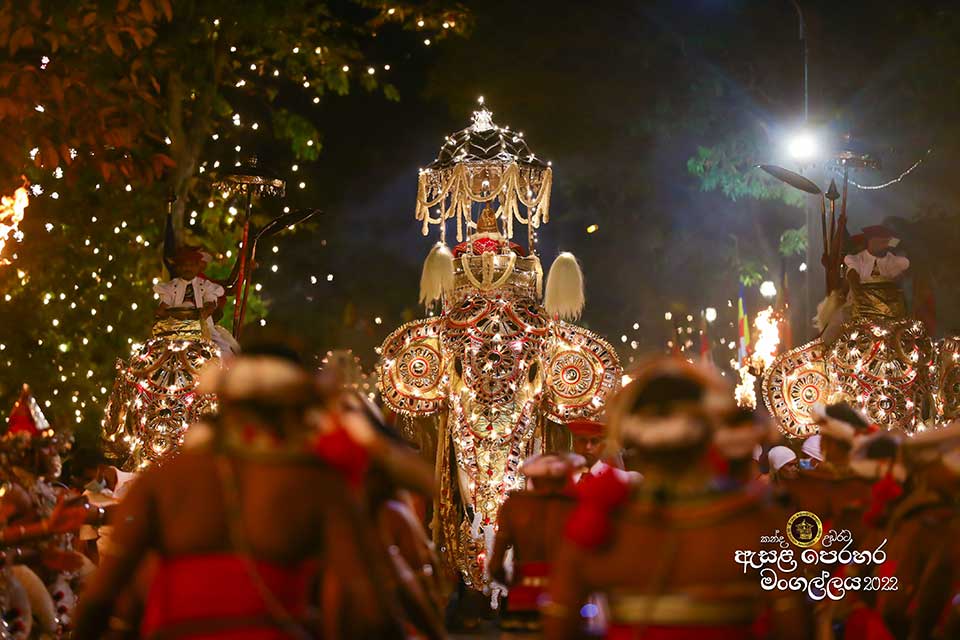
The procession is recognised for the disciplined performance of Kandyan drummers, whose rhythms provide much of its ceremonial character. The sound of the traditional drums, combined with ceremonial flutes and the movement of dancers, creates an atmosphere that is both celebratory and devotional.
Kandyan dancers, fire performers, flag bearers and other traditional artists contribute to a presentation in which movement carries historical meaning. Costumes are assembled with care, while ornaments, flags, fans and other ceremonial objects add colour to the evening streets of Kandy.
The elephants associated with the Perahera are also presented as part of the festival’s traditional visual language, with ceremonial decoration reflecting the dignity of the occasion. The processions are expected to be viewed with respect for the religious significance of the event and for the longstanding cultural practices through which the ceremony has been maintained.
The craftsmanship visible throughout the Perahera is particularly significant. Textiles, jewellery, decorative panels, traditional instruments and ceremonial accessories are not incidental details; they are elements of a cultural archive that remains active rather than confined to a museum or historical record. The festival consequently provides a valuable platform for the preservation of skills that might otherwise be vulnerable to decline.

A shared experience for Sri Lankans worldwide
The enduring appeal of the Kandy Esala Perahera extends well beyond the streets in which it takes place. Through television, digital media and live online broadcasts, the festival is now accessible to a much wider audience, allowing Sri Lankan expatriates to share the experience with children and grandchildren who may have grown up outside the island.
For families in Australia and other countries, the Perahera can serve as an educational introduction to Sri Lanka’s religious traditions, regional history and artistic heritage. The sight of the temple precinct, the sound of the drums and the movement of the procession can encourage younger generations to ask questions about the island’s past and to develop a more meaningful connection with its cultural identity.
The festival also demonstrates the value of responsible digital storytelling. When authentic ceremonies are shared with appropriate context, viewers are able to appreciate not only the pageantry but also the discipline, devotion and historical memory supporting it. Online coverage therefore becomes an instrumental bridge between Kandy and the global Sri Lankan community.
eLanka’s mission is similarly focused on connecting Sri Lankans across borders through positive stories, community information and cultural features. Readers can explore further articles through the eLanka News and Articles section, discover useful community resources through the eLanka Useful Links page and receive regular updates by subscribing to the eLanka Newsletter.

The closing ceremonies
The religious programme continues beyond the final night procession. The official 2026 schedule lists the Diya Kepeema, or water-cutting ceremony, for 27 August at 1:28 a.m. This important ritual marks a further stage in the conclusion of the festival and is followed by the Dahawal Perahera, or daytime procession, scheduled for 28 August at 2:18 p.m.
Together, these final observances complete a festival that has moved from its opening Kumbal processions through the increasingly elaborate Randoli evenings and into the closing ceremonies. The sequence illustrates how the Kandy Esala Perahera combines devotion, ritual, performance and public participation within a single cultural framework.
As the 2026 Perahera continues, its importance lies not only in its grandeur but also in its continuity. The festival remains a living institution through which Sri Lankan Buddhist traditions, regional craftsmanship and community memory are renewed each year. Its presence in Kandy, and its reach through global broadcasts, ensures that the story of Sri Lanka’s sacred heritage can continue to be shared with audiences both on the island and throughout the world.
Source: https://www.youtube.com/live/Iwh17sM0ZJo
This article was written based on the source https://www.youtube.com/live/Iwh17sM0ZJo, kindly email us at info@eLanka.com.au if any information needs to be corrected.
Source: https://sridaladamaligawa.lk/kandy-esala-perahera/
This article was written based on the source https://sridaladamaligawa.lk/kandy-esala-perahera/, kindly email us at info@eLanka.com.au if any information needs to be corrected.
(adsbygoogle = window.adsbygoogle || []).push({});
At eLanka, we respect the rights of creators. If we have used an image you own and you’d like it removed, please email us at info@elanka.com.au and we’ll handle it promptly.