Rajnath Singh’s Visit and the Shifting Geometry of India–Sri Lanka Relations-by Harold Gunatillake

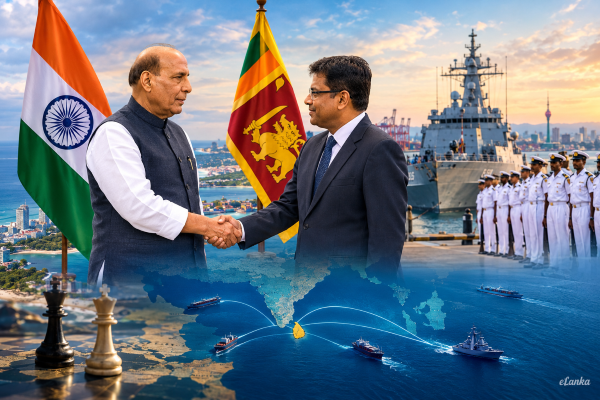
According to The Hindu, as reported by Saurabh Trivedi, Rajnath Singh’s three-day visit to Sri Lanka marks the first visit by an Indian Defence Minister in 38 years.
Indian Defence Minister Rajnath Singh’s three-day visit to Sri Lanka from September 8 to 10 signifies more than a routine diplomatic engagement. It exemplifies the ongoing reshaping of the Indian Ocean’s strategic landscape and illustrates Sri Lanka’s discreet repositioning amid competing spheres of influence.
This visit fundamentally centres on maritime security, regional stability, and India’s emerging role as the principal security provider in South Asia.
However, beyond the official declarations and ceremonial displays, there lies a more profound narrative: Sri Lanka’s pursuit of balance in a region increasingly characterised by powerful and unforgiving geopolitical currents.
A Visit Based on Strategic Necessity
India’s Ministry of Defence has characterised the visit as a continuation of “longstanding civilisational ties.” While this is accurate, it remains incomplete.
The primary motivation is strategic necessity.
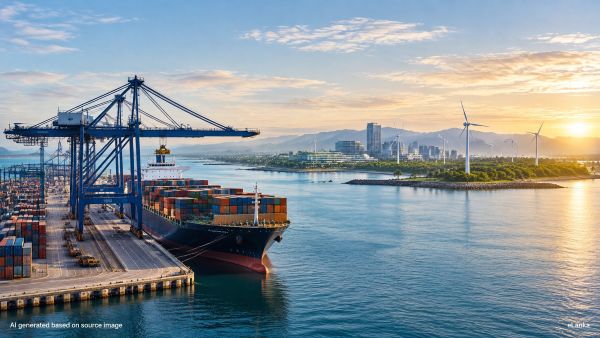
The Indian Ocean has emerged as the world’s most contested maritime region after the South China Sea.
Sri Lanka, situated at its heart, is only 18 nautical miles from India’s southern coast. For New Delhi, the stability of Colombo is not optional; it is vital.
Rajnath Singh’s consultations are expected to concentrate on:
- Maritime domain awareness
- Joint naval operations and training
- Defence technology cooperation
- Counter-smuggling and counter-terrorism coordination These objectives are not merely theoretical They constitute the foundational elements of India’s initiative to
maintain the Indian Ocean as a cooperative area, rather than a battleground for external powers.
Sri Lanka’s Balancing Act
For Sri Lanka, the visit arrives at a sensitive juncture. The nation continues to recover from economic upheaval, manage debt restructuring, and recalibrate its foreign policy after years of strategic inconsistency.
India’s support during the economic crisis — including currency exchanges and vital supplies — has transformed public and political perceptions.
The aid provided following Cyclone Dytwah in 2025 further solidified India’s role as a primary responder.
However, Colombo’s challenge persists: how to strengthen ties with India without alienating other allies, particularly China.
Rajnath Singh’s presence indicates that New Delhi anticipates clarity — or at least predictability — in Sri Lanka’s defence policies.
Neighbourhood First Meets Sri Lanka’s New Pragmatism
India’s Neighbourhood First policy has evolved into a more assertive stance. It is no longer solely about fostering goodwill; rather, it focuses on shaping the strategic environment.
Meanwhile, Sri Lanka is adopting a more pragmatic foreign policy, including seeking Indian investment in renewable energy and ports, expanding defence cooperation, maintaining economic ties with China, and engaging with Japan, the European Union, and the United States to diversify its sources of support.
While this multi-vector approach is prudent, it necessitates meticulous navigation.
Singh’s forthcoming visit will gauge Colombo’s ability to sustain this delicate balancing act.
The Indian Ocean: The Actual Arena
The paramount concern of the visit extends beyond bilateral relations to encompass the wider Indian Ocean context. India and Sri Lanka are progressively aligning their interests on several key issues, including:
- safeguarding maritime lanes
- preventing militarisation by external powers
- ensuring that regional security is influenced predominantly by regional stakeholders
This convergence is deliberate, shaped by geographic considerations, historical ties, and shared vulnerabilities.
Should Singh’s visit foster enhanced maritime cooperation—particularly in areas such as surveillance, intelligence sharing, and joint operations—it would represent a considerable transformation in the region’s security framework.
Implications for Sri Lanka
For Sri Lanka, the visit presents both opportunities and responsibilities.
Opportunity:
- Access to Indian defence training and technology
- Enhanced maritime security
- Strengthened crisis-response mechanisms
- Economic and strategic confidence arising from a stable partnership
Responsibility:
- Upholding transparency in defence agreements
- Ensuring that cooperation does not lead to dependency
- Maintaining strategic autonomy whilst engaging with regional security frameworks
Sri Lanka’s leaders must approach this visit with clarity: India is not merely a neighbour; it is the nation best positioned to shape Sri Lanka’s future security environment.
Conclusion: A Visit That Signifies a New Phase
Rajnath Singh’s visit is characterised by strategic significance rather than mere ceremony. It is both timely and consequential. It signifies:
- India’s intention to strengthen defence relations
- Sri Lanka’s readiness to engage more earnestly
- A mutual understanding that the future of the Indian Ocean will be defined by regional cooperation rather than external rivalry
In a global context where small nations frequently serve as arenas for great-power competition, Sri Lanka possesses both an opportunity and a responsibility to shape its own future. This visit represents a step toward that goal.
While Mr Singh conducts consultations with Sri Lanka’s highest leadership on various bilateral, regional, and defence-related issues, he also engages with members of the Indian diaspora in Colombo.
Mr Singh’s visit is expected to enhance the historically strong and amicable bilateral relationship between India and Sri Lanka, while
also fostering deeper collaboration in mutually advantageous sectors, notably maritime security and defence.
End