Image: Lankanews.lk.
Sri Lanka’s capital market may be moving towards a closer relationship with the Abu Dhabi Securities Exchange (ADX), creating the prospect of improved international access, stronger technical cooperation and wider opportunities for investors, while also placing greater importance on regulatory preparedness and investor protection.
As reported in an analysis published by Lankanews.lk on 9 September 2026, the proposed connection between the Colombo Stock Exchange (CSE) and ADX is intended to establish a framework for cooperation across several important areas of market activity. These include electronic trading, exchange operations, technical infrastructure, market surveillance, clearing and post-trading capabilities.
The proposed relationship also includes collaboration on newer financial products, including exchange-traded funds and derivatives. For Sri Lanka, where the capital market remains relatively small and requires continued modernisation, such cooperation could provide useful access to knowledge, systems and international experience.
However, the potential value of the initiative will depend on how carefully it is implemented. International market connectivity can create new opportunities, but it must be accompanied by suitable safeguards, transparent procedures and a clear understanding of the risks that may arise when investors, trading systems and financial institutions operate across jurisdictions.

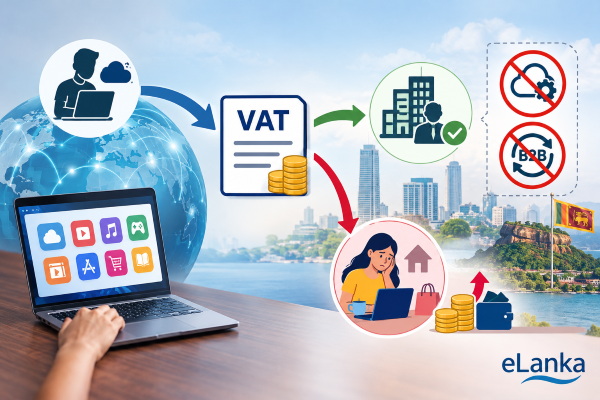
Featured image: AI-generated based on the source image, with eLanka branding.
A framework for closer market cooperation
The memorandum of understanding between the CSE and ADX is designed as a framework for cooperation and exploration rather than a guarantee of increased investment. Its significance lies in the areas that the two exchanges may examine together and in the possibility of creating stronger links between their respective markets.
The proposed areas of cooperation are broad. Electronic trading and exchange operations sit at the centre of modern securities markets, while technical infrastructure determines whether trading and related services can be delivered securely and efficiently. Clearing and post-trading functions are equally important because transactions must be processed, settled and recorded with consistency after an order has been executed.
Market surveillance is another central element. As trading becomes more connected, exchanges require the ability to monitor activity, identify unusual patterns and exchange relevant information where transactions involve multiple markets or jurisdictions.
The arrangement also opens the door to knowledge-sharing in relation to exchange-traded funds and derivatives. These products can broaden the range of instruments available to investors, although their introduction requires careful preparation because they may involve greater complexity and risk than ordinary share trading.
The potential role of the Tabadul Hub
One of the most significant proposals is the potential participation of the CSE in Tabadul Hub, ADX’s digital exchange network designed to support mutual market access and trading connectivity.
If developed successfully, such a connection could make Sri Lankan securities more accessible to international investors and could create new channels through which Sri Lankan investors may reach regional markets. For listed companies and market participants, improved connectivity could contribute to a more modern and outward-looking capital-market environment.

AI-generated illustration of cross-border market connectivity.
The opportunity is particularly relevant for Sri Lankan companies seeking greater visibility among international investors. Improved access can help securities reach a wider pool of participants, while cooperation between exchanges may support the exchange of technical expertise and operational knowledge.
For Sri Lankan investors living in Australia, the United Kingdom, the United States, Canada, New Zealand and other parts of the global Sri Lankan community, developments of this nature may also be of interest because they relate to the accessibility, transparency and modernisation of Sri Lanka’s investment environment.
Nevertheless, a digital connection does not automatically produce deeper or more sustainable investment. The success of the arrangement will depend on whether investors are able to understand the market, access reliable information and operate within a framework that treats domestic and international participants fairly.
Why market surveillance matters
The source analysis appropriately identifies market surveillance as a priority. The closer markets become, the more important it is for relevant authorities and exchanges to monitor trading activity in real time and to share information when activity crosses national borders.
In a less connected market, an unusual transaction may be easier to trace because the orders, investors and intermediaries are operating within a more limited environment. Cross-border arrangements can make that process more complex, particularly when a transaction involves different systems, institutions and regulatory expectations.
Cooperation on surveillance can therefore be valuable, but it must lead to practical capabilities rather than remaining a general statement of intent. Effective information-sharing procedures, clear responsibilities and suitable enforcement arrangements will be necessary if the benefits of connectivity are to be realised while protecting market integrity.
This is a sensible and achievable priority. International integration does not require Sri Lanka to abandon its own regulatory standards; rather, it requires the country’s market institutions to ensure that those standards remain effective as technology and participation develop.
Cybersecurity and operational resilience
The proposed technical integration also highlights the importance of cybersecurity. When trading systems and exchange infrastructure become more closely connected, operational reliability becomes a shared concern.
A technical failure in one part of an interconnected system may create consequences beyond the original point of failure. Similarly, a cyberattack directed at one institution could potentially affect connected operations, depending on the nature of the systems involved.
For this reason, technological cooperation should be accompanied by strong attention to cybersecurity resilience, system reliability and continuity arrangements. The objective should be to ensure that market participants can continue to receive accurate information and conduct transactions through dependable systems.
Such preparation should be viewed as an essential part of modernisation rather than as an obstacle to progress. A market that is technologically advanced but insufficiently protected would not provide a stable foundation for long-term investment. By contrast, secure and resilient infrastructure can strengthen confidence among companies, investors and intermediaries.

AI-generated illustration representing market safeguards and digital resilience.
A measured approach to derivatives
The proposed collaboration on derivatives deserves a particularly careful and phased approach. Derivatives can provide sophisticated investors with tools for hedging, portfolio management and risk control, but they can also introduce greater leverage and complexity into a market.
For that reason, new products should not be assessed only by their potential to increase trading activity. Investor education, appropriate risk-management systems and adequate regulatory expertise will also be important.
Domestic investors should be able to understand the nature of any new product before it becomes widely available. Clear explanations of potential gains, losses, costs and obligations can help ensure that product development supports informed participation rather than confusion.
A carefully staged process would allow the relevant institutions to assess market readiness, strengthen operational systems and address any weaknesses before more complex instruments are introduced on a broader scale.
Transparency before expanded cross-border trading
Before expanded cross-market trading becomes operational, investors will require clear information about the practical arrangements. The source analysis identifies several areas that will require transparency, including fees, investor eligibility, settlement arrangements, taxation, currency conversion and the repatriation of funds.
These matters may appear technical, but they directly influence whether investors can assess the true cost and practical implications of participating in another market. Unclear charges or procedures can discourage responsible investment, while transparent arrangements can support confidence and reduce avoidable disputes.
Clarity will also be important for Sri Lankan investors abroad who may be considering securities listed in Sri Lanka, as well as for international investors assessing opportunities through the CSE. A market becomes more accessible when its rules and costs can be understood before an investment decision is made.
Measuring success beyond connectivity
The CSE–ADX relationship represents a potentially constructive step in the continuing modernisation of Sri Lanka’s capital market. It may open new channels for market access, provide opportunities for technical cooperation and encourage the development of products that support a broader investment environment.
At the same time, the memorandum of understanding should be understood in its proper context. It is a framework for cooperation and exploration, not a guarantee that investment will automatically increase.
The more meaningful measure of success will be whether the initiative helps attract sustainable investment, improves the quality of market infrastructure and protects the interests of domestic investors. Connectivity, conferences and institutional agreements may mark the beginning of a process, but lasting value will be demonstrated through reliable systems, transparent rules and market participation that contributes to long-term economic development.
For Sri Lanka, the opportunity is therefore substantial, provided that progress is matched by preparation. Strong surveillance, cybersecurity resilience, investor education, careful product development and transparent cross-border procedures can ensure that closer international integration becomes a practical benefit rather than merely an administrative achievement.
For eLanka readers following developments in Sri Lankan business and finance, the proposed CSE–ADX connection is a reminder that the country’s capital market is becoming increasingly linked to wider regional networks. Its future value will depend on achieving the appropriate balance between openness, innovation and responsible protection.
Source: https://lankanews.lk/2026/09/09/colombo-abu-dhabi-alliance-opens-markets-exposes-new-vulnerabilities/
This article was written based on the source https://lankanews.lk/2026/09/09/colombo-abu-dhabi-alliance-opens-markets-exposes-new-vulnerabilities/, kindly email us at info@eLanka.com.au if any information needs to be corrected.
(adsbygoogle = window.adsbygoogle || []).push({});
At eLanka, we respect the rights of creators. If we have used an image you own and you’d like it removed, please email us at info@elanka.com.au and we’ll handle it promptly.