Sri Vikrama Rajasinha wore royalty on his sleeve even after losing his Kingdom-by P.K Balachandran
The British, who had dubbed him the devil-incarnate, became his guardian after overthrowing him
Source:Dailymirror
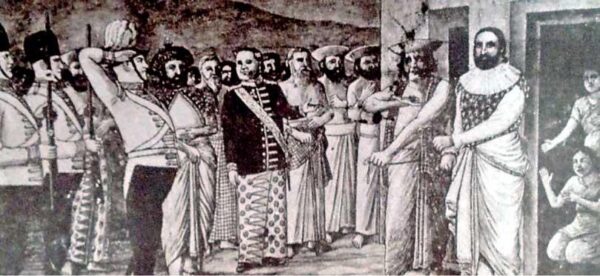
British officers salute the arrested King as the Kandyan chiefs arrest him
- After almost a year’s stay in relative comfort in Colombo, on January 24, 1816, Vikrama Rajasinha, his three wives and a large retinue were put on the British warship HMS Cornwallis for the 26-day journey to Madras and thence to the Vellore fort, 138 km from Madras
- Six foot tall, with a bulky body, Vikrama Rajasinha found his tiny cabin in the warship a virtual torture chamber. He would make strange noises expressing despair and displeasure
- Vikrama Rajasinha died at 52 in 1832 of edema (swelling that is caused by fluid trapped in body tissues). When his only son died in 1842, the Nayakar dynasty of Ceylon ceased to exist.
 The reign of Kandy’s last King, Sri Vikrama Rajasinha (1798-1815), was at once colourful and tragic. On the one hand, it was marked by the transformation of Kandy into a beautiful “celestial city” and on the other, it stood out for political intrigue, disloyalty, inhuman retribution, British machination and naked aggression, and finally, the elimination of the last indigenous sovereign entity in the island – the Kandyan Kingdom.
The British, who had been eyeing Kandy ever since they took over the Western coast from the Dutch, fueled and exploited dissensions between King Sri Vikrama Rajasinha and the Kandyan chiefs. And in a swift operation conducted in cahoots with the Kandyan chiefs, they overthrew the King and assumed formal power through the “Kandyan Convention” signed on March 2, 1815. After acquiring power, the British disregarded their erstwhile Kandyan collaborators while looking after the deposed Sri Vikrama Rajasinha pretty well, forgetting the invectives they had used against him.
 As Kandy fell to British troops, Vikrama Rajasinha fled to Medamahanuwara gap. But on February 18, 1815, a group headed by chief Ekneligoda, and comprising the followers of Ahelepola and a British military team, arrested him. According to M. B. Dissanayake, the King was badly roughed up by his Sinhalese captors. However, a picture of the event shows British soldiers saluting the arrested King. Apparently, the British had changed their stance towards the King.
John D’Oyly, the British spy who had meticulously masterminded the King’s downfall by weaning away the Kandyan chiefs with a mix of vile anti-King propaganda and bribes, visited Vikrama Rajasinha and assured him that he and his family would be treated well. The promise was kept. The British became his guardians. Governor Sir Robert Brownrigg got his officers to treat the ex-King with honour. And to save him from his local enemies, the British shifted him to Colombo where they were well entrenched.
Arriving in Colombo on March 6, 1815, Vikrama Rajasinha was put up in a spacious and well-furnished former Dutch bungalow located in the Fort area (on land now occupied by Ceylinco House). British officers who were put in charge of the King treated him with the utmost courtesy. His only grievance was that Governor Brownrigg did not visit him even once! Brownrigg’s discourtesy hurt his royal ego said William Granville, author of The Deportation of Sri Vikrama Rajasinha who was also his escort on his journey to India on exile later on.
Vikrama Rajasinha wanted to tell Brownrigg how to find the traditional emblems of his sovereignty so that his rival, chief Ahelepola, would not lay his hands on them and enable him to make a claim to the throne. But Brownrigg not only gave him the cold shoulder but decided to exile him to India.
- Governor Sir Robert Brownrigg got his officers to treat the ex-King with honour. And to save him from his local enemies, the British shifted him to Colombo where they were well entrenched
After almost a year’s stay in relative comfort in Colombo, on January 24, 1816, Vikrama Rajasinha, his three wives and a large retinue (totally numbering 60 persons) were put on the British warship HMS Cornwallis for the 26-day journey to Madras and thence to the Vellore fort, 138 km from Madras. Gananath Obeysekere in his book The Doomed King gives an interesting account of the journey during which Vikrama Rajasinha behaved as if he was still King. He was forever concerned about maintaining his exalted status according to William Granville.
On the day earmarked for sailing, the dethroned King reached Colombo harbour in his full regalia. When he noticed that his coach had to pass under an archway over which many common folk were perched to have a glimpse of the King, he insisted that the archway be cleared of people as the King “he could not pass the gateway with any individual above him!” The British officers dutifully cleared the archway of people.
According to Granville the British officers and sailors on board HMS Cornwallis treated the “fallen monarch with every mark of proper decorum” even as the King “regarded everything with sternness and silence.” Six foot tall, with a bulky body, Vikrama Rajasinha found his tiny cabin in the warship a virtual torture chamber. He would make strange noises expressing despair and displeasure. But he refrained from complaining to the British officers, perhaps thankful to them for sparing his life and protecting him from the angry mob at Medamahanuwara gap.
Giving due respect to the King, the vessel’s captain, O’Brian, would invite him to dine with him at the captain’s table. But more often than not, the King would decline the invitation. He preferred to eat with his family separately. Occasionally, the King would dine at the captain’s table with his Queens and would be in good spirits though according to Granville he imbibed no spirits which were a plenty on board. The King was an epicurean with a huge appetite. He was fussy about the quality of food and would fly into a rage if it was not up to his liking. Occasionally he would cook (mostly vegetarian) for all including the British crew who would eat it dutifully.
Though the King was polite to the sailors and British officers, he kept his wives and the servants under control with an iron hand. He always spoke in a loud voice as he thought that it was a hallmark of power. Once he severely beat up his first wife (who was like a personal servant) for an unknown misdemeanor. On another occasion, he broke a wooden bed into pieces only because one of his low caste servants had used it. And on his command, Granville threw the broken bed into the sea!
As the journey to Madras took longer than he expected, the King feared that he was being taken to England secretly. The worried man would often go into meditation to help him get over his anxieties and bear life in the “floating prison”. But he perked up when HMS Cornwallis sighted Pulicat near Madras. Usually bare-bodied above his waist, Vikrama Rajasinha quickly changed into his grand Kandyan royal attire. He was to enter Madras right royally in full regalia. According to Granville, the King wore an ornate and colourful Kandyan royal dress with gold, gems and precious stones embedded in it.
Before landing, he gave instructions to his retinue to follow the set ceremonial procedure followed when the King arrived at any place. As expected, thousands of locals were waiting to greet him on the shore. Sri Vikrama Rajasinha acknowledged the greetings of the assemblage with a slight nod of the head. After resting for a while in specially erected tents, the royal party boarded palanquins for the arduous 138 km journey to the Vellore Fort.
At the Vellore Fort, life was luxurious, writes M.B. Dissanayake. The royal family was housed in “Kandy Mahal” occupied earlier by the sons of the Tipu Sultan, the defeated ruler of Mysore. The British in Madras met every request of Sri Vikrama Rajasinha and his wives. They were supplied with clothes and all household necessities. Even jewellers were sent to meet the fanciful requirements of the women. The Madras government fully funded the lives of the royal family. And yet, the family piled up debts. The King’s third and the most beautiful wife ran up heavy debts but these were settled by the helpful government.
Vikrama Rajasinha died at 52 in 1832 of edema (swelling that is caused by fluid trapped in body tissues). When his only son died in 1842, the Nayakar dynasty of Ceylon ceased to exist.