A Home, At Long Last — India’s Gift to the Forgotten Backbone of Ceylon Tea: A Century of Labour, a Century Without a Home-by Harold Gunatillake

Overview:
The Indian government’s commitment to build 60,000 housing units in Sri Lanka under the Indian Housing Project (IHP) was not executed all at once; instead, it was carried out in phases beginning in 2010, with allocations for estate tea pluckers expanding progressively over the years.
While the initial phases primarily targeted families displaced by conflict in the Northern and Eastern regions, dedicated housing for estate plantation workers commenced in 2016–2017 and is projected to continue through 2026.
The detailed project breakdown shows how these 60,000 residences are distributed across the estate tea plantation sector.
Breakdown of the 60,000-House Project
- Phases I & II (Initiated 2010 – Concluded 2018): The initial 46,000 houses were constructed as part of post-war rehabilitation initiatives for families residing in the Northern and Eastern Provinces, rather than specifically targeting tea estate
- Phase III (initiated in 2016/2017 and concluded in 2026) was dedicated to estate workers within the Central and Uva Provinces, encompassing the construction of 4,000 residential units.
Construction began on estates such as Dunsinane and Bogawana in early 2017. Prime Minister Narendra Modi officially transferred the first major set of completed residences via video link in August 2018. The phase reached completion in April 2026.
- Phase IV (Announced 2017 / Launched late 2023 – Ongoing): Prime Minister Modi announced an additional 10,000 houses specifically for estate plantation Formal agreements were executed in November 2023, with ground implementation beginning in early 2024, and Stage 2 of this phase commenced in October 2025.
Construction on these final units is currently underway across six provinces as of late 2026.
A total of 14,000 out of 60,000 houses are explicitly allocated to underprivileged tea plantation communities, covering the period from the initial groundbreaking in 2017 through the ongoing active construction planned for 2026.
Few communities in Sri Lanka possess a history as profound, overlooked, and ethically pressing as that of the descendants of South Indian labourers brought by the British to work on the hill-country tea estates.
They arrived not as migrants seeking opportunities but as indentured workers transported to serve an imperial economic apparatus.
Their efforts significantly contributed to Ceylon tea’s global reputation; however, their lives remained confined within narrow,
dimly lit “lines”—rows of barrack-like rooms that epitomised both suffering and invisibility.
For more than 100 years, these families lived without citizenship, land, political voice, or the dignity of a home. Some affectionately called them Cooleys, but affection alone could not compensate for the structural neglect they endured.
Their contribution was vast. Their rights were minimal.
The world observed this and hesitated.
By the late 20th century, the international tea market commenced scrutinising the living conditions of estate workers. Certain foreign corporations quietly questioned whether they should continue buying Ceylon Tea while the people who harvested it lived in cramped, substandard housing.
Ethical sourcing was increasingly seen as a global standard, and Sri Lanka’s estate sector could no longer hide behind nostalgia or colonial legacy.
The reality was straightforward: the world appreciated Ceylon Tea, but could no longer overlook the suffering concealed behind its flavour.
India intervened—quietly, respectfully, and decisively.
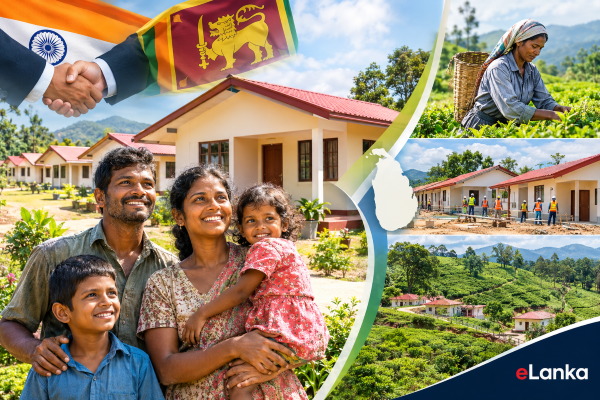
In a notable gesture of regional goodwill in recent decades, the Government of India financed and built over 60,000 modern homes for Sri Lanka’s estate Tamil community.
This initiative was undertaken without fanfare, political spectacle, or ostentatious diplomacy. Instead, it embodied dignity—manifested through bricks, roofs, and keys.
These residences transcend mere physical structures; they represent:
- The restoration of human dignity for a community that has long been deprived of it
- An acknowledgement of the shared heritage between India and the hill-country Tamils
- A stabilising element for Sri Lanka’s tea industry
- A demonstration that development can be compassionate rather than merely transactional
For families who have lived for generations in single-room dwellings, a proper home represents more than shelter; it embodies identity, a sense of belonging, and is the primary substantive inheritance they can pass on to their children.
A more promising future for the hands that shaped our national brand.
Sri Lanka’s tea pluckers, the women who traverse the slopes at dawn with baskets on their backs and display unparalleled skill with their fingers, have perpetually constituted the foundation of the nation’s most celebrated export.
Nevertheless, they were the last to reap the benefits of this prosperity.
India’s housing initiative seeks to alter this narrative by providing these workers with:
- Adequate living spaces that uphold dignity
- Foundations for education and social mobility
- A profound sense of stability following generations of uncertainty Furthermore, it gives Sri Lanka a commensurately important opportunity: the prospect of addressing a historical injustice that has persisted over time.
Gratitude that transcends politics
In a region often marked by geopolitical rivalry, this gesture stands out for its humanitarian significance. Sri Lanka is indebted to India with a heartfelt expression of gratitude — not merely as an act of diplomatic courtesy, but driven by moral conviction. For the first time in over a century, tens of thousands of estate families can articulate a sentiment their ancestors never could: “We have a home.”
The final word
This is not merely a housing project; it subtly redefines history.
It bridges nations founded on compassion rather than strategic interests.
Furthermore, it reminds us that development is most meaningful when it elevates those who have silently borne the nation’s burdens.
At eLanka, we respect the rights of creators. If we have used an image you own and you’d like it removed, please email us at info@elanka.com.au and we’ll handle it promptly.
Thanks.
eLanka team
eLanka Disclaimer
Content published on eLanka may be created by the eLanka team, submitted by contributors or third parties, reproduced or adapted from other sources with appropriate source acknowledgement, or provided as promotional/advertising material by our clients. While eLanka takes reasonable care in preparing and publishing content, we do not warrant its completeness or accuracy. Views expressed are those of the respective authors or contributors and do not necessarily represent the views of eLanka. Third-party contributors, content providers and advertisers are responsible for the accuracy of material they supply and for ensuring they hold the necessary rights and permissions for its publication. Advertising and promotional content should not be regarded as an endorsement by eLanka of any product, service or claim.