



Agnii Opens on Chapel Street: Gayan Pieris Brings a Flame-Throwing Sri Lankan Hearth to Melbourne

AI-generated illustration. The authentic photographs of Agnii by Simon Schluter for The Age could not be reproduced.
On 24 October 2026, chef Gayan Pieris opened Agnii, his second restaurant, at 105 Chapel Street in Windsor, bringing a fire-centred interpretation of Sri Lankan cooking to one of Melbourne’s best-known dining strips. The 160-seat restaurant, 18 months in the making, builds on Pieris’s work at hatted Many Little in Red Hill, while setting out to broaden perceptions of Sri Lankan food in Australia.
The opening has already featured in eLanka’s earlier coverage of Agnii. This longer account draws on the richer opening-day detail reported by The Age Good Food, examining the restaurant’s hearth, dishes, drinks and family connections.
Pieris has spoken about the assumptions that have shaped how Sri Lankan food is sometimes viewed in Australia: ‘The issue is that not too long ago most [Sri Lankan] restaurants here were buffets, and it was branded as a “cheaper” option’. His stated ambition for Agnii is to change perceptions ‘by introducing more technique and setting [Agnii] up as a new benchmark’.
That ambition is expressed through both the cooking and the restaurant’s defining piece of kitchen equipment: a large, open hearth built around a traditional Sri Lankan cooking form.
A hearth shaped by memory
Agnii means “fire” in Sanskrit, and the restaurant places woodfire cooking at the centre of its identity. Pieris has observed that woodfire cooking has become trendy, but that he has not really seen much of it in Sri Lankan restaurants. At Agnii, the open hearth, known as a dara lipa, is not simply a contemporary feature; it connects the menu to a domestic cooking tradition and to Pieris’s own family history.
The hearth was built by Samuel Fraraccio, also known as The Brick Chef, who won this year’s Good Food Guide Trailblazer award. It is flanked by racks for hanging, drying and smoking fish, as well as kilns for claypots. The arrangement gives the kitchen a visible, working focal point, with the equipment contributing directly to the restaurant’s cooking rather than serving only as decoration.
Pieris grew up in a farming family in central Sri Lanka, where his parents were rice growers. Reflecting on the hearth, he told The Age: ‘It’s still insane when I see it: my replication of my mum’s kitchen.’ The comment links Agnii’s modern Melbourne setting with a remembered family kitchen, where cooking methods and daily life were closely bound together.

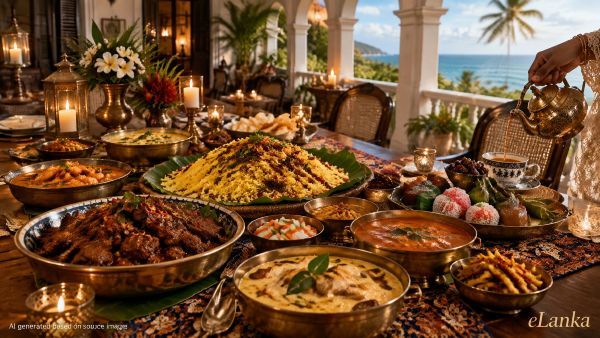
AI-generated illustration of Sri Lankan food and dining details; it does not depict Agnii’s actual dishes.
A meal with regional variety and table-side theatre
One of the restaurant’s signature experiences is bath mula, a banana-leaf-wrapped parcel of curry and rice that recalls the lunch Pieris took to school as a child. At Agnii, the parcel is heated over wood until steamy, then unwrapped at the table. Its contents include several components, among them a meaty curry, thick dahl, vegetable sides and a sweet-and-sour pickle.
A curry trolley adds another element of movement and choice to the meal. It carries regional specialities and may include a goat curry from Jaffna in the north. Rather than presenting Sri Lankan cooking as a single, uniform style, these details point towards the range of regional traditions that can shape a menu.
The kitchen also has dedicated stations for hoppers, dosa and kottu, the chopped-roti dish. Diners can choose the chef’s menu or order à la carte, with sections organised around snack-sized small bites, “entree-ish” short eats and larger share plates.
The dishes described in The Age’s opening report illustrate the breadth of techniques in play. Puttu, steamed cylinders of rice flour and coconut, is served with carrot and coriander. For another small bite, the flesh from cured kingfish heads is picked out and mixed with smoked eel to make a mousse, which is piped into a flower-shaped kokis cracker.
Pieris’s “patties” bring together several stages of preparation: succulent lamb cutlets seasoned with 16 spices are fried, wrapped in pastry brushed with curry-leaf oil, and cooked on the hearth. These are examples of the menu’s use of fire, spice and careful preparation, reported by The Age rather than a review of the food.
An abridged supper menu runs from 10pm to midnight on Fridays and Saturdays, offering a later option alongside the restaurant’s standard lunch and dinner services.
Drinks and a distinctly Sri Lankan character
The drinks list draws on ingredients and flavours associated with Sri Lanka. Cocktails feature arrack, a spirit made from the fermented sap of coconut palm flowers. The negroni is soured with goraka, a tamarind-like fruit used in Sri Lankan cooking.
These choices extend the restaurant’s wider approach: familiar formats are given a Sri Lankan point of reference through ingredients and flavour pairings, while the cooking and service retain connections to regional food traditions.

AI-generated illustration inspired by Sri Lankan short eats and drinks; it is not a photograph of Agnii’s menu.
A new Windsor setting
Agnii occupies a first-floor space that previously housed Hoo Haa Bar. The restaurant’s earthy tones and wooden features create a markedly different atmosphere from its predecessor. A private dining room seats up to 40 people, while a terrace is being transformed into what Pieris describes as a “tropical spice garden”.
The setting is designed to bring together several parts of the restaurant’s identity: the open hearth, the dining room, the food and drink, and a sense of hospitality rooted in Pieris’s experience of Sri Lankan cooking. In a city where food culture is shaped by communities from many backgrounds, an ambitious Sri Lankan restaurant on Chapel Street also gives local diners another opportunity to encounter the cuisine in a varied, contemporary setting.
For Sri Lankan readers in Australia, Agnii’s opening is a point of community interest as well as a new restaurant launch. It places a chef’s interpretation of Sri Lankan food in a prominent Melbourne location, while explicitly challenging the idea that the cuisine should be understood only through a buffet format. Its use of regional references, specialised stations and a traditional hearth gives that ambition a tangible form.
Visiting Agnii
Agnii is at 105 Chapel Street, Windsor. The reported trading hours are lunch from Friday to Sunday and dinner from Tuesday to Sunday. An abridged supper menu is available from 10pm to midnight on Fridays and Saturdays.
For current details and reservations, visit Agnii’s official website or use its reservation page. As with any newly opened venue, readers should check the restaurant’s website for the latest service information before visiting.
The restaurant’s opening brings a family memory of cooking over fire into a contemporary Melbourne dining room. In Agnii, the dara lipa is both a practical centre of the kitchen and a link between Pieris’s Sri Lankan heritage and his work in Australia: a fitting foundation for a restaurant seeking to present Sri Lankan food with technique, regional depth and confidence.
Source: https://www.theage.com.au/goodfood/melbourne-eating-out/agnii-sri-lankan-restaurant-now-open-20261024-p61769.html
This article was written based on the source https://www.theage.com.au/goodfood/melbourne-eating-out/agnii-sri-lankan-restaurant-now-open-20261024-p61769.html, kindly email us at info@eLanka.com.au if any information needs to be corrected.
At eLanka, we respect the rights of creators. If we have used an image you own and you’d like it removed, please email us at info@elanka.com.au and we’ll handle it promptly.
Thanks.
eLanka team
eLanka Disclaimer
Content published on eLanka may be created by the eLanka team, submitted by contributors or third parties, reproduced or adapted from other sources with appropriate source acknowledgement, or provided as promotional/advertising material by our clients. While eLanka takes reasonable care in preparing and publishing content, we do not warrant its completeness or accuracy. Views expressed are those of the respective authors or contributors and do not necessarily represent the views of eLanka. Third-party contributors, content providers and advertisers are responsible for the accuracy of material they supply and for ensuring they hold the necessary rights and permissions for its publication. Advertising and promotional content should not be regarded as an endorsement by eLanka of any product, service or claim.