



Anuradhapura : The City of Anuradha (Part III) – By Ama H. Vanniarachchy

Source :ceylontoday.lk
The Mahavamsa and other chronicles further say that King Pandukabhaya (437 – 367 BCE) built an Adhara Geya (possibly an almshouse or a rest hall) to the Brahmins and a Sivi Geya (a maternity house?) and a Gilan Hala (hospital) or an Ashirvada Shalawa (possibly a house for those who were healing or recovering from illnesses).
The king also allocated space for a centre for the Yonakas or the Greeks in Anuradhapura. By this time Greece was a powerful as well as a great civilisation that had spread almost all across ancient Europe as well as central Asia, and was spreading its political and cultural authority towards Northwest parts of India and the Hindu-Kush region. Hence, building a centre for the Greeks in Anuradhapura in the 5 – 4 century BCE reveals the importance of the city in the international arena. Perhaps this must have been for Greek diplomats and Greek traders.
The antiquity of Anuradhapura via archaeological data
So far we have presented to you the earliest written records about the earliest history of Anuradhapura. Now let us have a look at the archaeological evidence about the earliest history of Anuradhapura.
These archaeological data further strengthen and confirm the data recorded in ancient Pali and Sinhala chronicles in Sri Lanka, and add further information to the history recorded in the chronicles. These archaeological data coincide with the narrations in the Pali and Sinhala chronicles about the Indo-Aryan migrations.
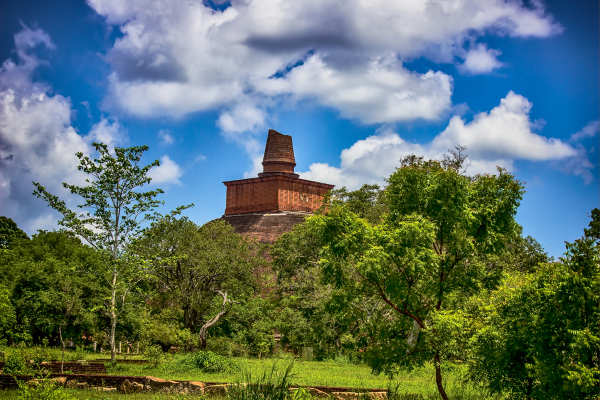
In the year 1969, the former Archaeology Director General Dr. Siran Deraniyagala excavated the area where the ancient Gedige ruins are located in the Citadel area of Anuradhapura, along with a few more sites in the Citadel or Inner City area of the ancient Capital city of Anuradhapura. These remarkable excavation findings revealed remains of an early historic Iron Age culture of Sri Lanka that slightly dates about two centuries beyond the known and accepted dates of the beginning of civilisation in Sri Lanka as narrated in the chronicles. These excavations also expanded the history of Anuradhapura approximately by two centuries to the time beyond the first historical Anuradha that we know as the founder of Anuradhapura.
Earliest known Anuradhapura (900 – 600 BCE)
Evidence of early urbanisation in Sri Lanka, cantering on Anuradhapura was discovered through this ground-breaking research by Dr. Deraniyagala. People who were engaged in agriculture such as paddy (rice) cultivation lived in Anuradhapura during the time around 600 – 900 BCE. The earliest dates given to an early urban civilisation in Anuradhapura are 900 – 600 BCE.
The research found evidence of early-urban settlers who were making pottery, knew the technology of iron production, used iron tools and equipment, used domesticated horses and cows, and were engaged in rice cultivation.
By 800 BCE the settlement in the citadel area was more than 10 hectares and around 700 – 600 BCE this settlement grew up to around 50 hectares.
By this time the pre-historic stone tool usage was almost over and it was replaced by the use of iron tools and equipment. Copper alloy tools/making of pottery using the potter’s wheel – especially black and red ware (BRW) – were practiced by the settlers in Anuradhapura during this time.
Glass beads, agate beads, carnelian beads, and lapis lazuli beads were found during the archaeological excavations. Most of these beads are not locally produced but imported from Northern India.
What could be the reasons for the expansion and advancement of the settlement in Anuradhapura and the notable sudden urbanisation of the Anuradhapura civilisation by the time of 900 – 800 BCE? The knowledge of iron technology and the production of iron tools made it easier to take control over nature, such as controlling the flows of rivers, building dams and water tanks, ploughing the soil, building water channels, clearing forest lands for agriculture as well as expanding human settlements.
The technology and tools needed for mining must have been produced through this advanced knowledge. More successful fishing methods and using marine resources successfully due to the use of advanced iron equipment contributed to the financial growth of these early urban civilisations. The use of iron and iron tools enhanced and advanced the process of plant and animal domestication which resulted in more advanced and productive agriculture, animal farming, fishing, and trade.
The advancement of language (writing) and mathematics also must have contributed greatly to the development of trade and financial matters.
Also, the location of the island was a great resource for a flourishing trade as Sri Lanka was located at a significant point on the land and maritime Silk Road. The fertile land of the Northern plain of Sri Lanka, and the city of Anuradhapura attracted more and more migrants/ and traders who expanded the civilisation further.
By 700 – 500 BCE Anuradhapura was a city that expanded over 50 hectares. Due to these above-explained reasons, by this time there was a great renaissance happening in Anuradhapura, in its cultural, social, and technological aspects.
Arrival of Vijaya and settlement of Anuradha in Anuradhapura
By 600 – 500 BCE, evidence of the earliest writing in Sri Lanka is found through these archaeological excavations. Pottery fragments found in the Citadel have letters inscribed on them. These were subjected to Thermo luminescence dating. Biya Anuradha was written on one piece of pottery in Indo-Aryan Prakrit letters. This proves that letters were introduced to Sri Lanka about two centuries before the arrival of Arhat Mahinda. These letters inscribed pottery fragments were dated as belonging to the lifetime of the Buddha. These dates slightly coincide with the time of the arrival of Prince Vijaya (Sinhala) in Sri Lanka. According to the chronicles, Vijaya landed in Thambapanni on the day of Parinibbana of the Buddha.
The Anuradha mentioned in this pottery fragment could have been one of the two Anuradhas mentioned in the chronicles; most probably Anuradha the minister of Vijaya. Or he could have been a third historical Anuradha that is not mentioned in the chronicles. However, through this discovery, we know for a fact that there was a historical figure named Anuradha living in the centre of Anuradhapura, and his importance is understood as his name was inscribed in a piece of pottery.
Indo-Aryans populated Sri Lanka and established settlements on riverbanks
Redware pottery, greyware (probably imported from North India), mutisalah (Indo – Pacific beads of orange and orange-red colour), red glass beads (600 – 400 BCE), west Indian carnelian beads, and writing equipment made out of bones were found at the citadel area during these excavations.
Some of these objects are produced in Northern India, Western India, and the Indo-Pacific region. This means they were traded or brought to Sri Lanka by migrants or traders. Such findings coincide with the narrations in chronicles about the arrival of Vijaya from Western or Eastern India and more Indo – Aryan groups from Northern India.
Vijaya’s queen arrived in Sri Lanka from Madhura Pura (Madurai). The father of the king was King Pandu of the Pandya Kingdom. Pandya country was in South India. Along with the Princess Vijayi, 700 royal maidens came to Sri Lanka (then Thambapanni). A large number of artisans and 1000 families that represented 18 crafts were also sent. Some of the findings at Anuradhapura and elsewhere in Sri Lanka (that belong to the pre and proto-historic times of Sri Lanka) are similar to the artefacts that can be seen in pre-historic South India.
These large royal groups surely have brought along tools, equipment, and objects that they need to continue their usual lifestyle. The thousands of artisans came along with them established their crafts and introduced them to the new kingdom they arrived at. Soon, the new technology from North and South India spread on the island, advancing its civilisation and culture.
We know that the princes and ministers who arrived in Sri Lanka (the four main Indo-Aryan migration groups) travelled across the island and established settlements along fertile river banks. These princes and ministers did not travel alone. They surely had artisans, craftsmen, scribblers, priests, scientists, and engineers traveling with them and these skilful people were the masterminds behind establishing these new settlements.
While a cultural, social, and technological renaissance was occurring all across the country by this time (600 – 400 BCE), the centre of this growing civilisation remained to be Anuradhapura. This was the reason why in no time, Anuradhapura became the administrative capital of this growing kingdom.
Archaeology data and literature data coincide…
Those who believe in the Ravana fantasy and those who believe that an advanced civilisation spread all across the globe from Sri Lanka, attempt to twist the archaeological excavation and findings at the citadel by Dr. Deraniyagala, saying that these findings suggest an ultra-urban civilisation existed in Sri Lanka centuries before the arrival of Vijaya (Sinhala) and the Indo-Aryan migrants. However, in contrast, these archaeological data and chronicle narrations as well as our inscriptions coincide with each other. It is clear that migrants and traders from West, East, and North India as well as South India arrived at Sri Lanka during proto-historic and early historic times and established settlements in river banks.
Moreover, these evidence does not suggest an ultra-urban or highly developed civilisation existed in Sri Lanka during these times (900 – 500 BCE), but the dawn of an urban civilisation on the island, that was growing around Anuradhapura and major riverbanks and ports elsewhere in the island.
International trade flourished in ancient Sri Lanka
International trade flourished in Sri Lanka during the early historic times. The Jataka tale Walahassa and the Vijaya-Kuweni tale say that Sri Lankan ports were busy with trade ships. Prof. Senarath Paranavitana suggests that those who first established settlements in Sri Lanka were perhaps rich merchants. Also, as the island of Thambapanni which had exquisite precious and semi-precious stones, spices, ivory, and beautiful pearls, Thambapanni was a favourite trading spot among merchants.
Prof. Paranavitana says that the rumour that this island was inhabited by man-devouring demons, especially by she-demons, dragons, and dangerous monsters, possibly was a story made up by traders who were competing with each other.
He further says that the pioneers in introducing Indo-Aryan civilisation to this island were merchant adventurers, who were most probably attracted to the country’s pearl banks, and gems.
Talking about the many tales about Yakkas or Rakshas living in Sri Lanka during ancient times, Prof. Paranavitana says that these could be tales that were invented by pioneers who desired to keep the valuable merchandise from this island as a monopoly to themselves, by discouraging possible competitors from visiting its shores for fear of these superhuman monsters.
The merchants who arrived in Sri Lanka for their riches established an Indo-Aryan civilisation in this country. They spoke the Aryan dialect. This is proven through inscriptions.
However, Prof. Paranavitana further argues that the Sinhalese must have arrived from the northwest parts of India. He sees a link between these early settlers and Pakistan and Afghanistan. Also, the queen of Sumitta (Vijaya’s brother) was of Panjabi origin and the term ‘Gamini’ or ‘Gamani’ used by Sinhalese is a term used by the people of this region. He believes that these early settlers or the earliest ancestors of the Sinhalese are originally from the Gujarat area, on the banks of the Indus River.
3rd century BCE, Anuradhapura: Devanampiyathissa and Asoka
By the 3rd century BCE (time of King Devanampiyathissa and the Mauryan Emperor Asoka), Anuradhapura was an urban settlement approximately spread across about 100 hectares.
Archaeologists say that by this time Anuradhapura was the 10th largest city in the Indian zone and the largest city south beyond Ujjaini (Udeni) and Sisupalagar cities. Thus, Mauryan Emperor Asoka noticed the importance of this city and the kingdom that Anuradhapura was the capital of, and decided to send Mauryan diplomats to the King of Anuradhapura.
The next significant stage of development of Anuradhapura is during the 3rd century BCE, during the time of King Devanampiyathissa. During his time, the city as well as the Anuradhapura civilisation underwent significant religious, cultural, social, and technological development. To be continued…
At eLanka, we respect the rights of creators. If we have used an image you own and you’d like it removed, please email us at info@elanka.com.au and we’ll handle it promptly.
Thanks.
eLanka team