Authorship of the Umpire Decision Review System (UDRS)A Plea for Reparative Justice: – By Senaka Weeraratna
Source : dailynews
Concerning the injury suffered by Senaka Weeraratna consequent to the denial of a rightful hearing of his claim of invention, copyright and authorship regarding a critical issue in the regulation of the game of Cricket.
http://www.dailynews.lk/2009/10/15/z_p26-theContovacy.jpg
Senaka Weeraratna – an enthusiast since his school days at Royal College, Colombo on matters pertaining to cricket – felt strongly that field decisions by Umpires that are questionable – in some cases outrageously wrong – because they share the heat of the action and are not at their best in quick judgments, and which umpiring errors were vividly displayed to the public on television through video replays should be corrected using the same technology.
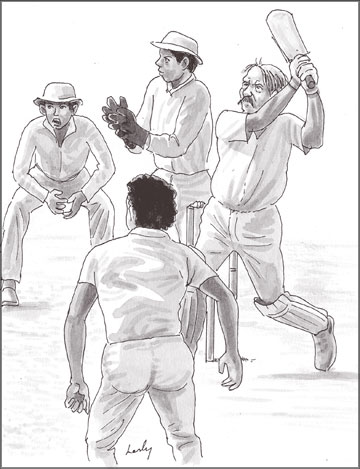 At the same time Weeraratna realized that patently wrong umpiring decisions were allowed to stand because of the absence of a mechanism in the laws of cricket to overturn them.
As a lawyer, he felt the pressing need for a dynamic review by a third umpire in a manner similar to a review of a lower court decision by an appeal court judge, competent in the game with access to new technologies e.g. video replay, but sufficiently separated from the players to make adjudications more evidence-based and thereby less prone to subjective error and ill-judgment.
Weeraratna – actuated by his desire to improve the adjudication of the game – conceived an entirely new innovative idea ‘player referral’ which has never been part of the adjudication system of cricket or for that matter any other sport in the world until Weeraratna brought it to the fore.
Essay
In an essay entitled ‘The umpire’s immunity limits appeal rights and accurate adjudication in cricket’, (published in 1999) he argued vehemently in elegant and moving prose that the approach to adjudication in cricket was outmoded; prevailing rules required a heavy reliance to be placed in the good faith of the umpires so much so that even when an umpire was wrong his decision had to be treated as right; the rule that the umpire’s decision was final had become so entrenched as a dominant paradigm in the philosophy of cricket that any attempt to modify this rule with a view to achieving fairness and accuracy in umpiring decisions, was viewed as heresy; Yet, the considerations of fairness that are paramount to the integrity of a sport, require such an approach to be adopted.
 Weeraratna further argued,
“The availability of modern technology today for review of a decision makes the unqualified adherence to the traditional principle morally unsustainable. To treat a wrong as a right without attempting to use the available resources to correct the wrong, is an unjust proposition. But this is exactly what the current adjudicating rules of cricket deliver”.
He then said that ‘The extraordinary immunity that the rules of cricket have conferred on the umpires is at variance with natural justice rules that underpin many democratic institutions. The right to challenge and have a decision reviewed is a basic rule in a democratic society. Even the judges in courts of law do not have absolute immunity.
Dissatisfied litigants have the right to appeal against the decision of a judge to a higher court or a full bench. The appellate procedure in the legal system is a mechanism that enables a judicial decision to be reviewed and corrected, if it is unsustainable. This appellate method serves as a good precedent for the transplanting of the concept of review to cricket through a paradigm shift in approach to adjudication”
Player Referral
Weeraratna proposed the player referral mechanism as the basis of a paradigm shift in approach to umpire decision making, that he advocated. In other words, the incorporation into cricket rules of ‘the Right of appeal of players against decisions of field umpires’.
He said that ‘Dissatisfied players should have the right of appeal against the decision of a field umpire to the Third Umpire. The Third Umpire’s powers should be extended to enable him to perform an appellate role like an Appeal Court judge, in respect of doubtful catches in front of and behind the wicket including catches by the wicket keeper, run outs and stumping (when appeals for these dismissals are not referred to the Third Umpire by a field umpire).
This proposed two-tier appeal process incorporates the principle of correction that is lacking in the existing system of video arbitration, which is used purely as an aid by the field umpire.
Any objection that a two-tier appeal process would unduly protract or destabilise the game can be met by limiting the number of appeals against the field umpires’ decisions to five per side per each innings. Such a restriction would contain a possible excessive number of appeals by forcing the players to use this right of appeal sparingly”
International publications
Senaka Weeraratna’s writings on this innovative idea were published in the popular press and leading cricket journals meant for aficionados of the game, beginning with the letter to the Editor of the Australian on March 25, 1997. The other publications include;
* Times of London – May 2, 1997;
* Sunday Age Melbourne – April 06, 1997;
* Sunday Times (Sri Lanka) – April 06, 1997;
* Dawn Pakistan – May 09, 1997;
* The International Cricketer (United Kingdom) – May 1997;
* Australian – February 20, 1999;
* Northern Territory News (Darwin) – March 01, 1999;
* Daily News (Sri Lanka) – March 02, 1999;
* Sunday Island (Sri Lanka) – March 14, 1999;
* Time Magazine – June 07, 1999.
http://en.wikipedia.org/wiki/Umpire_Decision_Review_System
He was widely acknowledged in the cricketing world as a prime mover in the adoption of this seminal notion of reference to a ‘Third Umpire through Player Referral’.
To Weeraratna’s astonishment and regret, the wealthy and powerful bureaucracy that rules the world of international cricket i.e. International Cricket Council (ICC), convinced of the strength of the idea proposed by Weeraratna adopted the idea in what became universally known as the Umpire Decision Review System (UDRS) or later abbreviated to Decision Review System (DRS) and started using it in Test Cricket from October 2009, and a few years later in International One Day Cricket, but jettisoned the author – for reasons best known to them but baffling to the cricket lovers outside the charmed circle of decision-makers.
Weeraratna protested at this seeming contumacy and executive purblindness on the part of the ICC in ignoring his sincere and disinterested contribution to the improvement of the game. To use a metaphor from the game itself, this stand on the part of the ICC was ‘not cricket’.
ICC Reply
A reply sent to Weeraratna by David Becker, the then Head of Legal of the ICC, dated May 09, 2010, resorted to a species of spurious legalistic logic when honesty and plain speaking was urgently needed.
Becker argued that Weeraratna’s contribution – treated as a species of ‘intellectual property’ – was not rightfully owned by him since it was aired incautiously and promiscuously in interacting with the Press and the General Public. The latter were regarded as ‘vulgar’ outlets for the ‘airing’ of well-formed and innovative proposals. He should have (so argued Becker) ‘registered a relevant patent’ or whispered in the ear of the Rulers of Cricket before addressing the popular (or commonplace) hoi polloi on this sensitive subject.
The absurdity of this position is evident for those even lightly informed of the history of discovery. Nowhere is it said that discoveries must be hidden until the Great Ruler is informed. Modern Pharmaceutical Giants and other Masters of Capitalism resort to this trickery – but they thirst for wealth, not fair play and their game is far more sordid than the cricket currently played. It is a high principle of Natural Justice to share when public beneficence is the goal. Senaka Weeraratna has lived up to this high ideal.
Becker has said – inter alia –
“you chose to publish your idea all over the world in a variety of magazines and newspapers, such that you would be taken to have waived your right to confidentiality of the idea”
This statement is ridiculous as a general proposition. Suppose a person – not a professional in the field – discovers a new way of destroying the breeding sites of mosquitoes in urban dwellings. His attempts to convince the expert establishment fails because he is not regarded as one of them.
Subsequently his ideas win public support and are accepted by the authorities and put into practice. Can it be argued that he has no ‘rights of ownership’ because he had done some public propaganda prior to the dawning of wisdom on the part of the authorities? Has he ‘waived his rights’ as the author of the new idea? Is not the case of Weeraratna an exact parallel even if the fields of applicability are very different?
Consider, next, the following statement of Becker
‘This, in turn, presupposes that the relevant ICC committee members who came up with the idea were even aware of your idea and the details thereof in the first place’.
Furthermore, there is the astonishing statement Becker that (I quote)
“I can assure you that the members thereof did not at any time during their deliberations have any regard to information which came from you”.
That a group of professionals cogitating on cricketing matters did not read the literature devoted to the problem at hand – including that of Weeraratna’s leading articles on the subject that were published in widely-read periodicals – is simply unbelievable. Were they like the proverbial Wise Monkeys who refused to see or hear because their great sagacity made all this unnecessary? Is it not more likely that this is a case of ‘Artful Forgetting’ to dodge a liability that greatly inconveniences the ICC?
The next argument of Becker, is that the ‘ICC brains trust’ that looked into the matter of a proposal of a ‘Third Umpire reviewing decisions on player referral’ had minds (and brains) that were tabula rasa in so far as prior knowledge on this issue was concerned. More specifically, in their session of brain-storming on this issue, they were, willy nilly, unaware of the existence of Senaka Weeraratna and his ilk.
Becker says in his email correspondence addressed to Weeraratna ‘With respect, they (ICC Cricket Committee) were not, and are not, even aware of who you are’.
We must ask, in all honesty if this is believable? Is it not a necessary compulsion in claims of priority or ownership to see if others have anticipated you in that which you claim to be autochthonously yours?
Suppose a stratagem is devised without inputs from external sources – a very strange procedure for an expert body – must not this innovation trigger a search for others who may have had the same idea and this precedence acknowledged?
Senaka Weeraratna’s ideas on ‘Player Referral to the Third Umpire’ issue were widely known because he was a vociferous advocate of such moves long before the ‘savants’ of the ICC met in a virtually hermetically sealed conclave.
Weeraratna’s reply to ICC
In Weeraratna’s reply to the ICC dated March 23, 2011 he reiterated that the idea that the decisions made by an on field umpire shall be subjected to process of reviewing was conceived by him in or around 1997, and the said idea of his had found expression in the UDRS system in the form that:
a) a dis-satisfied player shall have the opportunity to appeal against a decision of an on field umpire;
b) such appeal shall be routed through the captain of the relevant team (when the team is fielding) and through a batsman of the relevant team who has been dismissed by an on-field umpire upholding an appeal by the fielding side for his dismissal
c) such appeal shall be made to the third umpire; and
d) the number of appeals per inning against the decisions of an on field umpire shall be restricted.
He added that the said expression of his idea had been contained in several articles authored by him and published in several newspapers and periodicals having a wide readership internationally.
When regard is had to the Umpire Decision Review System as being currently adopted and used by ICC, Weeraratna said that it was apparent that the same had been developed by substantially taking from the aforesaid – His expression of the idea that the decisions made by an on field umpire shall be subjected to a process of reviewing upon a player referral.
He said that it would not be difficult for him to establish that the members of the relevant ICC Committee who had purportedly come up with the idea of the review system as claimed by David Becker, had access to the writings of Weeraratna, due to the same having been widely publicized much earlier in time as aforesaid.
Under these circumstances, Weeraratna averred that the acts of the ICC constituted a violation of his moral copyright by the ICC failing to attribute the authorship of the Umpire Decision Review System currently being adopted and used by ICC to him and also his economic copyright by publicly adopting and using the same without his license.
ICC fails to identify an author
It must be borne in mind that though the ICC maintains that it was a decision taken by the ICC Cricket Committee in 2006 to allow decisions made by an on field umpire to be subject to a process of reviewing, that led to the launching of the UDRS in November 2009, ICC has not been able to identify a single individual by name within the ranks of the ICC as the true author of the idea or the point of time of conception of the idea. The silence of the ICC on the authorship of the concept underlying the UDRS in terms of identification by name is another tacit admission that there is no such single person within the ICC ranks who can show by evidence of previous publications authorship of the original conception of the idea.
An idea that has brought about such a revolutionary change in the game of cricket has to germinate in the mind of a human being. It cannot just fall from the skies above.
Other sports
Any reference to Tennis or American Football as the source of the idea is an unsustainable argument because Tennis introduced player referral with video replay only in 2006, nine years after Weeraratna had first published his article in the ‘Australian’ in March 1997. In the case of American Football there had been a mechanism called ‘Coach Referral’ but not ‘Player Referral’.
There is a significant philosophical difference underlying coach referral as opposed to player referral. Weeraratna has clearly expounded in his writings at the beginning of his entry into this debate on the barriers that stood in the way of integrating player referral into rules of cricket or mounting any challenge by a player to a decision of a field umpire because of the fear that it would dilute the traditional authority of an on – field umpire.
Intellectual achievement
It would appear that there isn’t a single published article making a case unequivocally in favour of player referral in cricket before the publication of Weeraratna’s letter to the editor of the Australian on March 25, 1997. In the absence of a player referral mechanism in American Football before the aforesaid date March 25, 1997, the question arises whether Senaka Weeraratna was the first in the world to advocate in writing ‘ player referral’ in any field sport?
All available evidence points in that direction. If this can be established by an impartial inquiry at an international level this would be an huge intellectual achievement and honour for Sri Lanka.
Unless Sri Lanka takes pride in the intellectual and innovative achievements of its people the motivation for other Sri Lankans particularly of the younger generation to follow suit will not be there. At the recent Olympics held in London the host nation Britain went out of its way to ensure that those who had brought credit to the country and its good name in any sphere of life was given pride of place. Among those honoured was the inventor of the World Wide Web, Sir Tim Berners – Lee who was part of an amazing presentation made during the opening ceremony of the London 2012 Olympic Games.
Prejudice
We hesitate to say this of the ICC – but it is a brute fact of life that we live in a world where Western Values and Ideas dominate all aspects of modern life – including games such as Cricket. It is a natural corollary of this proud thesis that innovative ideas from the ‘Developing World and people of different skin colour i.e. brown and black’ have a hard struggle to overcome an ingrained Euro – centric prejudice against such contributions. The old fashioned rules of political correctness of a by – gone era of western imperialism and apartheid South Africa appear to continue to prevail in a discriminatory fashion in the corridors of power of the ICC. This is very unfortunate.
Stolen knowledge
In the case of the Ethno-Botanic and Medicinal Knowledge of the natives of North-America, no patents were taken out and the Drug Companies fattened greatly on stolen knowledge. This is, perhaps an historical aberration – but it is good to remember the hegemony of the powerful in dealing with some of the matters mentioned above.
In the context of Senaka Weeraratna and his claim for recognition by the International Cricket Council of a key innovative idea for the improvement of the efficiency and reliability of the Game, what is astonishing is that in this late day and age, the ICC appears to have resorted to a hoary legal stratagem that made billions for the Pharmaceutical Giants and woefully deceived the natives.
Weeraratna’s suggestion was made in conditions and context where ‘rights to the ownership of knowledge’ supposedly had little meaning – just as the lore of Medicine Men in Amazonia.
Native knowledge was damned for being shared. A follow-up logic is that native knowledge when ‘digested’ by experts looses all links to the original and must be treated as a wonderfully new innovation. Weeraratna is surely a victim of this deductive alchemy.
Reparative Justice
As a fellow Sri Lankan and ardent follower of the game of Cricket, I would like to urge the use of principles of Reparative Justice as a basis of resolution of this dispute. Unlike in conventional ‘inquiries’ of a quasi-judicial nature, it may not be advisable to proceed in the direction of identifying parties as offenders and victims in a situation that may cause breach of social harmony between free-ranging groups.
However, justice must be done. We call for reperative justice from the ICC that will bring about recognition of the moral copyright of Senaka Weeraratna as the true author of the key elements of the UDRS and appropriate economic redress for use of his brain child in the world of ICC administered cricket.