Education Ministry’s restructuring impact closure of one-third of public schools-By Arundathie Abeysinghe

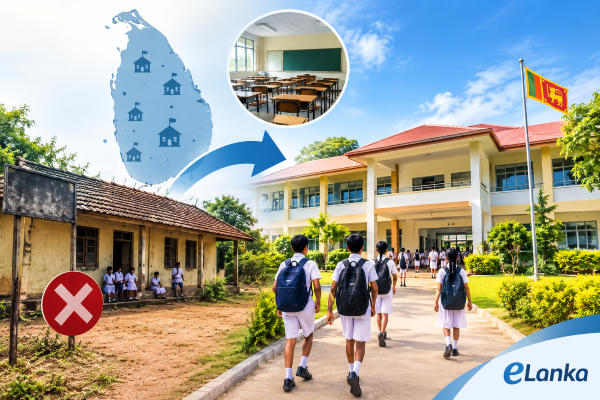
According to senior officials of the Education Ministry, one-third of public schools are facing closure or merger as the Ministry has commenced a school restructuring programme with a pilot project underway in two districts to test its feasibility. Statistics indicate that there are 3,144 schools with fewer than 100 students, which is approximately one-third of all government schools. Final decisions regarding these mergers will be implemented by the relevant District Coordinating Committees.
Initially, 170 selected schools are set for restructuring, while some schools are to be merged. This is part of a wider effort to improve the education system and create a more student-friendly learning environment and all facilities in the selected schools will be upgraded under this plan.
Senior Education Ministry officials informed that “currently, around 11,100 schools are managed by the Central Government and Provincial Councils. Out of these, more than 5,000 schools have fewer than 200 students. The reorganization aims to better use resources and improve learning conditions for school children island wide.”
“The project will assess the number of students in schools, teachers, infrastructure facilities, including scarcities in facilities in selected schools. During the second stage, all 10,000 schools in the country will be assessed which will also result in the closure of certain schools. Student population in these schools will be assessed and where there are fewer students, some from smaller schools will be moved into them.”
“Certain schools will also be upgraded for higher grades with teachers and other facilities provided on an equitable basis. Previously, the government announced plans to amalgamate schools with less than 100 students within a three-kilometer radius into one. According to statistics, in 2023, there were 98 schools with no new admissions. 115 schools had fewer than 10 students, 406 schools had fewer than 20 students, while 752 schools had fewer than 30 students. There were also 1,141 schools with fewer than 40 students and 1,506 schools with fewer than 50 students. Approximately 15 percent of the entire school system falls into these categories.”
According to senior academics Mayantha Kariyawasam and Ruwan Ekanayaka “education reforms must aim to overhaul socioeconomic structure as it is a widely accepted fact that the education system in Sri Lanka must be transformed in its structure as well as content. There seems to be insufficient public discourse on the proposed education reforms, except for politically motivated or self-centered criticisms by political parties and trade unions. Students, who are the target group of these reforms and their parents are in the dark. Hence, any set of reforms should be a part of a long-term overhaul of the system which would, in turn, impact the economy and the social fabric of the country, while also enhancing social harmony through an awareness and devotion to embrace diversity as well as inclusivity.”
“The primary issue in Sri Lanka’s education system is the vast gap in the sharing of resources between urban and rural schools. For example, water supply in Sri Lankan schools varies, with 76% having access to safe drinking water, often from wells or piped sources, while 16% have no water facilities at all, and 8% lack safe access. Around 500 schools across the country lack access to potable water. The gap between related sanitary facilities in schools is a broader issue, which has prevented tens of thousands of students from schooling. Students in some areas have to trek on foot several kilometers to reach their schools due to lack of transport facilities which has resulted in majority of students dropping out from school.”