I’m curious what were the reasons behind the Burghers leaving the country in the 1980s and before? Understanding their story can offer us some insightful perspectives-by Dr Harold Gunatillake

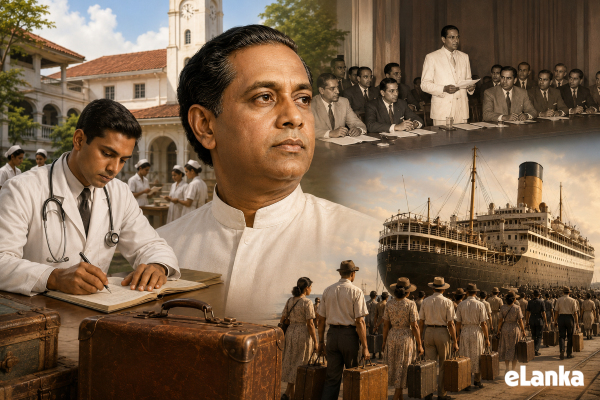
Thinking back to my early days as a young doctor at Colombo General Hospital, I can vividly remember the series of events that
led the lively and dedicated Burghers to leave Sri Lanka in large numbers.
Bandaranaike was a founding member and a key leader of the UNP when it was formed in 1946. He proudly served as the Minister of Health and Local Government in Sri Lanka’s first post-independence cabinet. However, as their visions began to diverge, he decided to resign from the UNP and join the Opposition in July 1951, marking a new chapter in his journey.
The SLFP was founded in 1951, an important milestone that holds a special place in our country’s political history. It’s a meaningful part of our story, shaping many moments over the years, whether for better or for worse.
Right after leaving the UNP, Bandaranaike excitedly founded the Sri Lanka Freedom Party (SLFP) on September 2, 1951. The SLFP was established as a welcoming centre-left, nationalist option, offering a warm alternative to the centre-right UNP.
Establishing the MEP Alliance in 1956 marked a significant step forward, bringing together nations with shared goals and laying the foundation for cooperation that would endure for years to come.
The Mahajana Eksath Peramuna (MEP), led by S.W.R.D. Bandaranaike and also known as the People’s United Front, was more than just a single political party he founded in 1950.
Over time, it grew into a broad coalition he brought together in 1956. He skilfully united the SLFP with various Marxist and socialist groups, enabling them to collaborate during the 1956 general election. The Buddhist clergy enthusiastically participated in campaigning for the MEP, eager to gain favours from Mr Bandaranaike.
Teachers also played a vital role in the party’s success. This collective effort led to a remarkable victory, and Bandaranaike joyfully assumed the position of Prime Minister of Ceylon in April 1956.
The ruling United National Party (UNP) actually secured 8 seats during that landslide defeat.
The 1956 Ceylonese parliamentary election was indeed a massive political watershed, often described as a “silent revolution” that reshaped the country’s history:
Let’s take a closer look at the 1956 Election Breakdown to understand its significance.
The MEP Coalition: S. W. R. D. Bandaranaike did not contest solely under the SLFP banner; he formed a broader socialist/nationalist alliance called the Mahajana Eksath Peramuna (MEP). The Seat Tally: The MEP alliance swept the election, winning 51 of 95 elected seats.
SLFP’s Dominance: Within that winning MEP alliance, the Sri Lanka Freedom Party (SLFP) was the dominant force, securing 43 of those 51 seats.
The UNP Defeat: The incumbent UNP, led by Sir John Kotelawala, suffered a humiliating downfall, dropping from 54 seats in the previous parliament to just 8.
Why was this such a pivotal moment?
Bandaranaike capitalised heavily on a powerful socio-political wave known as the Pancha Maha Balavegaya (The Five Great Forces): Buddhist clergy, traditional doctors, teachers, farmers, and labourers. By championing Sinhalese nationalism, anti-elitism, and democratic socialism, his victory brought an end to the post-independence monopoly of the Westernised,
The English-speaking elite played a key role in this election, which directly led to significant, and sometimes controversial, policy changes. One notable outcome was the passing of the Sinhala Only Act later that same year.
That was when the Eurasians and Dutch burghers started to feel nervous because of the ‘Sinhala Only’ policy.
What part did the Tamil people from the North play in this 1956 election?
During the 1956 Ceylonese General Election, Tamil political parties enthusiastically participated in voting and campaigning to counter the rising Sinhala nationalism, bringing meaningful change to the power dynamics in Tamil-majority regions. The main factor behind this important shift was the language policy. Both major southern parties—the United National Party (UNP) and S. W.
- D. Bandaranaike’s successful Mahajana Eksath Peramuna (MEP) coalition—moved away from their earlier promises of equal status, now supporting a “Sinhala Only” official language policy.
I believe this marked the start of a difficult period, especially with the subsequent exodus of the burghers.
The Rise of the Federal Party
The Tamil electorate made a clear choice by rejecting the ruling UNP, showing their strong support for Tamil politicians aligned with their interests. This led to a notable shift toward Tamil nationalist parties, including Ilankai Tamil Arasu Kachchi (ITAK / Federal Party), led by S. J. V. Chelvanayakam, who passionately advocated for autonomy and the preservation of their language. They secured 10 seats with 142,758 votes and emerged as the main representatives of Sri Lankan Tamils.
The All Ceylon Tamil Congress (ACTC), led by G. G. Ponnambalam, faced challenges among voters due to its previous collaboration with the UNP government. As a result, the party experienced a loss of trust and was reduced to just 1 seat, a significant setback.
Parliamentary Actions After the Election: Following the elections, the newly elected Tamil members formed a united front against the government’s language legislative plans.
When Prime Minister Bandaranaike introduced the Official Language Act No. 33 of 1956 (the “Sinhala Only” Act) in June 1956, all elected Tamil party MPs voiced their opposition by voting against the bill. They stood alongside Marxist parties like the Lanka Sama Samaja Party (LSSP) and the Communist Party—who were advocating for equal language rights—in their stance, even though the nationalist majority ultimately outvoted them.
The Official Language Act No. 33 of 1956, also known as the Sinhala Only Act, didn’t actually force the Burgher community to leave or deport them. However, the economic and institutional policies it implemented made it very challenging for many of them to continue living in Ceylon.
The law, introduced by Prime Minister S.W.R.D. Bandaranaike, changed the official language in government and public affairs from English to Sinhala. Since the Dutch and Eurasian Burghers relied heavily on English, this shift led many to choose to leave voluntarily.
This observation offers a really interesting glimpse into one of the key contradictions in Sri Lanka’s post-independence history, highlighting how complex and nuanced the journey has been.
When Prime Minister S.W.R.D. Bandaranaike introduced the Official Language Act No. 33 of 1956, commonly known as the Sinhala Only Act, it significantly affected the local education system.
While it greatly changed the landscape, it also helped the elite—wealthy, well-educated Sinhala English-speaking families—maintain their global advantages. This had a lasting impact on the country’s history, enabling children to be sent abroad for education and providing easier access to foreign exchange.
It’s quite understandable to feel puzzled by Mr Bandaranaike’s double standard; it may have been shaped by his personal familiarity with wealthy Sinhala families.
The Core Contradiction (more emphasis):
The Sinhala Only Act had a significant impact by ending English-medium instruction in many state schools and replacing it with local languages (Swabasha). This change made it more challenging for the average Sri Lankan child to access global opportunities and to become fluent in English, profoundly shaping their educational journey.
However, the system left explicit loopholes for the ruling and affluent class:
Privileged Exceptions: Wealthier families—mainly from the elite Sinhalese, Tamil, and Burgher communities—sometimes bypassed local channels by sending their children abroad to the United Kingdom, France, and other Western nations for their higher education.
Foreign Exchange Allocations: Even with strict financial controls in place, the government set aside special foreign exchange allocations specifically for overseas education. This made it possible for the wealthy to easily pay international tuition fees in British Pounds or US Dollars. The Premier’s Own Example:
This double standard in our political history has truly never been seen before.
Bandaranaike’s own family famously exemplifies this paradox. While his policies nationalised or localised education for the public, all three of his children were educated in Europe: Sunethra studied at Oxford, Chandrika Kumaratunga studied at the University of Paris (Sciences Po), and Anura studied at the University of London.
Socioeconomic Legacy: This duality sparked a significant social divide in Sri Lanka. Local, non-elite youth often found themselves limited to Sinhala- or Tamil-medium degrees that didn’t carry international recognition. In contrast, the English-educated elite continued to hold a dominant position in the corporate sector, diplomacy, and top legal fields. Many years later, it was actually his daughter, President Chandrika Kumaratunga, who took steps to bridge this gap by reintroducing English-medium tracks into state schools, aiming to create more opportunities for all.
Public Sector Mandates:
- The Act required public servants to achieve proficiency in Sinhala within a strict timeframe to retain their positions or qualify for
- Loss of Livelihoods: Many Burghers, who often held key senior and administrative positions in government ministries, the
judiciary, banking, and the Ceylon Government Railway, found themselves facing sudden career changes, as they were unable or hesitant to switch to Sinhala. This shift was a significant and challenging transition for many during that time.
- The quick move away from English-medium education made Burgher families feel uncertain about their children’s academic and professional prospects within the
Social and cultural pressures can significantly shape our experiences and perceptions. Understanding these influences can help us navigate challenges more kindly and thoughtfully, fostering a more supportive environment for everyone.
- During British colonial times, the English-educated Burgher minority enjoyed special social and economic privileges that they truly However, the rise of Sinhala-Buddhist nationalism soon challenged and disrupted this privileged status, leading to significant changes almost overnight.
- Faced with a difficult decision, many Burghers faced a dilemma: to fully embrace the local culture by abandoning English as their primary language, or to seek new opportunities Most chose that migration was their best option.
During the 1970s and 1980s, many Eurasian families chose to start new chapters in places such as Australia, Canada, and the UK as part of a significant migration known as the Burgher exodus. Their departure signalled the closing of a special chapter for the community, with deep roots dating back to colonial Ceylon.
The Flight to Australia and the West
- The “White Australia” Appeal: The primary destination for the migrating Burghers was At the time, Australia operated under the restrictive White Australia Policy, which favoured European immigrants. Because of their European ancestry (Dutch, Portuguese, British, or German mix), many Burghers successfully met the strict immigration criteria.
- Other Destinations: Large segments also resettled in the United Kingdom, Canada, and New Zealand.
Demographic Impact: The mass emigration deeply changed the country’s makeup. The Burgher community, once a vibrant part of society, saw its numbers shrink dramatically, making up less than 1% of the population by the late 20th century.
While many focus on the Sinhala Only Act’s role in fuelling ethnic tensions and leading to civil war with the Tamil community, it’s also important to remember that the law’s first direct consequence was almost wiping out the Burgher community from the island’s social and political scene.
Planter Community
Eurasian and Burgher planters didn’t start moving abroad until the late 1980s. I clearly remember those days: I was working as a surgeon at Badulla General Hospital in the early 1970s, and the Uva Planters Club was always lively with Burgher and Eurasian planters. Even government workers like us were warmly welcomed there. Those truly were unforgettable times, full of camaraderie and rich history.
Reasons for Planters to emigrate
During the 1970s, Sri Lanka saw a significant change in its plantation sector with the nationalisation efforts led by the United Front government under Prime Minister Sirimavo Bandaranaike.
Their proactive legislative changes brought about a transformative impact on the economic and social fabric of the country’s plantations.
The legislative process unfolded in two key stages led by Hector Kobbekaduwa, the Minister of Agriculture and Lands. The first was the Land Reform Law, No. 1 of 1972, which introduced limits on private land ownership. People could keep up to 50 acres for plantation crops such as tea, rubber, and coconut, and up to 25 acres for paddy fields.
Any land exceeding this limit was vested in the state’s newly created Land Reform Commission (LRC).
Land Reform (Amendment) Law, No. 39 of 1975: This crucial amendment expanded the scope to include the acquisition of all private estates owned by public companies, including sterling companies (British-owned) and rupee companies (locally owned).
Through this amendment, massive, contiguous estate networks were nationalised outright.
Impact on European and Burgher Planters
The nationalisation marked the end of an era for the traditional plantation elite:
Mass Exodus: Before these laws, British/European companies owned roughly two-thirds of the island’s hill-country tea plantations, which were managed by European and elite Dutch Burgher superintendents (known locally as Periya Dorays).
With the state stripping away private ownership, most remaining European companies liquidated their assets and left.
Understanding the Compounding Factors for Burghers can help us better appreciate the challenges they face. By recognising these elements, we can foster a more supportive and empathetic environment for those affected.:
Many Burgher planters, who played important roles managing these estates, often moved to English-speaking countries like Australia. Their migration was encouraged by the Sinhala Only Act of 1956, which made speaking Sinhala a requirement for official jobs. This change made it more challenging for them to find opportunities locally.
When the government took over the lands, they transferred ownership to state-run groups and cooperatives, mainly the Janatha Estates Development Board (JEDB) and the Sri Lanka State Plantations Corporation (SLSPC). This marked the end of centuries of private estate management, a system similar to that of colonial times.
Great loss
The Burgher community served as a key socioeconomic pillar in Ceylon before and after independence. Their large-scale emigration later on led to a notable talent gap, which deeply affected the country’s growth in both institutions and culture.
“Poignant & Reflective”
The departure of the Burgher community represented a subtle but profound loss for our nation. As they exited the shores of Ceylon, they carried with them a distinctive element of our cultural fabric, thereby rendering both historical and contemporary Sri Lanka notably diminished in their absence.
“Tribute & Appreciation”
From governance to the arts, the Burgher community truly makes a significant impact in shaping modern Sri Lanka. The brain drain during the transition from Ceylon to Sri Lanka took away some of our nation’s brightest minds— a loss that we still feel deeply today.
The Burghers played a vital role in the story of Ceylon, and their widespread migration is truly one of Sri Lanka’s most heartfelt losses.
Sri Lanka has undergone substantial transformations after the departure of the Burgher community, signifying a new chapter in its historical narrative.