Iran’s High-Risk Uranium Strategy Deepens Global Tensions-by Harold Gunatillake

Overview:
Iran is engaging in a perilous strategy. It has declined to supply uranium to the United States. President Trump stated that sanctions will persist and that the blockade remains in effect.
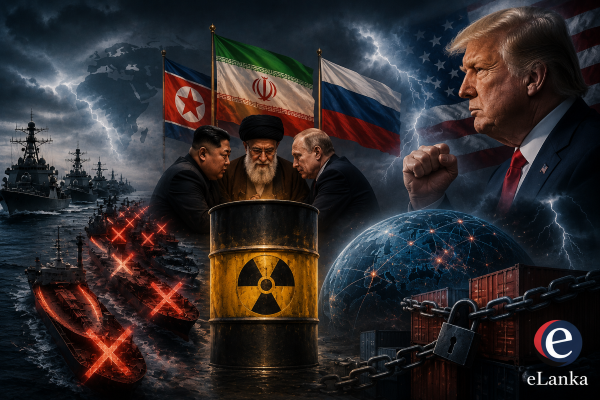
Additionally, Iran is transferring uranium to Russia. North Korea, Russia, and Iran are collaborating. Trump reiterated that the sanctions remain in effect, and reports indicate that his administration redirected 89 ships. These actions are perceived as a conspiracy against the United States. Trump issued warnings to North Korea and Russia regarding their involvement with Iran’s uranium. He emphasised that it constitutes a plot and expressed his displeasure. Iran’s conduct is considered highly risky and provocative.
A volatile standoff with extensive implications for Sri Lankans worldwide.
Iran has undertaken a hazardous geopolitical endeavour by refusing to relinquish its stockpile of enriched uranium to the United States — a decision that has heightened tensions within an already unstable Middle Eastern region. President Donald Trump has reiterated that sanctions will be maintained in full and that the structure of the U.S. blockade remains unchanged.
Concurrently, reports of uranium transfers to Russia and increasing cooperation among Iran, Russia, and North Korea have elicited concerns in Washington.
For Sri Lankans around the globe — particularly those reliant on employment in the Middle East, global fuel prices, and maritime trade routes — this escalating conflict presents considerable economic and security challenges.
The Uranium Standoff: A Dangerous New Phase
Iran’s Refusal
- The United States has demanded that Iran surrender its highly enriched uranium stockpile in
- Tehran has categorically rejected the request, arguing that its enriched material is sovereign property and
non-negotiable.
The Third-Party Custody Proposal
- Under mounting pressure, a compromise proposal emerged: Iran could transfer its uranium to Russia or China for “external ”
- President Trump rejected this outright, warning that such an arrangement would strengthen a growing axis involving Russia, China, North Korea, and Iran.
U.S. Red Lines
- Trump has insisted that Iran’s “nuclear dust” must either be:
o Transferred directly to the United States, or
- Destroyed entirely on Iranian soil under strict supervision.
- Any alternative, he warned, would be treated as a hostile
This hardening of positions has pushed the crisis into a more unpredictable phase, with both sides signalling that they will not back down.
The Naval Blockade and the Redirected Ships
Maritime Pressure Campaign
- B7 CENTCOM reports that S. naval forces have intercepted or redirected at least 89 commercial vessels — later rising above 100
— effectively choking Iran’s maritime trade.
This redirection has been interpreted by some analysts as part of a broader U.S. effort to isolate Iran. An economy can disrupt its strategic partnerships.
Partial De-escalation
Following a tentative 14-point memorandum of understanding, Trump announced the lifting of the formal blockade of the Strait of Hormuz.
However, U.S. naval assets remain heavily deployed, ready to reinstate the blockade instantly if Iran violates the agreement.
For Sri Lanka — a nation deeply dependent on Gulf shipping lanes for fuel imports — any instability in the Strait of Hormuz threatens higher energy costs, supply disruptions, and inflationary pressure.
Inspections, Denials, and Conflicting Narratives
The diplomatic landscape is currently characterized by conflicting assertions:
- Washington’s Position: President Trump maintains that Iran has consented to enduring, and potentially “infinity-level,” nuclear inspections mandated by the United
- Tehran’s Position: Iranian officials publicly refute any immediate timetable for the reintroduction of IAEA inspectors, particularly in relation to damaged or sensitive
The United States persists in warning that any progression towards weaponization will result in prompt and robust military measures.
The Significance of This to the Global Sri Lankan Community
- Sri Lankans—whether residing in the Middle East, employed within the global shipping industry, or operating enterprises influenced by fuel prices—are directly impacted by this standoff:
- Fluctuations in fuel prices may place strain on household budgets and national reserves.
- The job security of Sri Lankan workers in the Gulf region may be jeopardised by regional instability.
- Disruptions in global shipping could adversely affect trade, remittances, and economic recovery.
- Geopolitical realignments might alter the strategic environment that Sri Lanka must navigate in its foreign policy.
Conclusion
Iran’s refusal to relinquish its uranium reserves, its strengthening alliances with Russia and North Korea, coupled with the United States’ unwavering position, have contributed to an unstable geopolitical landscape. The situation now primarily depends on inspection issues, adherence to agreements, and the risk of miscalculation by either party. For Sri Lankans globally, this is not merely a distant conflict but a developing scenario with tangible economic and strategic implications.
End