Is it possible to attract and retain estate women employees with Empowerment through Socio economic and Technology? By Nisal Rukshan

Modern technology, driven by the rapid rise of Artificial Intelligence (AI), is transforming global industries and reshaping the future of human labor. While experts warn that automated robotics could significantly diminish traditional job opportunities, certain vital global sectors remain deeply dependent on human hands. A prime example is Sri Lanka’s tea plantation sector, celebrated globally for producing high-elevation, premium-quality black teas in the country’s Central Highlands. In this unforgiving terrain—characterized by steep hills, deep slopes, weed-covered ground, and harsh, misty weather—the feasibility of automation is heavily restricted.
Consequently, the industry faces a severe, systemic labor scarcity, particularly in the critical first phase of production: tea plucking. Because the exceptional quality of top-branded teas relies entirely on the precise hand-picking of two leaves and a bud, solving this labor crisis requires looking beyond quick technological fixes. Instead, regional plantation companies must implement long-term strategic moves that directly address deep-rooted socio-economic vulnerabilities, historical social stigmas, and institutional voids by fundamentally empowering the female workforce that sustains the industry
Major reasons behind this are social stigma, challenging weather, domestic financial challenges, male cadre dominance in decision-making, less concern for mental and physical well-being by RPCs, workload stress (norms), and more.
Most RPCs are making strategic moves to address this in one line, but still fail because they lack concern for longer-term plans and un availability of research data.
This article discusses strategic moves that can deliver longer-term results through women’s empowerment as a response to the existing labor shortage in Sri Lanka’s Central Highlands.
A better strategy needs to address historical stigma, socio-economic vulnerabilities, and institutional voids ( a situation where the specialized intermediaries, regulatory systems, and contract-enforcing mechanisms needed to support a functioning market are missing, weak, or underdeveloped).
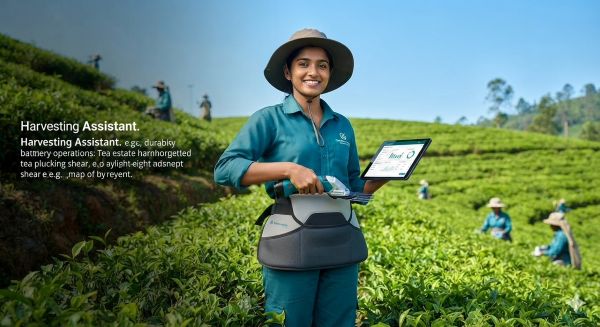
Let’s explore how we can empower female tea estate employees to address labor scarcity. Stopping rural out-migration by professionalizing this job cadre is key. Hence, many younger generations leave the fields because they are categorized as underpaid and of low social status. Therefore, this needs to be addressed through better wages and a professional outlook, with some organizations using the term “harvesting assistants” instead of the Plucker name. Similarly, appropriate uniforms for the terrain and climate can also be motivating factors for future generations to return, followed by better training. But this should be a clear path, including a career ladder, without being a short-term social trap. It must be dignified, inclusive, and offer career growth.
Meanwhile, Plantation patriarchy ( a system of labor control and social organization that combines capitalist economic exploitation with male dominance inside agricultural estates) needs to be changed; hence, a system where women do the most labor-intensive work while the majority of men lead administrative and thalavar roles (union leadership positions). As solutions, organizations can use contract farming and revenue-share models. This helps workers feel ownership and importance (this is already happening on some scales today, but it needs to be strengthened with clear explanations, meetings, and advertising). The creation of leadership opportunities for women in the field is also recognized as the best option; almost Hatton Plantations runs with the concept of harvesting team leaders (young girls from the same harvesting assistant to lead and supervising roles by replacing traditional male kangani)
Mitigation of the double burden also considers their empowerment; hence, early work in domestic tasks like cooking, cleaning, etc and getting to the fields under different climate and geographical conditions, followed by stress norms (20 kg of green leaves to have daily wage, if not half pay ) to be completed to have daily wage, and night shifts at home like cooking, cleaning, washing, etc. Therefore, strengthening child care centers, improving water supplies, and addressing grievances with practical solutions will be highly effective. Meanwhile, it’s essential to provide reliable childcare and education facilities to relieve women from the crushing cycle of the double burden.
Fair and Stable Compensation is another key solution; employees must be educated on this, and businesses cannot be affected by the consequences. Must run with win-win (monthly fix salary based with performances can consider or any recognized transparent mode) .
Similarly, there are now trends of fully women-operated hospitality, manufacturing, etc. Even though men dominate the plantations sector, it can be tried with a pilot program, where empowered and courageous women are employed in a specialty like 100% organic on a small scale to empower others.
On the plus side, most RPCs use technology for plucking with handheld machines (charged devices), simple scissor-type equipment called shears, and digital weighing scales for transparency; these digital techs are now in the fields. But they don’t motivate or present themselves as a reason to retain or attract new generations to the fields. We believe the art of marketing, advertising, introducing, maintaining, and validating can enhance this in both long-term and short-term plans.
Recent examples show that Hatton plantations-built field toilets for female employees, while others invested in hot-water bathing facilities for employees, which is a significant step toward sustainable agriculture.
This is a wide topic, as thousands of factors are interrelated and need to be discussed. But this article focused on needs and possibilities, and how we can think as a nation toward deeper solutions with proper research where to have human-centric investments rather than quick fixes.
Nisal Rukshan, MHRM, PGDip HSC , B.A. (Defence), BSc (Hons.) Counselling Psychology, Dip .THM, DCPsy, DOSH,
At eLanka, we respect the rights of creators. If we have used an image you own and you’d like it removed, please email us at info@elanka.com.au and we’ll handle it promptly.
Thanks.
eLanka team
eLanka Disclaimer
Content published on eLanka may be created by the eLanka team, submitted by contributors or third parties, reproduced or adapted from other sources with appropriate source acknowledgement, or provided as promotional/advertising material by our clients. While eLanka takes reasonable care in preparing and publishing content, we do not warrant its completeness or accuracy. Views expressed are those of the respective authors or contributors and do not necessarily represent the views of eLanka. Third-party contributors, content providers and advertisers are responsible for the accuracy of material they supply and for ensuring they hold the necessary rights and permissions for its publication. Advertising and promotional content should not be regarded as an endorsement by eLanka of any product, service or claim.