Longest irrigation tunnel in South Asia providing new life for the dry zone – By Arundathie Abeysinghe

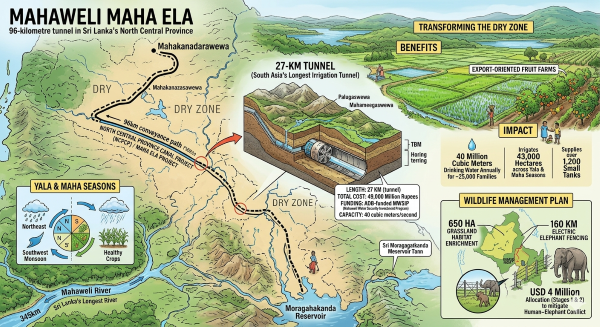
The longest irrigation tunnel in South Asia is nearing completion this month providing new life for the dry zone. Once completed, it will be the longest irrigation tunnel in the South Asian region. Under ADB funding, the total investment amounts to USD 510 million for the Mahaweli Water Security Investment Program (MWSIP), of which 56 percent is allocated for the construction of the 27-kilometre North Central Province Canal Project (NCPCP) tunnel. The 96-kilometer irrigation mega-tunnel in the North Central Province is part of the Maha Ela project designed to transport water from Moragahakanda reservoir to Mahakanadarawewa.
Due to the hilly terrain in Palugaswewa and Mahameegaswewa, a section of the canal is constructed through a tunnel. The construction cost of the tunnel is expected to be approximately 49,000 million rupees.
Meanwhile, under Stages One and Two of the project USD four million has been allocated for the implementation of a wildlife management plan to protect biodiversity to mitigate human–elephant conflict in project-implemented areas. This includes 650 hectares of grassland habitat enrichment and development, as well as the construction of 160 kilometers of electric elephant fencing in the region.
The main objective of the MWSIP is to divert surplus water from *Mahaweli River basin covering a catchment area of 10,256 km², to water-scarce regions in the North Central, Northern and Eastern provinces.
According to Project Director Udaya Ranathunga, “the main features of the North Central Province Canal Project MWSIP include a 96-kilometre canal system with a 28-kilometre tunnel as well as a 30.3-kilometre transfer canal extending from Yakalla to Mahakanadarawa, in addition to the 8.8-kilometre Kaluganga–Moragahakanda transfer canal. The project is expected to provide 40 million cubic meters of drinking water annually to approximately 25,000 families while benefiting seven major reservoirs.”
“Once completed, the tunnel will channel excess water from the Moragahakanda and Kaluganga reservoirs to the dry zone. The tunnel stretches underground from Konduruwawa/Elahera to Mahameegaswewa/Palugaswewa. It is part of a larger 96-kilometer water conveyance mega-project under Mahaweli Consultancy and the NCPCP. This tunnel will carry 40 cubic meters of water per second. Once completed, it will irrigate 43,000 hectares of land across the *Yala and Maha seasons, supplying water to over 1,200 small tanks.”
According to scholars, “once the North Central Province Canal is completed, Sri Lanka will be able to utilise approximately 1,000 MCM of water that currently flows into the sea. The completion of the project will also finalise one of the most complex and essential water resource development initiatives, transforming the Northern dry zone into an export-oriented fruit production region, strengthening rural livelihoods, creating youth employment as well as enhancing climate resilience in the country’s agri-food sector.”
“In 1976, a dramatic transformation was brought about by the Mahaweli diversion significantly altering the biodiversity and surrounding environment of Anuradhapura and the dry Kala Oya basin in North Central Province into a greener urban environment, while the previously water-scarce Rajangana Reservoir became water-rich. Similar transformation can be expected in the beneficiary area of the North Central Province Canal covering approximately 500,000 hectares in one of Sri Lanka’s driest regions. With water diversion to this region, the environment is expected to change significantly, with five major rivers becoming perennial systems. Thereafter, the entire area can be developed as a commercial agricultural zone in Sri Lanka, while also emerging as a tourism hub similar to Habarana tourism development zone in Polonnaruwa, supported by water diversion through the Huruluwewa feeder canal and supply to Minneriya and Kandalama tanks”, scholars emphasized.
- Mahaweli River – Sri Lanka’s longest river spanning 345 kilometers and collecting water from Wet, Intermediate, and Dry Zones, represents a major climate mitigation asset, supported by large storage reservoirs and diversion canals along its course from Horton Plains (Central Province) to its outfall at Trincomalee (Eastern Province).
- Yala and Maha seasons –Two primary monsoon-driven seasons in Sri Lanka. Maha Season is from September/October to March driven by the northeast monsoon, whereas, Yala Season is from April/May to August driven by the southwest monsoon.
At eLanka, we respect the rights of creators. If we have used an image you own and you’d like it removed, please email us at info@elanka.com.au and we’ll handle it promptly.
Thanks.
eLanka team