Ragging rages on: From Centres to Margins-BY Shamala Kumar
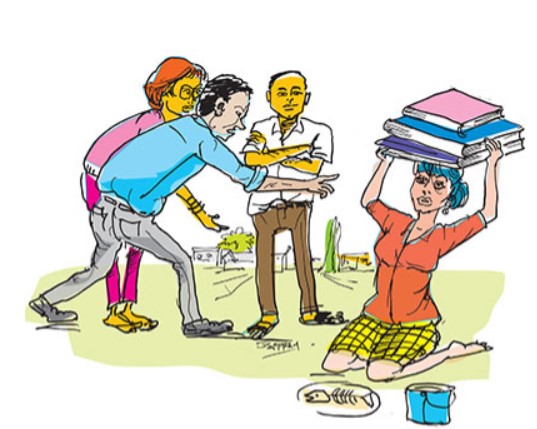
Source:Island
A student, who publicly described the ragging-related sexual violence he experienced, was accused of having ulterior motives for speaking out. A junior staff member, who spoke out about the ragging she witnessed was bullied for doing so, not only by raggers, but also by the staff. A faculty member, who worked hard to stop ragging, was vilified for apparently causing divisions among students. In a survey on ragging, a student commented, “We can finally speak about ragging.” As tempting as it is to identify ragging as the problem, the response to these acts of resistance, even simply speaking about ragging, indicate the complexities of the problem and the difficulties in finding solutions.
Ragging
 Much of ragging is invisible. We may hear of a student who is hospitalized after a tire was rolled over him or another who is paralysed after jumping out of a second storey window to escape rape, and we are shocked. These are, however, the most blatant of acts, and they can be easily condemned. Ragging, however, is not always obviously violent. In fact, many will say their experience of ragging was fun, describing it as ‘harmless’ and simply involving singing or listening to filth. Some who engaged in these outwardly silly acts may even say that ragging brings fond memories. But when students resist, they are dealt with swiftly, ostracised, and abused, both physically and emotionally.
Reinforcing a subculture of violence
Encountering uniformly dressed first-years walking solemnly (laughing is forbidden!) in a line, two-by-two, is so common on campus that they pass almost unseen. Their invisibility is a sign of how entrenched ragging is within the university system. Ragging reinforces the hierarchy of senior students over new students, academic staff and administration over students, men over women, and dominant languages over minority ones, instituting a command and control- structure which establishes who can speak and whose opinions count.
Ragging is built on a culture of misogyny. A past student described how her “mistakes” during ragging resulted in punishments, not to her, but to a male first-year nearby. Women are apparently not even responsible for their actions within this subculture; it is the men around them who ‘own’ and must pay for their misbehaviour. Ragging simply initiates new students to this system of oppression and violence. Yet, this culture remains even after ragging season is over, and the consequences of violating or resisting the system continue throughout the student years, and even beyond.
Academics frequently enforce hierarchies and penalise those who challenge authority. Junior staff are told, even during ‘staff development’, to remain silent in forums, as they may be dismissed as troublemakers or ignored when they speak. Those in the margins are “managed” rather than engaged with in an honest and meaningful way. This toxicity, at its extreme, ends in sexual harassment and bullying. Each of us know of such incidents but rarely discuss them in the open, allowing the ethos cultivated to permeate the university system. It is this pervasiveness that makes much of ragging invisible. And because a similar culture of violence pervades broader society, ragging remains invisible even to those outside the system.
A ragging reinforced social order
If ragging is about creating a hierarchical social order, understanding whom such a system serves is important. True, unions influenced by political party affiliations, use ragging to fulfil their agendas. They co-opt the ragged to their fold. However, vibrant student activism is integral to universities, and unions do bring up important concerns. Yet, their weak position on ragging and complete control over student activism are unacceptable. Placing blame solely on politically-affiliated unions, however, leaves unexplained the persistence of ragging on campuses where such student activism is absent and its presence even in high schools.
New and senior students benefit from the support systems and bonds formed through ragging. Students receive academic support through ‘kuppi’ classes and mentoring relationships. The batch helps out when students encounter personal crises with remarkable efficiency. Students eligible for housing share housing with those ineligible. For some students, these support systems are essential and being subjected to ragging may thus seem desirable.
The compliance cultivated through ragging also helps the university administration ‘handle’ the student body. When non-ragging related problems arise, the administration simply negotiates with student leaders to defuse them. Teachers comfortably teach, unencumbered by critically engaged students. Governments manage and manipulate student activism without much fear of organic student movements forming. Overall, a large swath of entities benefits from the social order that ragging creates.
Ending ragging difficult?
Outsiders regularly express incredulity that ragging persists at universities. Enacted laws, committees and task forces, copious research, and countless newspaper articles have done little to abate it. Why?
Firstly, the scope of ragging is misunderstood. The anti-ragging act of 1998 makes ragging unbailable with mandatory jail sentences. As all forms of ragging may not justify such severe punishments, responsible officers hesitate to implement the Act.
The Act neglects treating ragging as a group process where perpetrators collectively victimise others and are themselves victims. Those caught ragging can generally point to others who coerced them, because senior batches oversee the batch conducting the ragging. Seniors use coercive relationships established during previous years to punish students who do not rag to their liking. Nor does it implicate institutions that tacitly condone ragging. The anti-ragging act is not equipped to address these complexities.
As ragging is symptomatic of a broader culture of violence and misogyny, the violence of ragging is frequently unrecognised. A deafening silence surrounds ragging that allows it to remain hidden. Consequently, discussions among staff are coloured by a false equivalence of “both sides”, raggers and non-raggers, even though violence and coercion should never be acceptable. Ragging investigations are also often tainted by such a mindset. Sometimes a deliberate effort is made to make ragging invisible by the authorities. Complainants and victims are not always supported or protected and are even harassed and accused of tarnishing the image of the institution.
The recent proposal to involve the military in controlling ragging is also ill-conceived. The military promotes their own version of violence, hierarchy, and authoritarianism. In fact, induction into the military involves its own brand of ragging. In universities, such attempts will only result in alternative, even more corrosive problematic social orders, in which we must submit to the whims and fancies of even more powerful forces.
Strengthening education and democracy
Without acknowledging the deeply problematic anti-educational and anti-democratic nature of the ragging culture, we can neither eliminate ragging nor strengthen university education. Ragging must be understood as a manifestation of pervasive, frequently invisible, forces built on an uncritically accepted patriarchal and violent culture that undermines institutional structures and violates the very concept of education.
Confronting ragging requires a radical shift in how the problem is conceived and a firm rejection of the social order and subculture that sustains it. We need an ethos in universities that promotes dialogue, allows students and staff to voice themselves, and expand spaces for collective action in which plurality of perspectives is encouraged. Students and staff should be able to express, including through various art forms, their experience of violence, not just in terms of ragging, but also the myriad forms of violence in the classroom, and that perpetrated by institutional structures and social systems.
Laws and policies designed to address ragging must recognise its group-based nature. While identifying the range of activities that constitute ragging, they must recognize that all acts of ragging are not equal. They must address ragging by tying it to other forms of violence that afflict universities and even the country as a whole.
Importantly, they must not curb student activism, infringe on academic freedom or violate principles of democracy. Such policies should be created through discussion, debate and other democratic processes.
As institutions, we must understand the gap that ragging fills in students’ lives and attempt to address that void. Students are dependent on senior students for a range of services that institutions do not provide. A student who barely understands English is traumatized when confronted with a degree programme delivered in English. Transitioning to university is difficult under any circumstances. Helping students during this period requires well-planned programmes of support and a dedicated and equipped staff.
We must recognize that ragging is deeply entrenched in the university’s social fabric. Such a framing implicates us all: staff, students, administration, and even the general public. It requires a willingness to accept vulnerability. We must recognise that addressing ragging requires tremendous strength, unwavering commitment, and collective effort.
Ragging is a cancer; confronting it will hurt and result in collateral damage, but however painful, it ultimately is a lifegiving activity that targets wellness. Ignoring it, on the other hand, will result in a slow and tortuous death. We must be prepared for the hurt and pain while courageously working towards a ragging-free university system.
Kuppi is a politics and a pedagogy happening on the margins of the lecture hall that parodies, subverts and simultaneously reaffirms social hierarchies.