Rugby Memories – First wins against Trinity and Royal
Source:Thomiana – S.Thomas’ College Old Boys Association Australia Branch Newsletter
- Thomas’ College (STC) and St Joseph’s (SJC) kicked off into schools rugby in 1955, thereby joining Trinity, Royal, St Peters and Zahira, which had been the only schools playing the game in the country. Prior to that year, the football
played at STC was soccer and it was reliably known that the change to rugby was initiated by Old Thomian / Oxonian, Noel Gratien, the eminent Advocate, Attorney General and later Supreme Court Judge.
Although Mr Gratien presumably started playing rugby only after leaving college, he represented CR & FC and subsequently, the Gratien Cup was awarded in his honour for the Colombo Schools vs Outstation Schools annual fixture. He had advised Warden De Saram that playing rugby would improve employment opportunities for Thomians within the plantation, as well as mercantile sectors:
As a brief explanation of the relevant background to those years, at the time Sri Lanka (then Ceylon) gained independence in 1948, most of the planting and senior executive positions in leading mercantile establishments were held by British personnel. After that year, the government began to progressively restrict work visas for ex pats, to pave the way for Ceylonese to be also recruited into those positions. When that policy came into practice, a high proportion of Trinitians were taken into plantations, followed by Royalists and Thomians in smaller numbers. Working on plantations was a much-desired occupation, as, apart from the healthy outdoor lifestyle and opportunities for sport, it provided excellent benefits such as spacious bungalows, as well as domestic and garden staff.
Perhaps based on the adage that the “battle of Waterloo was won on the playing fields of Eton”, the British owners and their agents preferred to engage rugby players to manage their estates: their thinking may have been that the hard knocks and pain absorbed on the field, built the endurance and character needed to work in climatic extremes and handle large, sometimes troublesome work forces.
That first STC XV in 1955 was coached by Mahes Rodrigo, an Old Royalist and probably the country’s best scrum half in his playing era. As very few Thomian players then had much knowledge of the game, the team comprised boys drawn from other sports such as athletics, cricket, hockey, tennis and swimming, but most of them were versatile and outstanding in their respective activities. K.S. Ananthan, a swimmer, was appointed team captain, with cricketer S.B.L. Perera as his deputy. Only two official matches were played that year. One against a strong and experienced Trinity Team, which included players who already were (or were to become) Rugby Lions and the other with St Joseph, when STC registered its first rugby win (5 – 0).
Against Trinity, in a closely contested game where there was no score until the final stages, STC lost 0 – 13. A match report of the game in a daily newspaper was headlined “Trinity win but S. Thomas’ make great debut”. Clearly, a gritty and spirited performance by the newcomers to the game “played in heaven”.
Percy Perera, an Old Peterite, took over as the rugby coach in 1958 and continued until 1964, when he was succeeded by Quentin Israel. His connection with STC was that his two sons, Cecil and Ranjit (Banjo), were students at STC. He was also an experienced referee in the Clifford Cup Tournament and popularly (and no doubt, undeservedly) known as “Penalty Percy”. He was an insurance agent by occupation and also owned a flower shop along Galle Road, opposite the Green Cabin. In those days, coaches volunteered their time and expertise with no thought or expectation of payment, nor were there specialised coaches for different elements of the game. It was simply a single all-purpose coach. Percy used to drive to Mt Lavinia in his black Morris Minor twice a week for rugby training, with diminutive and well- respected Lassie Abeywardena as the master in charge.
The 1960 STC First XV was led by Nihal (Baila) Samarasinghe, and included six public schools’ athletics coloursmen – Nihal Samarasinghe, Maurice Fairweather, Ronnie Asirwatham, Mohan Samarasinghe and Bandula Molligoda were in the backline and, at wing forward, Selva Kanagasabai, who later represented Ceylon as a centre and wing three quarter.
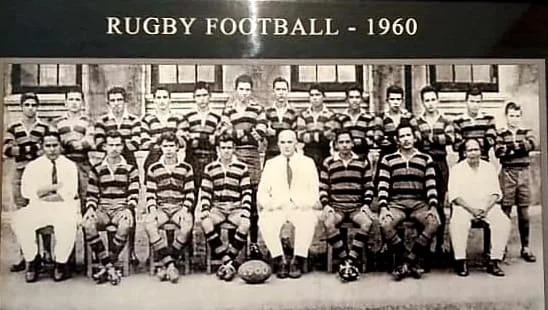
Image Source:Thomianrugby
Captained by Eric Roles, the best lineout specialist in schools, Trinity came down to Longden Place with a formidable side. It was an open, fast- paced game, with both sides well matched in attack, as well as defence. Trinity’s characteristic flowing moves were effectively nipped through fierce tackling by the fast Thomian defence. The game swung both ways and remained scoreless until the final ten minutes, when a misdirected kick towards the touchline by Tony Buultjens was collected by our wing three quarter, Maurice Fairweather, the country’s fastest schoolboy sprinter: He outpaced the defence to score a converted try that gave STC a historic win 5 – 0. However, a double against the top two sides proved elusive, with a disappointing 0 -11 loss to Royal, who had a good game plan and executed it very well.
The following year (1961), STC was led by scrumhalf Tony Sirimanne, with several new players coming into the senior team.
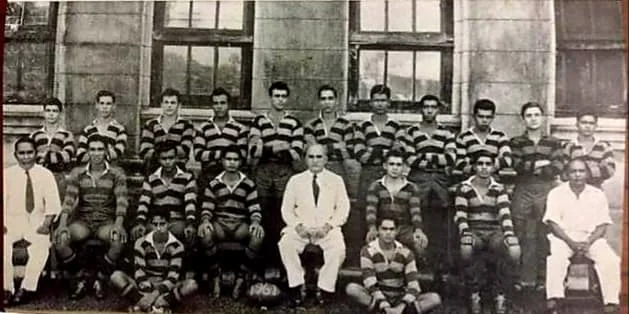
Source:Thomianrugby
The match against Trinity at their home ground in Kandy was convincingly won by us 10 – 6, with STC dominating in all departments of the game. Throughout the season, we had honed our skills and tactics, enabling us to face Royal with confidence a fortnight later. It was therefore no surprise to us, when we outplayed them, with a convincing 8 – 0 win at Longden Place, thereby achieving a creditable double, after only six years of rugby.
Mr Gratien’s ‘judgement’ proved to be “right on the ball” when 12 players from the 1960 and 1961 teams were subsequently selected for careers in plantation management. This trend continued into subsequent years. Incidentally, Dimbula, a leading planters’ team which used to beat some of the strongest Colombo clubs at its elevated home ground, Radella (5000 feet above sea level) had seven Old Thomians in its 1966 side. (The team photo can be seen on this link:
https://www.historyofceylontea.com/media-archive/selva-kanagasabai–198
Also, the following players from the 1955 – 61 era went on to captain leading rugby clubs in the Clifford Cup competition: – Rodney Ingleton: CR & FC: 1961 and 1962; Frankie David: Havelocks: 1966; Selva Kanagasabai: Dimbula: 1966; Tony Sirimanne: CR & FC: 1968. We would like to mention that Larry Schokman, an outstanding athlete who had left STC prior to 1955 and learnt to play rugby only after he started planting, also captained Dimbula, Upcountry and represented the country as a wing three quarter over a long-playing career.
Further, the following players from Percy Perera’s coaching era were later selected for national teams: Rodney Ingleton*, Frankie David, Maurice Fairweather, Maxim Flamer-Caldera, Selva Kanagasabai, Tony Sirimanne and Juni Cader. (*Rodney was from the 1955 team and prior to Percy’s tenure).
The foundations and groundwork laid by Percy Perera, as well as the achievements of the teams mentioned above, generated the interest, impetus and confidence for the groups that followed, to take STC rugby to higher levels and continue to be one of the leading schools in the game. This is the 60th year since that historic win against Trinity and we remember with much affection Percy, Lassie and our former teammates who heard the final whistle several years ago and are no longer with us.
Contributed by two players from the 1960 & 1961 Rugby Teams – Selva Kanagasabai and Bandula Molligoda – August 2020