Sri Lanka Launches First Project in 300MW Solar Power Programme in Veyangoda
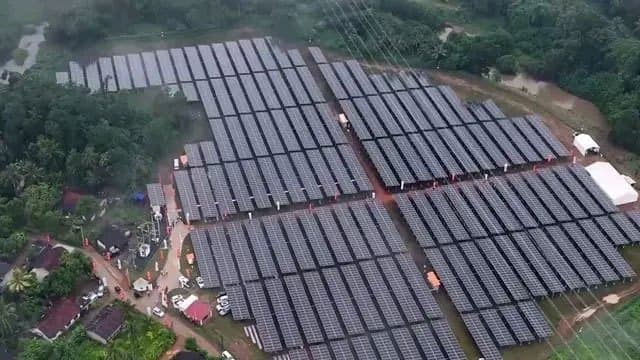
The first 3MW ground-mounted solar project under Sri Lanka’s 300MW national programme has been inaugurated in Veyangoda. Photo credit: Newswire.
Sri Lanka has taken a significant step towards strengthening its renewable energy capacity with the launch of the first project under a national programme designed to add 300 megawatts (MW) of solar power to the electricity grid. The initiative, inaugurated in Veyangoda on Sunday, 13 September 2026, represents an important development in the country’s continuing effort to reduce dependence on imported fossil fuels while improving long-term energy security.
The first project is a 3MW ground-mounted solar facility situated in Veyangoda, and it was inaugurated by Ports, Civil Aviation and Energy Minister Anura Karunathilaka, also known as Anura Karunatilaka. It has been identified as the first in a planned series of solar developments that will be established across Sri Lanka, with the combined capacity of the programme expected to reach 300MW.
The project has been introduced at a time when reliable and affordable energy remains central to Sri Lanka’s economic development. By expanding domestic electricity generation through renewable sources, the programme is expected to assist in reducing the country’s exposure to fluctuations in international fuel prices, lessen the requirement for imported fossil fuels and create a cleaner foundation for future industrial, commercial and household electricity consumption.
Veyangoda facility introduces modern solar technology
The Veyangoda project uses 640-watt bifacial solar panels, a technology designed to produce electricity from sunlight reaching both the front and rear surfaces of each panel. Unlike conventional panels that primarily depend on direct sunlight striking one surface, bifacial modules can also capture reflected and diffused light from the surrounding ground and environment.
This technology is particularly suited to carefully designed ground-mounted installations, where panel height, spacing, surface reflectivity and orientation can be managed to improve energy collection. The use of high-capacity bifacial panels at Veyangoda demonstrates the increasing role of modern engineering in improving the efficiency of renewable energy infrastructure.
According to government estimates, the facility is expected to generate approximately 6.35 million kilowatt-hours of electricity each year for the national grid. This output will contribute to the country’s overall electricity supply while reducing the amount of electricity that would otherwise need to be generated through fossil-fuel-based sources.
The project is also expected to reduce carbon dioxide emissions by approximately 4,340 tonnes annually. Although the facility represents only one part of the wider national programme, its projected environmental benefit illustrates how a sequence of medium-scale renewable energy projects can produce a substantial cumulative impact when developed across several locations.
A broader national programme for clean energy
The Veyangoda installation is not an isolated development. It forms the opening stage of a broader programme under which solar projects with a total capacity of 300MW are planned for different parts of Sri Lanka. The government has indicated that private-sector participation will be encouraged in selected projects, creating opportunities for investment, technical cooperation and the expansion of renewable energy expertise within the country.
Private-sector involvement could be instrumental in accelerating the development of solar infrastructure, particularly where investment, construction capability, equipment supply and operational management are required at scale. A well-organised partnership between public institutions and private companies may also support the creation of specialised employment, local procurement opportunities and new services connected with renewable energy maintenance and technology.
The programme’s geographical spread is expected to be important because a diversified network of solar facilities can support more balanced electricity generation, rather than concentrating renewable capacity in a limited number of locations. The final contribution of each project will depend on its design, connection arrangements, land conditions and access to suitable grid infrastructure; however, the combined 300MW target provides a clear indication of the scale of the country’s renewable energy ambitions.
Supporting Sri Lanka’s renewable energy targets
Sri Lanka has established a target of meeting 70 per cent of its energy requirements from renewable sources by 2030 and achieving carbon neutrality by 2040. These objectives will require sustained investment in solar, wind, hydropower and other appropriate renewable technologies, supported by effective planning, transparent procurement and dependable electricity transmission systems.
Solar power has a particularly important role in this transition because Sri Lanka receives substantial levels of sunlight throughout much of the year, allowing photovoltaic systems to generate electricity without the direct fuel costs associated with thermal power stations. Solar projects can also be developed at different scales, ranging from household rooftop installations to larger ground-mounted facilities connected directly to the national grid.
The expansion of renewable energy, however, requires more than the construction of generating facilities. Electricity networks must also be modernised to accommodate a greater share of variable renewable power. Solar generation changes according to daylight, weather and seasonal conditions, making transmission capacity, grid stability, forecasting and energy management increasingly important.
The government has confirmed that upgrades to the national electricity grid are being carried out to accommodate a greater proportion of renewable energy as new projects are brought online. These improvements are expected to help integrate additional solar capacity while supporting the reliable distribution of electricity to homes, businesses and public institutions.
Energy security and a greener future
The Veyangoda project carries significance beyond its installed capacity. It provides a practical demonstration of how Sri Lanka can move from broad renewable energy targets towards visible infrastructure capable of producing electricity for the national grid. Its expected annual generation and emissions reduction also establish measurable benchmarks against which future projects can be assessed.
The reduction of fossil-fuel dependence is likely to remain a central consideration in Sri Lanka’s energy planning. Imported fuels can place pressure on national finances and expose electricity generation costs to international market conditions. Renewable energy, once the required infrastructure has been established, can provide a more stable domestic source of power, although careful management and continued investment are needed to address intermittency and grid integration.
The 300MW solar programme therefore represents both an environmental measure and an energy security initiative. Its success will depend on the timely completion of projects, the quality of technical standards, the effective participation of the private sector and the continued strengthening of transmission and distribution networks.
For Sri Lankans at home and abroad, the development also offers a positive example of national innovation directed towards a more sustainable future. Renewable energy projects can support cleaner air, lower emissions and greater resilience, while encouraging the development of technical skills and new economic opportunities.
As the first project in the programme begins supplying electricity from Veyangoda, Sri Lanka’s transition towards a greener energy system has acquired a tangible and highly visible foundation. Continued progress across the remaining projects could help transform the country’s electricity mix, strengthen energy independence and bring the national targets for 2030 and 2040 within closer reach.
For continuing updates on Sri Lankan developments and positive stories from the global Sri Lankan community, readers can follow eLanka, Australia’s long-standing online community portal for news, events, business information and community connections.
Source: https://www.newswire.lk/2026/09/14/sri-lanka-launches-first-project-in-300mw-solar-power-programme/
This article was written based on the source https://www.newswire.lk/2026/09/14/sri-lanka-launches-first-project-in-300mw-solar-power-programme/, kindly email us at info@eLanka.com.au if any information needs to be corrected.
(adsbygoogle = window.adsbygoogle || []).push({});
At eLanka, we respect the rights of creators. If we have used an image you own and you’d like it removed, please email us at info@elanka.com.au and we’ll handle it promptly.