


Sri Lanka’s NPP Government at Two Years: Stability Without Social Transformation-by Harold Gunatillake

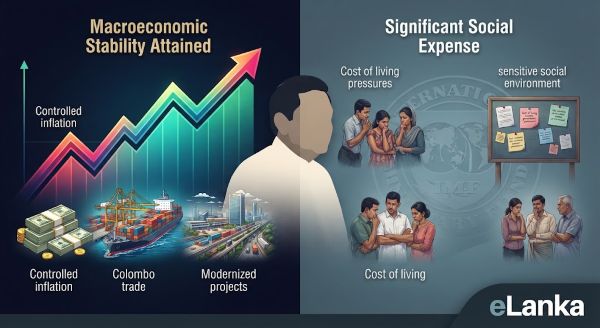
Overview: As President Anura Kumara Dissanayake’s National People’s Power (NPP) government nears its two-year milestone in September 2026, analysts, civil society, and voters characterise its tenure as a guarded success: macroeconomic stability attained
at significant social expense, without the profound structural or social reform initially promised.
Two years after assuming office, Sri Lanka’s National People’s Power (NPP) government offers a revealing example of how post-default states manage the tension between economic stabilisation and social expectations.
Assuming authority amid public dissatisfaction after the 2022 crisis, the NPP committed to effecting “system change.” Nevertheless, what has been accomplished is a disciplined, technocratic administration operating within the rigorous framework of an IMF program and a sensitive social environment.
A Calculated Embrace of IMF Orthodoxy
Despite initial talk of renegotiating the International Monetary Fund’s (IMF) Extended Fund Facility, the New Patriotic Party (NPP) ultimately chose continuity.
This decision helped stabilise the macroeconomic environment: inflation rates declined, foreign reserves improved, and debt restructuring agreements extended repayment deadlines to 2028.
For international analysts, Sri Lanka’s recovery trajectory resembles other post-default recoveries — prioritising fiscal consolidation initially, followed by social investment.
However, the social costs remain pronounced.
Value Added Tax (VAT) and indirect taxes continue to burden low-income households; real wages have stagnated, and poverty remains high.
The government’s efforts to mitigate austerity through targeted relief measures have not sufficiently alleviated the broader pressures on living standards.
Anti-Corruption: A Notable Regional Outlier
The National Peace Council (NPP) has made its most distinctive mark in governance reform. In a region where political privilege is deeply entrenched,
Sri Lanka has undertaken notably bold initiatives:
abolishing pensions for former presidents, eliminating concessionary vehicle permits for Members of Parliament, enhancing anti-corruption institutions, and broadening asset recovery mechanisms.
These measures have earned international commendation and helped restore some public trust. The current challenge is institutionalising these reforms to ensure their sustainability beyond the present administration’s tenure.
A New Development Vision, Slow in Execution
The government’s shift from debt-financed megaprojects to digitalisation and export-oriented industrialisation aligns with contemporary global development paradigms.
A comprehensive digital economy strategy targeting USD 15 billion by 2030, along with expanded e-governance initiatives and enhanced support for the ICT and manufacturing sectors, signals a strategic transformation.
However, foreign investment remains limited, and implementation has progressed more slowly than initially projected.
Democratic Conduct Under Pressure
The NPP has taken symbolic steps toward reconciliation, such as reducing the military presence in the North and reviewing land dispute issues.
However, concerns persist about the authorities’ forceful responses to protests and the slow pace of constitutional reform.
Sri Lanka’s democratic development remains delicate, and the government’s capacity to sustain transparency amid economic challenges will shape global perceptions.
A Government at a Critical Juncture
Sri Lanka currently faces a paradox: macroeconomic stability has returned, yet social relief remains absent.
The NPP has regained international credibility; however, domestic frustration continues to escalate.
For global audiences, Sri Lanka’s experience emphasises a crucial lesson — stabilisation does not equate to transformation.
The next two years will be pivotal in determining whether the NPP serves as a transitional government that averts further collapse or as a reformist administration capable of fostering equitable growth and renewing democratic institutions.
End