


The Middle East on the Brink: A Region Holding Its Breath – By Dodwell Keyt
Dawn breaks over the Persian Gulf, but for the captains of oil tankers anchored in nervous clusters beyond the mouth of the Strait of Hormuz, there is no relief in the light. They wait, engines idling, crews tense, for a radio call from the Islamic Revolutionary Guard Corps. Permission, or denial. Passage, or peril. This is the new reality of 2026.
The Strait of Hormuz, barely 33 kilometres wide at its narrowest point, has long been the jugular vein of the global economy. Through it flows approximately 20% of the world’s oil. Every supertanker bound for Asia, Europe, and the Americas must pass through these waters. There is no bypass. There is only the strait, and today, Iran holds the gate.
Since the outbreak of hostilities between the United States, Israel, and Iran earlier this year, Tehran has moved from threatening to control the waterway to actually doing so. Vessels attempting to transit without explicit IRGC approval have been attacked in at least 20 confirmed incidents since March alone. Some ships have been boarded. Others struck by drone or missile fire. The message from Tehran could not be clearer: you pass when we say you pass.
A ceasefire was brokered in April, and for a brief, breathless moment, the world exhaled. Within 24 hours, US President Donald Trump changed his mind and Iran reversed course. The strait was closed again. Peace talks continue; Trump has described them as progressing rapidly. But for the crews still waiting at anchor beyond the Gulf, diplomacy feels very far away. Insurance premiums for Gulf-bound vessels have skyrocketed. Major shipping firms have rerouted around the Cape of Good Hope at enormous cost. Germany has warned that the crisis exposes just how fragile global supply chains truly are. China, officially condemning the US naval blockade, has nonetheless been observed allowing its tankers to quietly pay toll to the Revolutionary Guard to continue passage.
Beyond the economics lies a deeper and more troubling truth. What the Middle East is showing the world in 2026 is not a new conflict. It is an ancient one, wearing modern clothes. The grievances, the pride, the hunger for control over land, water, and resources stretch back not decades but millennia, to the very cradle of human civilisation that these lands once nurtured. A coalition of 40 nations is working toward a framework for safe navigation. Diplomats are talking. But the region has always moved to its own rhythm, shaped by forces that no summit communiqué has ever fully tamed.
The Strait of Hormuz will eventually reopen. It always has. But when it does, it will do so, as it always has, under the long shadow of a region that the world perpetually underestimates.
***
As Iranian warships patrol the Strait of Hormuz and the world holds its breath, one remarkable work of fiction predicts what’s on its way.
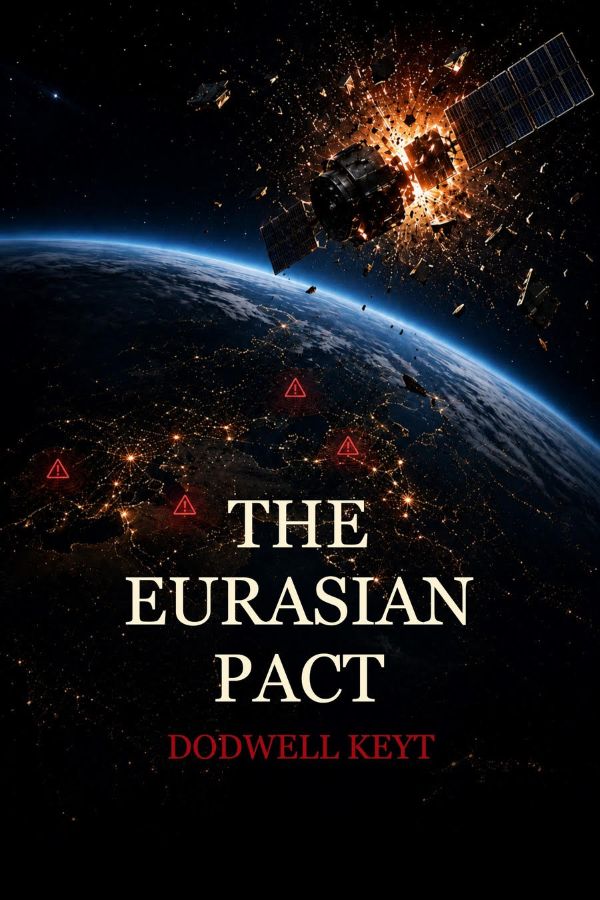
In The Eurasian Pact, four nations quietly assemble an alliance that rewrites the global order before anyone notices it has happened. And coming soon, The Oil Empire, the story of a united Middle East holding the world’s energy supply hostage.
The future already written. The next chapter almost here.
The Eurasian Pact by Dodwell Keyt — available now from Amazon.
The Oil Empire — coming soon.