WILL INDIA’S POPULATION LEVEL UPSET GLOBAL DEMOGRAPHIC BALANCE ? – By N.S.Venkataraman
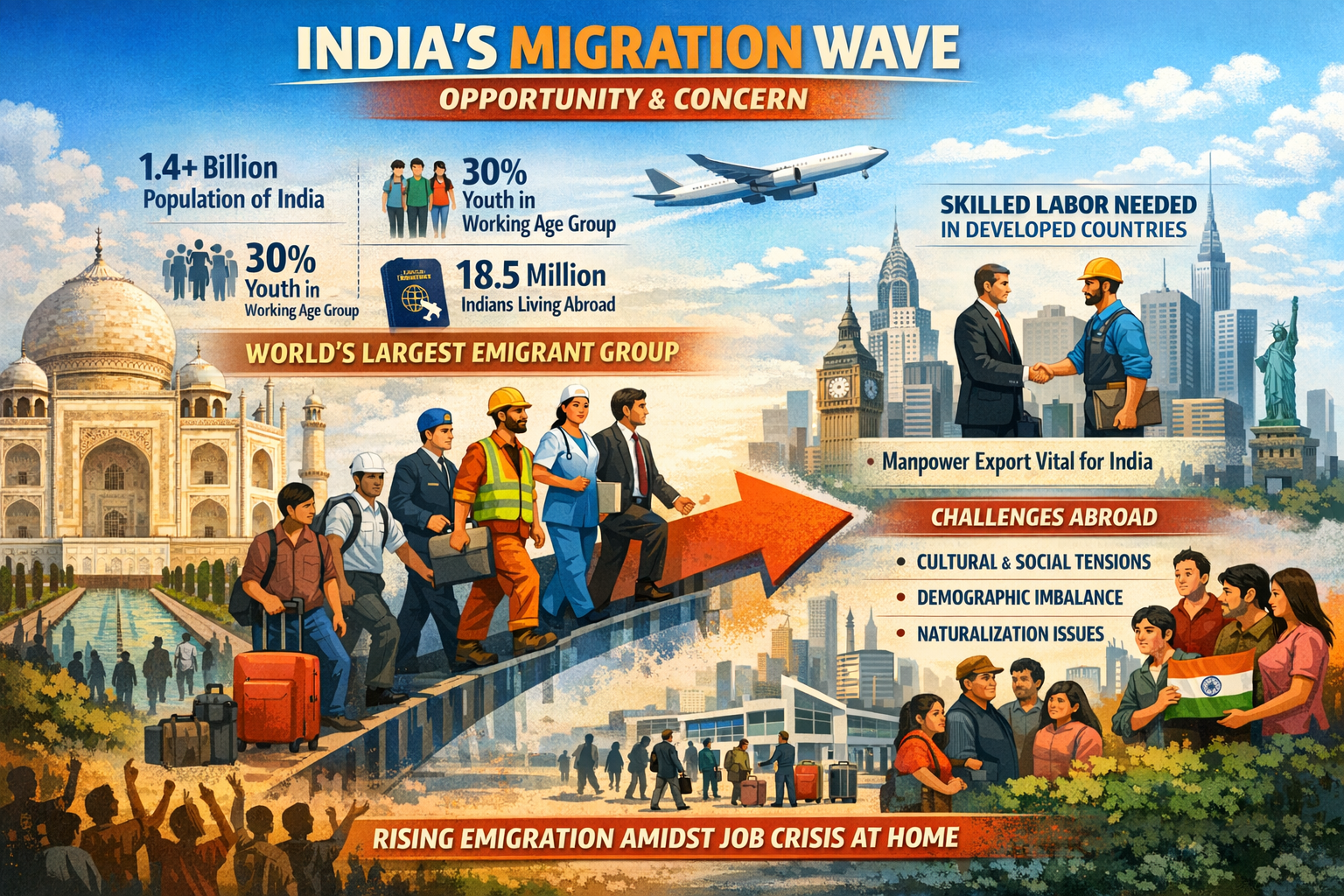
India has registered remarkable level of economic development in the last eleven years , with India emerging as the fourth largest economy in the world now. With government of India implementing proactive economic and industrial development plans, such growth rate is likely to be maintained in the coming years.
With the vibrant economy , massive efforts are being put up to expand the base of educational institutions in India and skill development in multiple sector are happening now. In short, efforts are being put forth to enable the population to take up jobs both in India and abroad.
Job scenario :
In spite of such scenario, joblessness continues to remain as a grim issue confronting the country. While job avenues are available both in organized and unorganized sector, they are no way adequate to offer employment to the people in the working age group due to large population. It appears that the employment scenario is unlikely to improve particularly since, automation, robotics and artificial intelligence are rapidly replacing the traditional job portfolios. Considering the fact that around 30% of the population consist of youth looking for appropriate job avenues , many discerning analysists are of the view that the joblessness may lead to sort of social unrest in the future, if the issue is not tackled with the level of urgency that it deserves.
While India’s population is reported to be around 1.4 to 1.5 billion people and it is claimed that the fertility rate in the country is slowly decreasing and family size are becoming leaner, still the population is increasing and it is estimated that India’s population will reach an unacceptable level of 1.8 billion people by the year 2050. It is impossible to provide jobs to everyone in the working age group in such a large population in India, whether it is organized or unorganized sector.,
Recently, India has emerged as the most populated country in the world. India’s current population density is 480 to 492 per square kilometer in the period 2023-25. This level of population density is uncomfortably high, which become particularly evident when compared to other countries such as 36 per square kilometer in USA, 4.2 per square kilometer in Canada, 8.4 to 9 per square kilometer in Russia 150 per square kilometer in China and 240 per square kilometer in Germany and 101 per square kilometer in Kenya.
While such is the population scenario in India, native population in several developed countries such as Japan, European countries including Russia are reported to be declining, causing huge concern amongst these countries,. After China implemented one child one family norm, the population in China also has stabilized and is unlikely to increase significantly in the coming years, as reported by several population experts.
The present concern in several developed countries, including middle east countries is that natives are not available in adequate number to accept the employment opportunities that would arise due to the steady growth in the increasingly modernizing economy, with several technology inputs. Therefore, it is feared that short supply of labour as well as employees with required level of expertise in multiple fields would impact such countries in variety of ways in the coming years.
In such developed countries , job content are also becoming increasingly sophisticated in multiple fields, requiring skilled and highly skilled people to execute the job.
In such conditions, with high population level in India with the country unable to offer job opportunities to millions of people in the working age group and with increasing number of people getting training in various skills, India is in an ideal position to export manpower to countries around the world. Such export of manpower has become a matter of necessity for India, due to massive population and inability to provide job opportunities to all people in the working age group.
It is reported that India has the world’s largest emigrant population, with over 18.5 million people of Indian origin living overseas in the year 2024. It is reported that Indian emigrants account for 6% of all international migrants globally. This migration trend from India is likely to be increasingly seen in the coming years, as India’s population is continuing to increase and extensive skill oriented training programmes are now being provided to Indians in various fields, to enable them to take up overseas jobs.
Migrant issue is now being discussed as a matter of concern in several countries , as merging of migrants with the local population often poses issues due to cultural, traditional and religious faiths of the migrants , which may be different from that of the natives.
The number of migrants from India to developed countries is steadily increasing and such migrants getting citizenship in other countries over a period of time. This condition is viewed by developed countries as sort of necessary but unwelcome measure , as such migrant population would inevitably upset the demographic balance in their countries.