Sri Lanka Cricket: From World Champions to a System in Crisis-by Gamini Goonetilleke

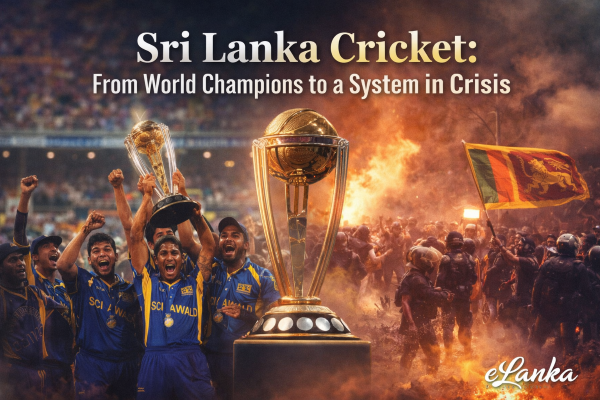
Cricket in Sri Lanka has never been merely a sport. It has long served as a unifying force, transcending divisions of ethnicity, religion, and class, particularly during periods of national adversity. At its height, it gave the country not only victories, but belief. Yet today, that sense of purpose appears diminished. Sri Lankan cricket is no longer setting standards; it is struggling to keep pace with a rapidly evolving game.
The contrast with the past is striking. The triumph at the 1996 World Cup was not an isolated success but the culmination of vision, discipline, and fearless innovation. Sri Lanka redefined limited-overs cricket with aggressive batting, imaginative tactics, and a collective spirit that elevated the team beyond its individual parts. That identity bold, confident, and united became the hallmark of Sri Lankan cricket for nearly two decades.
However, the modern era, dominated by the demands of T20 cricket and global franchise leagues, has exposed structural weaknesses that were once masked by natural talent and resilience. The game today is faster, more analytical, and more commercially driven. Success depends not only on skill, but on systems including data analytics, sports science, structured development pathways, and professional governance. It is in these areas that Sri Lanka has fallen behind.
Perhaps the most visible symptom of decline is the instability in team selection. Frequent changes in selection committees, shifting criteria, and inconsistent decision-making have undermined continuity. Players are introduced with promise, only to be discarded after limited opportunities. Roles within the team remain unclear, and confidence so vital at the international level is easily eroded. Selection, instead of being a pillar of stability, has become a source of uncertainty.
This inconsistency was reflected on the field. Batting performances lacked clarity and intent. The power play was often underutilized, the middle overs drifted without momentum, and the finishing phase rarely delivered the acceleration required in modern cricket. Against quality opposition, these deficiencies were quickly exposed.
Fielding standards, once a competitive strength, have declined noticeably. Dropped catches, misfields, and lapses in intensity proved costly in closely contested matches. In contemporary cricket, where margins are minimal, such errors are decisive.
Bowling, too, showed signs of stagnation. Opponents, armed with sophisticated data analysis, have been able to anticipate and exploit predictable patterns. While leading teams rely heavily on analytics and strategic match-ups, Sri Lanka has yet to fully integrate these tools into its tactical approach.
Equally concerning were issues of fitness and injury management. Modern cricket demands peak physical conditioning, yet Sri Lanka continues to grapple with frequent injuries to key players. This not only disrupts team balance but also raises questions about workload management, conditioning programs, and the application of sports science. Without a structured, evidence-based approach to injury prevention and rehabilitation, such setbacks will persist.
Closely linked to this is the lack of bench strength. Successful teams are built on depth, ensuring that replacements can perform at the same level as those they replace. Sri Lanka, by contrast, often appears overly dependent on a few individuals, with limited capacity to absorb the loss of key players.
The psychological dimension of the game has also become increasingly important. In high-pressure situations, Sri Lankan teams have at times appeared tentative rather than assertive. This suggests a gap in mental conditioning. In an era of intense media scrutiny and public criticism, players require structured psychological support to maintain confidence and composure. The absence of such support mechanisms is a significant oversight.
Even the advantage of playing at home was not effectively utilized. Familiarity with local conditions should provide a strategic edge, yet recent performances suggest otherwise. Preparation appeared inadequate, and adaptability limited. While public support remains passionate, repeated disappointments tested the patience of even the most loyal supporters.
The challenges extend beyond the playing field. Sri Lanka’s economic constraints have inevitably affected investment in cricketing infrastructure, grassroots development, and high-performance systems. While facilities exist, their optimal utilization and integration into a coherent development framework remain uncertain.
Governance issues further complicate the picture. Concerns regarding transparency, accountability, and continuity within cricket administration have persisted for years. Regardless of the validity of specific allegations, the perception of entrenched leadership and limited reform undermines public confidence. Effective governance is not merely administrative, it is foundational to sustained success.
It must also be acknowledged that the global cricket economy has changed irreversibly. The rise of franchise leagues, particularly those with significant financial backing, has altered player priorities. For many cricketers, the economic incentives of these leagues surpass those of international cricket. Sri Lanka, with comparatively limited resources, cannot compete on equal financial terms. However, it can and must develop policies that balance player welfare with national commitment.
The path forward requires more than incremental adjustments; it demands comprehensive reform. Selection processes must be transparent, consistent, and insulated from external pressures. Domestic cricket needs restructuring to enhance competitiveness and players better prepared for international demands. Investment in sports science, fitness, and injury management is no longer optional but essential.
Equally important is the development of mental resilience through structured psychological support. Coaching systems must function as cohesive units, guided by clear leadership and unified strategy. Above all, governance must be strengthened through accountability, independence, and a long-term vision that prioritize the national interest over short-term considerations.
Sri Lanka’s cricketing history demonstrates that success is possible even in the face of limited resources. What distinguished past achievements was not wealth, but clarity of purpose, discipline, and collective belief. Those qualities remain within reach, but they require deliberate effort to restore.
The risk, if these issues remain unaddressed, is not merely continued defeat. It is the gradual erosion of a cricketing identity that once inspired a nation. Sri Lanka cannot afford to become a passive participant in a game it once helped to redefine.
The challenge, therefore, is clear. To move forward, Sri Lankan cricket must rediscover its foundations while embracing the demands of the modern era. Only then can it hope to reclaim its place, not just as a competitor, but as a respected and influential force in world cricket.