Climbing the Great Pyramid of Giza- Written by Roderic Grigson
Source:Thomiana – S.Thomas’ College Old Boys Association Australia Branch Newsletter
The sky to the east glowed from the lights of Cairo which filled the eastern horizon as far as the eye could see. The night sky behind the city was lightening with the false dawn. Tiny boats on the river Nile, some already underway before sunrise, crept along the wide river that disappeared into the darkness to the south.
In 1978 when I was living in Egypt working for the UN Emergency Force, I joined a group of colleagues who had negotiated with one of the local tour guides to take us to the top of the tallest pyramid outside Cairo.
The Great Pyramid is the oldest and largest of the three pyramids in the suburb of Giza located to the south- west of Cairo. It is the oldest of the seven wonders of the ancient world and the only one to remain mostly intact. The pyramid was built around 2560 BC and was
the tallest man-made structure in the world for over 3,800 years.
Image Source:Eshemagazine
We had heard from others who had climbed to the top of the great pyramid, that watching the sunrise over the city of Cairo was one of the great travel adventures in the world—climbing the pyramids. However, once a popular tourist activity was considered extremely dangerous and was officially forbidden.
In the early evening, nervous with anticipation for what we had planned, we left Ismailia, a small city on the Suez Canal, to drive to Cairo. There were eight of us in two cars, four Brits, two Aussies, a Canadian and me. Tony, a Brit who had climbed the monument before, had volunteered to take us to the top. The real reason, I found out later, was that he was sweet on Wendy, one of the two Aussie girls who were accompanying us, and had offered to take her to the top to ‘see the sights.’ I don’t think he was too happy when he found out that she had invited her friends along and that his little tête–à–tête had expanded exponentially.
The desert road between Ismailia and Cairo was straight and flat, the only danger being a stream of ‘flying coffins’ racing past. These Mercedes wagon taxis, filled to the brim with passengers, some sitting on one another, were driven at extremely high speeds which would be considered dangerous even on the immaculate autobahns of Germany. But here in Egypt, where fast, modern machines competed with centuries-old means of transport like donkeys and camels that wandered where they may, the clash of the
ancient and modern was sudden and always catastrophic to both parties.
We arrived in the outskirts of Cairo after dark, passing through a checkpoint manned by Egyptian soldiers. Driving past the Cairo International Airport, we crossed the wide Nile River at the Giza Bridge before driving to the Mena House Hotel where we had reserved a few rooms for the night.
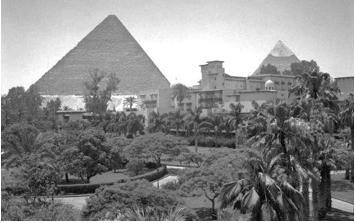
The Great Pyramid seen from the Mena House
The Mena House was once a hunting lodge for the Khedive Isma’il (Isma’il Pasha, known as Isma’il the Magnificent was the Khedive or Viceroy of Egypt and Sudan from 1863 to 1879). The building was used by him when hunting in the surrounding desert or visiting the pyramids. It was opened as a hotel in 1886 and is one of the oldest and most unique hotels in Cairo.
Dinner at the hotel, located less than a kilometre from the pyramids, was loud and exhilarating. The pyramids which could be seen from where we were sitting, was lit up for the nightly Sound and Light show which bathed the structures in coloured lights. The excitement was palatable and most of us drank too much in anticipation of the adventure ahead of us.
We planned to leave the hotel after midnight so some of us took the opportunity to go to our rooms to rest in anticipation of the strenuous climb we had before us. I had heard that getting to
the top of the pyramids was not for the faint-hearted. Some of the limestone blocks at the lower level were taller than the average human, and I was smaller than an average human’s height.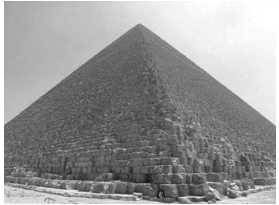
We slipped out of the hotel in ones and twos. We had been warned that the hotel guards often stopped guests from going out at night on foot, demanding baksheesh to look the other way. We got past the guards without raising the alarm, but the walk in the dark to the entrance of the pyramid
precinct was far from unnoticeable. Word must have gotten out that a group of foreigners were climbing the pyramids that night, and as we got closer to the gates, we seemed to attract a group of Egyptian locals like bees to honey.
The guards at the gate must have been surprised to see the approaching horde. Luckily, the guide with whom we had arranged the climb, had done his job. The few guards manning the gates chased off all the touts, pimps and souvenir sellers allowing us to enter the enclosed area unhindered. Money changed hands, and with broad smiles and pats on the back, we were asked by the guards to follow the guide who gestured us towards the base of the pyramid.
Even in the dark, the Great Pyramid was an imposing sight. It towered over us, totally shutting off the night sky and stars from view. We were taken around to the eastern side, opposite the tomb of Queen Hetepheres, where we would begin our climb. The guide who could speak passable
French explained that it was easier to climb the side facing the city. The glow from the city’s lights would help us find our way up the 146-metre monolith
Much to my delight, the first two levels of the pyramid were only shoulder high, and most of us needed a boost to get to the flat surface at each level. But after the third level, the blocks were only waist-high, making it much easier to negotiate. We didn’t climb up in a straight line however, the guide led us through crumbling gaps in the limestone blocks which allowed a much easier climb. One of the Brits whose name was Johnny and his Canadian friend Jim, decided to go straight up. I followed the two girls and the rest of the group who sedately followed the guide, mostly along one corner of the pyramid.
The limestone blocks were steep and crumbly. What looked like solid blocks of stone from the bottom were in fact covered with loose pebbles and sand. It was not easy to climb as our feet kept slipping out from under us and our hands kept losing their grip on the rock. What struck me
as we were about halfway up was how cold it was getting. There was a light breeze which made it seem much colder. The change in temperature between day and night in the desert is quite significant, and it felt much colder towards the top than it did at the bottom.
There was nowhere to rest as each ledge was only about two feet wide. We finally got to the top of the pyramid, where I promptly sat on the ground. My legs trembled, and my calves hurt from the exertion of climbing the limestone blocks. Jim, the Canadian who had rushed up the side of the pyramid with Johnny, had twisted his ankle badly and lay on the ground rubbing his leg in agony.
Johnny who had brought a pair of binoculars with him, was looking through them towards the city.
The view from the top was spectacular. The lights of Cairo spread out to the north-east and the Nile River, looking like a black ribbon in the grey darkness, meandered sinuously towards the south
The flat summit was bigger than I expected, perhaps the size of an exceptionally large living room. An old wooden postmarked its center. We sat quietly, our feet dangling over the side, awed by what we could see. No one spoke louder than a whisper. Not that anyone could hear us, but we were just overwhelmed by what we had done and what was spread out in front of us.
The enormity of the man-made structure was incredible. I had read at the hotel that the pyramid had been constructed of over 2.3 million limestone blocks and taken 20 years to build. The stones at the summit were worn smooth, and I could
see scratches and grooves cut into the rock from people who had been there before us.
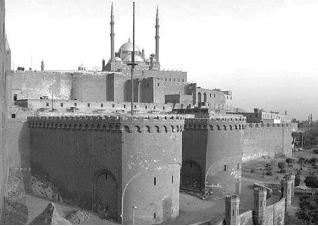
Sunrise over Cairo was everything I had heard it would be. The normal pollution over Cairo had been blown away during the night and a thin sliver of light tinged with red and yellow suddenly appeared outlining the horizon, which could not be seen in the dark. The sky got gradually lighter and red streaks
mixed with pinks, yellows and blues
reflecting off scattered clouds gradually brought the city of Cairo into view. The sun peeked into view shining off the great walls of the Cairo Citadel, a medieval fortification built by Salah al-Din in 1183 to protect the city from the Crusaders. We had been warned not to bring cameras as the pyramid guards often confiscated them and sold them in the local souk. It was common practice amongst UN staff not to carry cameras around. Our job was to maintain a buffer zone between the Egyptian and Israeli forces, and crossing the front lines was normal for us. The sight of a camera invariably meant being stopped and questioned and having the camera confiscated, and sometimes even being arrested for spying.
Ant-like figures in the pyramid precinct made me realise how high we were. To one side, a great sea of yellow sand stretched as far as the eye could see. On the other, a broad green belt with harvested fields and date palms surrounded the river Nile with the awakening city of Cairo on its banks. There was no sound to be heard except the undulating call to prayer from a mosque far below us.
The guide who had brought us to the summit started calling to us. He wanted to start the descent as he didn’t want to get caught climbing down. We waved off his pleas to leave, wanting to spend more time enjoying the view. But as the sun rose, it started to get hot, and we reluctantly gathered ourselves to begin the descent.
Getting ready to climb down I could see graffiti dating back many centuries ground into the rocks at the summit. There were Greek, Latin, Arabic, and other languages which I could not recognise plus those in English and other Western scripts. There were names of soldiers from the time of the French and British occupations with their regiments and years served carved into the rock.
Climbing down the face of the pyramid felt more dangerous than climbing up. We could now see
how high we were and how dangerous it was. Jim struggled coming down and had to be assisted by the rest of us who carried him from one level to the next.
We finally got to the bottom. It was only 8:00 am, but it was now really getting hot. We sat down talking excitedly amongst ourselves when we were startled to see a guard, shouting in Arabic, rushing at us waving a pistol in the air. Our guide ran forward to meet him, and a loud discussion with much hand waving took place. The guide came over and explained that the guard wanted to arrest us. Pulling a couple of us aside, he
whispered knowingly that if we gave the guard some money, he would go away quietly and ignore that we had just climbed down the pyramid. Tony shrugged and handed a US$20 bill for the guard who immediately holstered his gun when he saw the money. The guard went off with a big grin on his face, and I could not help but think that this was a well-rehearsed incident, and we had just been suckered.
Walking back to the Mena House through an area of mud huts and wandering donkeys which looked like it had been there for centuries, I looked back up towards the summit feeling a sense of awe at what I had accomplished. A bit irresponsible and a bit dangerous no doubt, but I had done something that not many people had done. I had climbed the Great Pyramid of Giza!
Written by Roderic Grigson, Old Thomian, Recipient of the OBA President’s Award 2020 and author of the ‘Sacred Tears’ trilogy: a historical fiction set during the civil war in Sri Lanka. www.rodericgrigson.com