


World Bank Investment: A Pivotal Moment for Kandy-by Harold Gunatillake

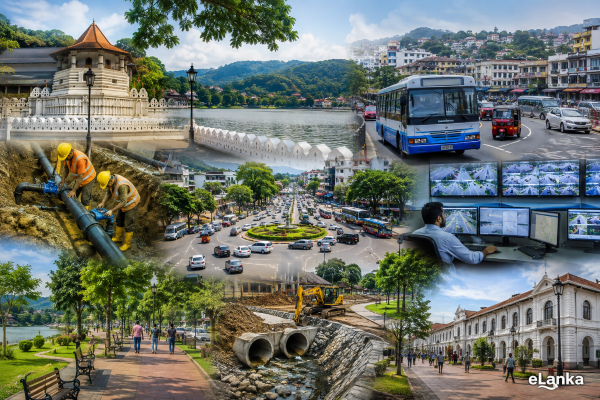
This is excellent news for the residents of Kandy, as the ongoing World Bank-funded developments are directly addressing the city’s most severe bottleneck: persistent traffic congestion and disruptions in public transportation.
Under the Strategic Cities Development Project, Kandy has been designated as a pilot city for comprehensive upgrades. The initiative will concentrate on rehabilitating the municipal water supply, enhancing drainage systems, streamlining traffic management, and implementing environmental improvements around Kandy Lake. Additionally, it aims to augment public spaces, improve walkability, and restore historic buildings.
The pivotal element of this transformation is the Kandy Multimodal Transport Terminal (KMTT) Project, a $69.33 million initiative designed to fundamentally reform transportation dynamics within the city centre.
The project has progressed through essential construction phases, with an updated target completion date projected for around mid-2027, following extended restructuring to address complex underground site conditions.
Upcoming Major Improvements in Kandy
- The ongoing interventions predominantly concentrate on a comprehensive transit overhaul and enhancements in public safety measures:
- Centralized Transit Hub: The KMTT replaces fragmented terminals, thereby consolidating operations to accommodate an estimated 330,000 passengers and 5,000 bus trips daily.
- Significant Traffic Reduction: By transforming over fifty percent of arriving bus routes into “touch-and-go” trips, the project aims to eradicate excessive idle bus parking within the town, which serves as the primary contributor to daily traffic congestion.
- Pedestrian Skywalk: A 150-meter-long elevated skywalk will directly connect William Gopallawa Mawatha, Peradeniya Road, the Kandy Railway Station, and the Kandy General Hospital, thereby fully segregating pedestrian movement from congested roadways.
- Smart Management Operations: The deployment of an IT-based Terminal Operating System will facilitate efficient management of bus bays and will provide real-time departure schedules to passengers.
- Flood Mitigation and Infrastructure: Structural diversion and rehabilitation efforts on the Meda Ela storm water drainage canal, which traverses the project area, are intended to mitigate localized flooding.
Long-Term Management and Strategic Vision
The Sri Lanka Stormwater Drainage Canal, which traverses the project area, is intended to mitigate localised flooding. This dedicated entity is specifically tasked with managing, standardising, and commercially developing major nationwide hubs, explicitly including the ongoing construction at the Kandy terminal.
Furthermore, this physical infrastructure is integrated into the broader Greater Kandy Urban Plan 2026–2035, administered by the Urban Development Authority. Supported by additional smart-mobility planning grants, this long-term blueprint aims to preserve the city’s historic heritage while transforming Kandy into a highly livable, green urban environment.
Pedestrian layout plan
The planned pedestrian layout for the Kandy Multimodal Transport Terminal (KMTT) is strictly designed to completely separate pedestrian foot traffic from active bus and rail movements, resolving the dangerous layout of the old Goods Shed area. The blueprint establishes a seamless multi-level flow split across vertical layers and elevated structures:
The 150-Meter Elevated Skywalk
The focal point of the external pedestrian arrangement is an extensive 150-meter-long overhead Skywalk.
The route: It establishes a high-altitude, continuous walkway extending from Old Peradeniya Road to William Gopallawa Mawatha, crossing directly over the railway track premises.
Direct Rail & Health Links:
The skywalk diverges to provide direct access to the Kandy Railway Station and extends seamlessly to the Kandy Teaching Hospital.
This infrastructure facilitates hospital visitors, patients, and train commuters in transitioning between transit modes or accessing medical services without engaging with street-level vehicular traffic.
Terminal Integration:
The walk structure bridges straight into the second-floor concourse of the main KMTT building.
Underground and Street-Level Layouts: For street-level integration, the design shifts pedestrians below ground and introduces protected arteries:
Underground Passageways: Commuters accessing the terminal from neighbouring major roads can utilise a network of underground pedestrian walkways.
These tunnels channel foot traffic safely under the bustling lanes of Sirimavo Bandaranayake Mawatha and William Gopallawa Mawatha.
Alleyway Anchors: Existing local alleys—such as those connecting the Peradeniya Road and the nearby “Aadu-patti” zone—are being modified to channel seamlessly into protected terminal entry points at the ground level.
Upon the completion of the infrastructure construction funded by the World Bank, Kandy will be transformed into a highly organised, pedestrian-friendly, and streamlined heritage city.
The $69.33 million Kandy Multimodal Transport Terminal (KMTT) Development Project fundamentally reconfigures the city’s approach to traffic management, pollution mitigation, and commuter logistics.