The Day Washington Trembled: Dr Fauci’s Silence and the Political Storm That Followed-by Harold Gunatillake

Dr Fauci’s Explosive Senate Showdown: What Sri Lankans Should Understand About the Controversy
Overview: On a tense morning in Washington, under the cold glow of the Senate’s overhead lights, the world witnessed a spectacle unlike any other in America’s pandemic-era politics.
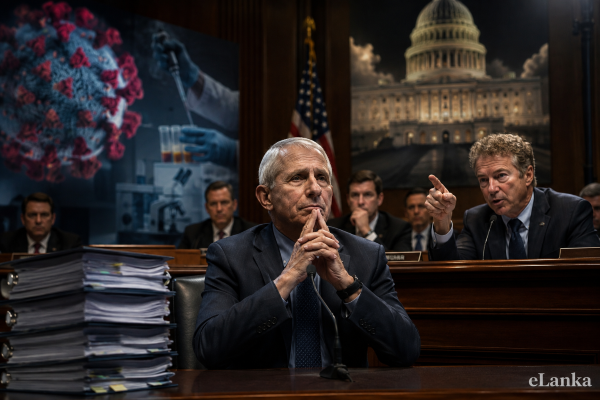
Dr Anthony Fauci—the man once hailed as the steady voice guiding a frightened nation through COVID–19—sat before a panel of lawmakers, his face expressionless, his posture rigid, his voice reduced to a single, repeated sentence.
During a Senate hearing regarding his conduct during the COVID-19 pandemic, former Director of the National Institute of Allergy and Infectious Diseases, Anthony Fauci, exercised his Fifth Amendment right to refuse to answer questions, citing concerns that Republicans might attempt to utilise his testimony to pursue perjury charges.
Committee Chair Rand Paul (R-KY) issued a subpoena to Dr Fauci. He disclosed over 1,100 pages of his diary maintained during the pandemic, which included his reflections on the origin of the virus. Senator Paul had previously criticised Dr Fauci for his involvement during the pandemic and accused him of concealing funding related to experimental research in China, suggesting that the virus may have originated from a Chinese laboratory.
Following Dr Fauci’s invocation of the Fifth Amendment, Senator Paul cautioned him about potential obstruction of an investigation and announced that the committee would hold a contempt of Congress vote the following week.
In his opening remarks, Dr Fauci defended himself and described Senator Paul as having an “unhinged obsession” with him.
The recent Senate hearing in Washington involving Dr Anthony Fauci—America’s most recognisable expert on infectious diseases during the COVID-19 pandemic—has reignited vigorous political debate within the United States.
For Sri Lankans observing global affairs, this incident provides valuable lessons regarding political accountability, scientific transparency, and the ongoing influence of pandemic-era decisions on public discourse worldwide.
Below is a clear, structured explanation tailored for Sri Lankan readers, designed to help you understand the events that transpired, their significance, and their relevance to the broader international discussion on COVID-19 governance.
What precisely occurred?
During a tense Senate hearing presided over by Senator Rand Paul, Dr Fauci invoked the Fifth Amendment, a constitutional safeguard against self-incrimination, on more than 100 occasions. This demonstrated his refusal to respond to nearly every inquiry directed at him, including minor questions such as the colour of his tie.
Such a high degree of non-cooperation is exceptionally uncommon for a public official of his standing and has consequently heightened political tensions.
Key Issues Addressed During the Hearing
- Fifth Amendment Invocation
Dr Fauci’s legal representatives advised him to refrain from responding to any inquiries that might be exploited against him in subsequent legal proceedings. His consistent response—employed for every question—was perceived by critics as evasive and by supporters as a judicious legal tactic.
2. Attorney Removed from the Room
Senator Rand Paul instructed that Fauci’s legal representative, David Schertler, be excused after he endeavoured to speak without prior formal acknowledgement. This incident contributed to the escalating tension and underscored a decline in decorum.
3. Leak of Fauci’s Personal Diaries
Before the hearing, Senator Paul disclosed 1,100 pages of Dr Fauci’s confidential diaries from the pandemic period. He asserted that these documents exposed discrepancies between Dr Fauci’s private opinions and his public declarations regarding the origins of COVID-19.
Dr Fauci condemned the leak, characterising it as an effort to “embarrass and intimidate” him.
4. Threat of Contempt of Congress
Following Dr Fauci’s refusal to respond to inquiries, Senator Paul declared his intention to advocate for a vote to hold Dr Fauci in contempt of Congress. The Republican Party asserted that Congress possesses the authority to compel testimony through the provision of immunity, referencing a precedent established by the Supreme Court in the 19th century.
5. Partisan Firestorm
- The hearing rapidly descended into political spectacle:
- Republicans alleged that Fauci misled the public, endorsed detrimental lockdown measures, and financed hazardous research in Wuhan.
- Democrats dismissed the hearing as a “partisan waste of time,” accusing Republicans of pursuing a personal vendetta rather than engaging in a sincere investigation.
Why This Matters to Sri Lanka
Although this is an American political struggle, it bears broader implications for nations such as Sri Lanka.
1. Trust in Public Health Leadership
The pandemic revealed the critical importance of clear and transparent communication. When leaders appear evasive or entangled in political issues, public trust diminishes—an experience also encountered by Sri Lanka during its COVID-19 response.
2. Global Debate on Virus Origins
The question of whether COVID-19 emerged through natural origins or resulted from a laboratory accident remains a highly politicised issue. Decisions made within the United States have significant implications for global scientific inquiries and international policy deliberations.
3. Accountability in Crisis Management
Sri Lanka, like many other nations, faced difficult decisions about lockdowns, travel restrictions, and public health communication. The hearing involving Dr Fauci highlights how policymakers may subsequently be subject to scrutiny regarding these decisions.
4. The Influence of Political Polarisation
The hearing illustrates how profoundly partisan politics can eclipse scientific investigation. Sri Lanka, likewise, must safeguard against the excessive politicisation of health and scientific issues.
A Message for the Sri Lankan Public
This episode transcends being merely an American spectacle; it serves as a reminder of how decisions made during the pandemic era continue to resonate on a global scale. It underscores the significance of:
- Transparent communication from public officials
- Non-politicised scientific decision-making
- Robust legal and ethical frameworks for crisis response
- Respect for democratic oversight, even when such oversight may be uncomfortable
As Sri Lanka proceeds with its recovery from COVID-19, it is imperative to strengthen public trust in health institutions and to ensure accountability—eschewing political witch-hunts—as fundamental elements of this process.
What happens next remains uncertain. Chairman Rand Paul opted not to submit the resolution to the full Senate, citing the probable inability to secure the 60 votes necessary to overcome a filibuster. Instead, he is directly referring the contempt decision to the Department of Justice (DOJ) for potential criminal prosecution. A conviction for contempt of Congress may result in a maximum penalty of one year’s imprisonment. The U.S. Attorney’s Office in Washington will ultimately determine whether to pursue charges.
Check out this video, “Fauci testimony 3026”
https://share.google/kAWhaojQ3wYhePWad
https://www.cnn.com/2026/07/29/politics/anthony-fauci-fifth-amendment-plea
https://youtube.com/watch?v=a30KG_QySQU&si=VNY-QOQK7NkCNQU9