Sri Lanka’s Ministry of Industry and Entrepreneurship Development and the United Nations Development Programme (UNDP) have entered into a partnership to establish an Expert Support Unit designed to strengthen the government’s technical capacity for industrial and entrepreneurship reforms.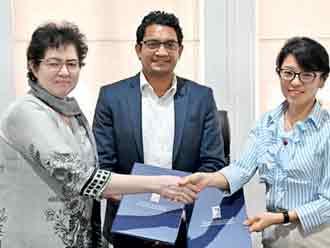
The initiative, formalised through a memorandum of understanding (MoU), represents a forward-looking effort to place stronger technical, analytical and coordination capabilities at the centre of Sri Lanka’s economic development agenda. By embedding a multidisciplinary team within the ministry, the partnership is expected to support more coherent policy formulation, improved programme implementation and stronger collaboration among public institutions, development partners and the private sector.
The MoU was signed by J.M. Thilaka Jayasundara, Secretary of the Ministry of Industry and Entrepreneurship Development, and Azusa Kubota, Resident Representative of UNDP Sri Lanka, in the presence of Deputy Minister Chathuranga Abeysinghe.
A specialised unit for practical reform support
The Expert Support Unit will be established within the ministry rather than operating as a separate external body. This embedded structure is significant because it can enable technical specialists to work directly with officials responsible for policy development, industrial programmes and entrepreneurship initiatives.
The unit is expected to provide support in several strategically important areas, including small and medium enterprise (SME) development, industrial zones, trade policy, digital transformation, data analytics, skills development and international relations. These fields are closely connected, and progress in one area can often determine the success of another.
For example, SMEs require access to finance, markets, technology, skilled employees and efficient regulatory systems. Industrial zones, meanwhile, depend upon suitable infrastructure, reliable services, investment facilitation and effective coordination between government agencies. Trade policy must reflect the needs of local producers while also supporting competitiveness in regional and international markets.
A technical unit with a multidisciplinary mandate could therefore help ensure that these matters are considered as part of a connected industrial strategy rather than addressed through isolated programmes.

Supporting evidence-based decision-making
One of the partnership’s central objectives is to promote evidence-based industrial policies. This requires reliable information, regular performance measurement and an accurate understanding of the challenges faced by businesses across different sectors and regions.
Data analytics can assist the ministry in identifying where support is most needed, measuring the performance of business development programmes and assessing whether industrial policies are producing practical results. It can also help reveal emerging opportunities, including new export markets, technology applications and industries with strong potential for employment and investment.
For Sri Lankan entrepreneurs, a more data-informed approach could contribute to clearer policy priorities and better-targeted support. Businesses may benefit when government programmes are designed around verified market conditions, sector-specific evidence and the practical experiences of enterprises operating on the ground.
The unit is also expected to assist with project management, monitoring and performance measurement. These functions are instrumental to ensuring that reform proposals progress beyond their planning stages and are translated into measurable outcomes.
A stronger platform for SMEs and entrepreneurs
SMEs are an important part of Sri Lanka’s economic landscape, supporting employment, local production and household incomes in urban, regional and rural communities. Many small businesses also provide the foundation from which larger companies and export-oriented enterprises can eventually emerge.
However, entrepreneurs frequently require assistance that extends beyond a single government department. Business registration, access to finance, technical training, market intelligence, digital tools, standards compliance and export preparation may involve several institutions and layers of administration.
The Expert Support Unit could help improve coordination across these areas by bringing together relevant expertise and supporting the ministry in developing more integrated programmes. Its work may be particularly valuable in helping promising businesses move from informal or small-scale activity towards greater productivity, formal employment and participation in wider supply chains.
A modern entrepreneurship policy should not merely encourage the establishment of new businesses; it should also help existing enterprises become more resilient, innovative and competitive. Technical assistance in business planning, production efficiency, digital commerce, quality assurance and international market access could strengthen the prospects of Sri Lankan enterprises in a changing global economy.
Digital transformation and industrial competitiveness
Digital transformation is another important area identified under the partnership. Across the world, digital systems are changing how companies produce goods, manage inventories, communicate with customers and reach international markets.
For Sri Lankan industry, digital adoption can improve productivity while reducing delays and administrative costs. Online licensing systems, digital trade documentation, electronic payments, business intelligence tools and integrated supply-chain platforms can make it easier for companies to operate efficiently and respond to market demands.
The successful use of digital technology, however, depends upon more than the availability of software or equipment. Businesses also require suitable skills, reliable connectivity, clear standards and confidence that digital systems will provide practical value. The Expert Support Unit’s role in combining digital transformation with data analytics and skills development may therefore help create a more balanced approach.
Digital tools can also improve communication between the public sector and businesses. When entrepreneurs can access accurate information through clear and user-friendly channels, the overall business environment becomes more transparent and responsive.
Industrial zones and sustainable growth
The partnership also covers industrial zones, which can serve as important platforms for manufacturing, investment and regional development. Well-planned industrial zones can provide shared infrastructure, logistics connections, utilities, waste-management systems and access to a skilled workforce.
Their effectiveness depends upon careful planning and consistent management. Businesses are more likely to invest when industrial locations offer dependable services, efficient approvals, suitable transport links and opportunities to connect with suppliers and customers.
Technical and analytical support could help the ministry evaluate industrial zones according to their economic performance, environmental standards, employment contribution and ability to attract productive investment. Such an approach would support the development of industrial locations that are not only physically established but also commercially viable and aligned with long-term national priorities.

International expertise and private-sector participation
The MoU is also intended to facilitate the deployment of technical specialists and mobilise support from development partners and the private sector. This broadens the potential contribution of the Expert Support Unit beyond government administration.
International development partners can provide experience in industrial policy, entrepreneurship support, institutional reform and sustainable development, while private-sector participants can contribute practical knowledge of markets, production systems, technology and investment requirements.
A constructive relationship between government and business is essential for policies that are both ambitious and workable. Consultation with manufacturers, exporters, small-business owners, technology companies, financial institutions, chambers of commerce and training providers can help ensure that reform measures respond to genuine commercial conditions.
For Sri Lankan professionals living in Australia and other parts of the global Sri Lankan community, the initiative may also create opportunities for knowledge exchange, investment connections and professional collaboration. Entrepreneurs and specialists with experience in international markets can contribute insights into digital business models, supply-chain management, export development and industrial innovation.
A timely foundation for implementation
The establishment of the Expert Support Unit does not, by itself, complete Sri Lanka’s industrial reform process. Its long-term value will depend upon the quality of its technical work, the clarity of its priorities and the extent to which its recommendations are implemented and measured.
Nevertheless, the partnership provides a valuable institutional foundation. By combining ministry leadership with UNDP expertise, the initiative can help strengthen coordination, improve access to specialised knowledge and promote a more systematic approach to industrial and entrepreneurship development.
The emphasis on SMEs, trade policy, industrial zones, digital transformation, data analytics, skills and international relations reflects the complexity of modern economic development. Sri Lanka’s industrial future will depend upon the ability to connect these areas effectively while creating practical opportunities for businesses of different sizes.
The new Expert Support Unit therefore has the potential to become an instrumental mechanism for turning reform objectives into coordinated programmes and measurable results. With sustained cooperation among government, development partners, businesses and professional communities, the initiative could contribute to a more innovative, competitive and inclusive industrial environment in Sri Lanka.
eLanka continues to share positive stories about Sri Lankan achievement, enterprise and institutional progress around the world. Readers can visit the eLanka website for community news, business information, events and opportunities, or subscribe to the eLanka newsletter for regular updates delivered directly to their inboxes.
Source: https://www.dailymirror.lk/
This article was written based on the source https://www.dailymirror.lk/, kindly email us at info@eLanka.com.au if any information needs to be corrected.
At eLanka, we respect the rights of creators. If we have used an image you own and you’d like it removed, please email us at info@elanka.com.au and we’ll handle it promptly.