Why not consider keeping a symbol that has deeply shaped a nation? The discussion around Sri Lanka’s Lion, the Elephant, and what truly defines national identity reflects a heartfelt connection to heritage and pride.-by Harold Gunatillake

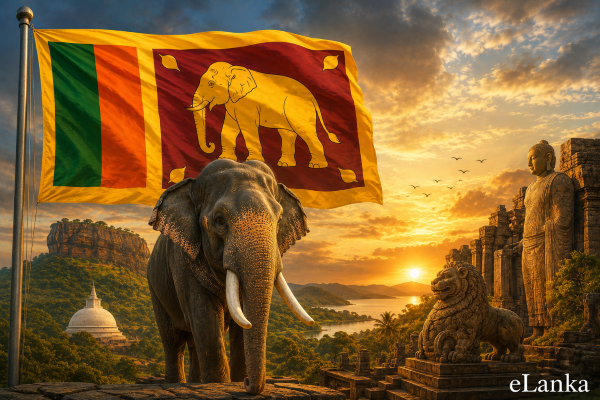
Sri Lanka’s national flag is more than just a piece of cloth fluttering in the wind. It’s a beautiful tapestry that tells stories of our history, sovereignty, and cultural memories accumulated over more than two thousand years.
The golden lion—majestic, holding a sword, and full of resolve—has been a proud symbol of Sinhalese kingship, courage, and independence for generations. Nowadays, a lively new conversation is taking shape: Should we consider replacing the lion with the Sri Lankan elephant as our national animal, and perhaps even as the main symbol on our flag?
This discussion, sparked by Opposition Leader Sajith Premadasa’s suggestion to recognise the Sri Lankan elephant as the national animal, invites us to reflect on a deeper question:
What do our national symbols truly mean, and why might we want to change something that was carefully designed to represent our identity?
The Lion: A Proud Symbol Steeped in History
The lion on Sri Lanka’s flag carries a rich and meaningful history. It originates in ancient times, with roots dating back to the 2nd century BCE, when the Anuradhapura kings used the lion on their royal standards, symbolising the connection between the monarchy and the mythical origins of the Sinhalese people.
Throughout medieval kingdoms, the lion banner was a familiar sight in battles and diplomatic missions, embodying sovereignty and strength.
When Sri Lanka gained independence in 1948, the lion flag was proudly reinstated as a sign of their newfound freedom.
Later, in 1972, the current flag — featuring the lion, bo leaves, and stripes of green and orange — was officially adopted, reinforcing its significance.
The lion isn’t just a national emblem; it’s a powerful symbol of the country’s history, identity, and the enduring story of its civilisation and governance.
The Elephant: Embracing a Symbol of Heritage, Ecology, and Cultural Reverence
Sri Lanka’s elephant holds a special place in the nation’s heart, representing more than just wildlife—it’s a symbol woven into the fabric of our culture, history, and natural environment.
These majestic creatures are deeply connected to Buddhist traditions, temple life, and royal ceremonies.
As a keystone species, they play a vital role in maintaining the balance of our rich biodiversity.
Sadly, they face threats from habitat destruction and human–elephant conflicts, making their conservation more important than ever.
The idea of making the elephant the national animal, inspired by both conservation efforts and cultural pride, is a heartfelt gesture
to honour these gentle giants who have shaped our landscapes and traditions for centuries. But it does make us wonder—should the elephant replace the lion on our flag?
Should we consider replacing the Lion? Exploring the key questions that matter.
Changing a national symbol is more than just surface-level—it represents a deep constitutional, cultural, and emotional transformation. There are three important questions we should consider:
1. What do you think the lion represents that the elephant doesn’t?
The lion is a symbol of political sovereignty, martial courage, and the historical roots of the Sinhalese nation. The elephant, on the other hand, represents cultural heritage, ecological identity, and spiritual reverence. These symbols reflect different aspects of our identity.
2. Could changing the symbol affect our national identity?
A flag is a nation’s face, and modifying its main symbol could change how Sri Lankans see themselves and influence how others view our country. It might also bring sensitive questions about ethnic representation, historical stories, and constitutional symbols.
- Is the discussion about the flag itself, or is it about conservation? Premadasa’s emphasis is mainly on recognising and protecting the Swapping the lion on the flag is a much more significant move, one that touches on national identity far beyond conservation.
The lion’s enduring strength is truly inspiring. It reminds us of resilience and courage that can overcome obstacles.
Appreciating these majestic creatures helps us find motivation in our own challenges, knowing that perseverance can lead to revival and success.
Symbols hold deep stories that resonate through time. The lion’s story reflects its rich heritage of ancient kingship, independence struggles, cultural continuity, and national sovereignty.
It’s not a recent creation but a cherished inheritance passed down through centuries of history, mythology, and nationhood. To change it would be like rewriting a fundamental chapter of Sri Lanka’s shared identity.
Is it possible for both symbols to coexist peacefully? Let’s explore how they can work together harmoniously.
Sri Lanka doesn’t have to pick just one symbol; it’s wonderful to embrace both the lion and the elephant.
Many countries celebrate multiple national symbols, including a flag, an animal, a flower, a bird, and a tree.
Recognising the elephant as the national animal enriches our cultural and ecological identity without diminishing the lion’s important history.
These two symbols can beautifully work together: the lion representing sovereignty and pride, and the elephant standing for our rich heritage and connection to nature.
In conclusion, a flag is more than just a symbol—it’s a story, and stories deserve to be treated with care and respect.
The question “Why change the animal symbol on our national flag?” really touches on who we are.
Sri Lanka’s lion isn’t just a decoration—it’s been an important part of our history for centuries.
The majestic elephant, loved and revered, deserves respect and protection, but replacing the lion on the flag isn’t necessary.
Symbols play a big role in showing us our identity.
Changing them should be a decision made with everyone’s agreement, respect for history, and cultural understanding.
Sri Lanka can celebrate its elephant without changing the flag. The lion, a symbol rooted in our ancient banners and journeys of independence, continues to protect and represent our nation’s story.
End