OxfordAQA has launched its new International GCSE Digital and Information Technology (DIT) qualification in Sri Lanka, introducing a modern, UK-aligned course designed to help students develop practical digital capabilities alongside a strong academic foundation.
The qualification was announced on 17 August 2026 and has been developed in consultation with Sri Lankan international schools, reflecting the growing importance of digital knowledge across education, business, creative industries and wider society. Rather than treating technology as a purely theoretical subject, the programme combines examinations with extended practical projects, allowing students to demonstrate how digital concepts can be applied in realistic situations.
For Sri Lankan students preparing for further study and future employment, the qualification represents a useful expansion of the international education options available within the country. Its content is intended to connect classroom learning with the ways in which digital tools are used to analyse information, create content, support organisations and address social challenges.
A contemporary approach to digital learning
OxfordAQA is a partnership between Oxford University Press, a department of the University of Oxford, and AQA, the United Kingdom’s largest provider of GCSEs and A-levels. The new International GCSE DIT qualification builds on the foundations of traditional Information and Communication Technology, while placing greater emphasis on the practical and creative use of technology.
The course has been designed around the reality that digital skills are now required across a broad range of professions, including fields that may not traditionally have been regarded as technology-based. Data handling, digital communication, content production, online collaboration and problem-solving are increasingly relevant to business, education, healthcare, media, design and community development.
By introducing these areas through a structured international qualification, OxfordAQA aims to provide students with an organised pathway through which technical knowledge and creative thinking can be developed together. The programme also places importance on the attitudes and habits required for responsible, confident and effective use of digital technology.

Learning through data, content, business and social impact
The International GCSE DIT qualification covers contemporary contexts including data, digital content, business and social impact. These themes provide students with opportunities to consider not only how technology operates, but also how it can be used to communicate ideas, support decision-making and respond to practical needs.
Work involving data can introduce students to the principles of organising, interpreting and presenting information. These abilities are increasingly important in an environment where organisations rely on accurate information to understand customers, plan services and evaluate performance.
The digital content component can encourage students to explore how text, images, audio and other media are developed for particular audiences. Such learning is relevant to communication, marketing, publishing, education and creative production, while also helping students understand the importance of clarity, purpose and responsible content creation.
The business context enables learners to examine the role of digital tools within organisations, including how technology can improve communication, administration and the delivery of services. At the same time, the focus on social impact encourages consideration of how digital solutions may be used to address community needs and wider challenges.
This combination gives the course a breadth that extends beyond basic software familiarity. It presents digital technology as a means of investigation, expression, organisation and constructive participation in society.
Examinations combined with extended practical projects
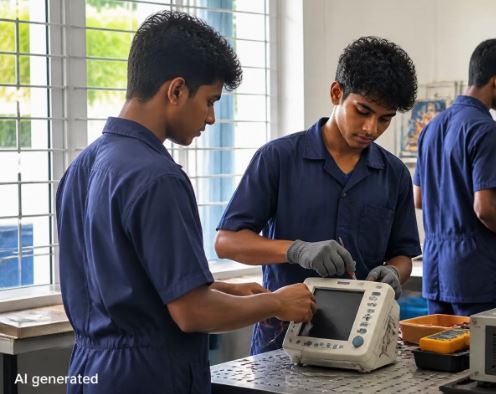
A central feature of the qualification is its combination of formal examinations and extended practical projects. This blended model enables students to demonstrate both their understanding of key principles and their ability to apply that knowledge in a practical setting.
The examination component provides a structured assessment of subject knowledge, concepts and understanding. The extended projects, meanwhile, give students the opportunity to work through a more substantial task, consider a defined context and develop a digital response.
Project-based learning can require students to identify a need, plan an approach, produce digital content or a solution, and evaluate the result. Through this process, learners may practise organisation, research, design, technical execution and reflection. These are valuable habits for further education, where independent assignments and collaborative projects form an important part of academic life.
The approach also provides teachers with a broader way to observe student progress. While examinations remain an important measure of academic understanding, practical work can reveal how effectively students transfer knowledge into action, manage a task and respond to challenges during development.

Developed with Sri Lankan international schools
According to the Newswire report, the qualification was developed in consultation with international schools in Sri Lanka. This consultation is significant because it allows the programme to take account of the circumstances and requirements of schools delivering international curricula in the country.
OxfordAQA’s Country Director for Sri Lanka, Panchalika Kulatunga, said that schools had shown growing demand for qualifications reflecting how digital skills are used in the real world. She explained that the new DIT qualification provides students with an opportunity to build practical capability, while offering teachers a flexible and manageable approach to delivery.
The comments indicate that the qualification has been shaped with attention to both sides of the learning process. Students require opportunities to develop useful skills through meaningful tasks, while teachers need a course structure that can be delivered effectively within school programmes and supported through clear assessment requirements.
The Sri Lankan education sector includes students preparing for university pathways in Sri Lanka and abroad, and qualifications with international recognition can form an important part of that preparation. The new programme may therefore be of interest to schools seeking to strengthen their technology-related subjects while maintaining alignment with UK educational standards.
Supporting preparation for higher education and work
The qualification is intended to support progression to further study and the workplace, although individual outcomes will naturally depend on a student’s wider academic record, interests, effort and future choices.
Its practical emphasis can help learners become more familiar with the processes involved in completing a digital task from beginning to end. Planning, researching, selecting suitable tools, creating an output and reviewing the final result are activities that can be relevant well beyond the classroom.
Students who continue into higher education may encounter similar requirements when completing presentations, research projects, digital portfolios and group assignments. Those entering employment may also find that confidence with data, digital content and technology-supported communication is relevant across a variety of roles.

The broader value of the programme lies in its attempt to connect technical learning with judgement and purpose. Digital competence is not limited to knowing how to use a particular application; it also involves understanding the intended audience, selecting an appropriate method, considering the reliability of information and recognising the consequences of digital decisions.
Part of OxfordAQA’s international education offering
The International GCSE Digital and Information Technology qualification forms part of OxfordAQA’s wider international portfolio. The organisation states that its qualifications are designed to maintain high standards associated with UK education while using clear language and culturally relevant content.
OxfordAQA Managing Director Andrew Coombe said that the organisation was committed to providing qualifications that respond to the evolving needs of international schools. He described the new DIT programme as an addition to its portfolio intended to help students develop the knowledge, skills and confidence required in a rapidly changing digital world.
For Sri Lankan schools, the launch provides another option for introducing structured digital education through an international examination board. For students, it offers a course in which academic study and practical application are deliberately brought together.
As technology continues to influence education, employment and community life, programmes that combine knowledge with practical development may prove increasingly valuable. OxfordAQA’s new qualification does not promise a particular academic or professional result, but it does provide a framework through which Sri Lankan international-school students can explore the responsible and purposeful use of digital technology.
More information about OxfordAQA’s new qualifications is available at www.oxfordaqa.com/newqualifications. Sri Lankan readers can also follow education updates and community news through the eLanka website and subscribe to the eLanka Newsletter.
Source: https://www.newswire.lk/business/oxfordaqa-launches-international-gcse-digital-and-information-technology-to-support-modern-uk-aligned-digital-learning-in-sri-lanka/
This article was written based on the source https://www.newswire.lk/business/oxfordaqa-launches-international-gcse-digital-and-information-technology-to-support-modern-uk-aligned-digital-learning-in-sri-lanka/, kindly email us at info@eLanka.com.au if any information needs to be corrected.
(adsbygoogle = window.adsbygoogle || []).push({});
At eLanka, we respect the rights of creators. If we have used an image you own and you’d like it removed, please email us at info@elanka.com.au and we’ll handle it promptly.