


MasterChef New Zealand Winners Kārena and Kasey Bird Return to the Sri Lanka That Stole Their Hearts

AI-generated illustration. The authentic photographs accompanying Kārena and Kasey Bird’s column are held by The Post and have not been reproduced.
A return shaped by food, memory and hospitality
A decade after their first visit, MasterChef New Zealand-winning sisters Kārena and Kasey Bird have returned to Sri Lanka, the island whose food, varied landscapes and generous hospitality stayed with them long after their initial journey.
In a personal travel column published by The Post on 20 October 2026, the sisters recount a trip made this year as more experienced cooks, travelling for themselves rather than filming a programme. Their first visit had come when they were 25 and 26, newly crowned MasterChef New Zealand winners and filming the second season of Kārena and Kasey’s Kitchen Diplomacy. Although they had already visited more than a dozen countries, they write that Sri Lanka made a particular impression: its colours seemed brighter, its pace gentler, and the experience remained with them.
Their return, hosted by Aitken Spence Travels, was designed around eating, tasting and remembering what had first drawn them to the island. The route took them from the cultural heartland to the central highlands, Ella, Yala, the southern coast and Colombo, offering a portrait of Sri Lanka through encounters with its food and people as much as through its celebrated sights.
Learning in a village kitchen
The journey began in Dambulla with a village cooking experience that brought the sisters into the rhythms of local life. They travelled by a farmer’s tractor past tamarind and mango trees, went out by boat to weave hats from waterlilies, and then joined a mother and daughter in the kitchen as they learned to make fresh-pounded sambal and curry.
For cooks accustomed to studying ingredients and techniques, the meal offered an understanding that could not be reduced to a recipe. Kārena and Kasey explain that Sri Lankan rice and curry is not a single curry served with rice, but a table of small bowls: curries, condiments and other accompaniments, each with its own purpose and place in the meal. The contrast of flavours and textures invites diners to combine them as they eat.
The arrangement also resonated with their own experience of cooking beside aunties and kaumātua in the marae kitchen. In both settings, they suggest, the food is inseparable from the people who teach it, prepare it and share it.

An AI-generated illustration of the small bowls and varied accompaniments that characterise a Sri Lankan rice-and-curry table.
That emphasis on learning from cooks and communities is one reason the column may feel especially familiar to Sri Lankans living in Australia and New Zealand. A meal is not merely a list of dishes: it is a way of passing on knowledge, hospitality and regional character.
From Sigiriya to Kandy
From Dambulla, the sisters travelled to Sigiriya, the ancient rock fortress whose Lion’s Paw entrance leads towards the summit. They recall dragonflies looping through the still air and monkeys watching visitors closely. One tourist, they report, lost her passport to a monkey, setting off a prolonged effort to retrieve it.
In Kandy, they visited the sacred Temple of the Tooth Relic. A chance encounter with a staff member celebrating a birthday became one of the trip’s most personal moments: the sisters were welcomed into the celebration and invited to a traditional afternoon tea. The table included fish cutlets, chicken patties, kimbula buns filled with sweet coconut, maalu paan with spicy mackerel and vegetables, and birthday cake, accompanied by tea.
The sisters describe being received as guests at a celebration despite having only just met their hosts. They write that the warmth they experienced at the temple became a familiar feature throughout their travels.
Tea country and Ella’s highland scenery
In Nuwara Eliya, known as “Little England”, they followed tea from bush to cup at Damro Labookellie, a Sri Lankan-owned working plantation and factory. The visit offered a view of the process behind a product that has long helped define Sri Lanka’s international reputation, from cultivated highland slopes to the finished cup.

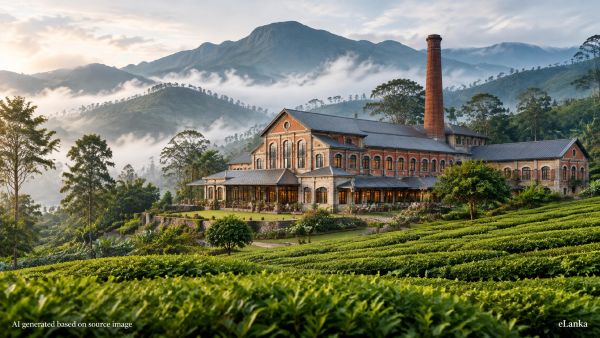
An AI-generated illustration evoking Sri Lanka’s central highlands and tea-growing landscape.
Their itinerary then brought them to Ella, where the sisters went ziplining above the valley and stopped for a drink at Ravana Pool Club, overlooking Little Adam’s Peak and Ella Rock. They also walked to the Nine Arch Bridge, the colonial-era railway viaduct built from stone, brick and cement without steel.
In Ella, they stayed at Newburgh Ella, a century-old tea factory restored as a hotel. The original industrial history remains part of the setting, while breakfast put local flavours firmly in the foreground: tuna hoppers with curry, kola kanda, and sambals and chutneys.
For visitors interested in the island’s food and agricultural heritage, a converted tea factory can offer a particularly tangible connection between place and product. The sisters recommend spending at least one night in one, citing Newburgh Ella and Heritance Tea Factory as examples.
Wildlife, the southern coast and Colombo
At Yala National Park, the sisters saw elephants and sloth bears and describe the region as having some of the highest leopard density anywhere in the world. Their account then follows the coast to Koggala, where they spent a night at The Fortress Resort & Spa. They write that the beachfront setting and standard of the stay felt like the kind of experience they might expect to pay twice as much for elsewhere.
At Sama Retreat, an eco-retreat, a doctor-led pre-visit consultation helped shape the sisters’ programme, including Ayurvedic treatments. One culinary highlight was a meal of large river prawns prepared by chefs from the surrounding village.
Colombo brought the journey to a close with a visit to the Lotus Tower and a sunset cruise with Sail Lanka. The sisters describe those final hours on the water, as the city skyline came into view against the evening sky, as among the most memorable of the trip.
They also single out their driver, Manouj from Aitken Spence, for praise. They valued his knowledge when they wanted conversation and his calm, smooth driving when the winding roads made a rest in the car welcome.
A useful reminder for visitors planning a return
The Bird sisters’ account offers a welcoming perspective for Sri Lankans in Australia and New Zealand who are planning a visit home, as well as for international travellers discovering the island for the first time. Its appeal lies not only in well-known landmarks, but in the details between them: a shared cooking lesson, tea tasted at its source, an unexpected invitation, and a meal prepared by people from the surrounding community.
For food lovers, the sisters’ practical suggestions are straightforward: say yes to sambal with everything, since every family and region makes it differently; ask tea estates to compare high-grown and low-grown leaves, as tastings are commonly offered; and allow slower days between major sights. They also recommend a night in a converted tea factory, such as Newburgh Ella or Heritance Tea Factory.
For readers travelling from New Zealand, the column’s fact file notes that Singapore Airlines flies from Auckland to Colombo via Singapore. The sisters travelled with Aitken Spence Travels.
The article’s warm account is also a timely contribution to Sri Lanka’s tourism reputation in Australasia. When two celebrated cooks return not simply to perform or work, but to eat, taste and remember, their reflections communicate the island’s culinary and cultural strengths in a personal register. Their story brings together the varied landscapes, distinctive food traditions and human welcome that can make a visit meaningful well beyond a checklist of attractions.
As the sisters write: “Ten years on, what struck us most wasn’t how much had changed. It was how much of what we loved was still exactly there.”
They conclude: “Sri Lankan food is generous the way its people are: layered, unhurried and built to be shared.”
And, looking ahead to another return: “We came home certain of one thing. We’ll be back well before another ten years pass.”
Source: The Post, “MasterChef NZ winners Kārena and Kasey Bird return to the Sri Lanka that stole their hearts”. The column is bylined to Kārena and Kasey Bird and was published by The Post on 20 October 2026.
This article was written based on the source https://www.thepost.co.nz/travel/361095170/masterchef-nz-winners-karena-and-kasey-bird-return-sri-lanka-stole-their-hearts, kindly email us at info@eLanka.com.au if any information needs to be corrected.
At eLanka, we respect the rights of creators. If we have used an image you own and you’d like it removed, please email us at info@elanka.com.au and we’ll handle it promptly.
Thanks.
eLanka team
eLanka Disclaimer
Content published on eLanka may be created by the eLanka team, submitted by contributors or third parties, reproduced or adapted from other sources with appropriate source acknowledgement, or provided as promotional/advertising material by our clients. While eLanka takes reasonable care in preparing and publishing content, we do not warrant its completeness or accuracy. Views expressed are those of the respective authors or contributors and do not necessarily represent the views of eLanka. Third-party contributors, content providers and advertisers are responsible for the accuracy of material they supply and for ensuring they hold the necessary rights and permissions for its publication. Advertising and promotional content should not be regarded as an endorsement by eLanka of any product, service or claim.