


A sojourn in ‘Ceilon’ and carefree life of Dutch colonial society
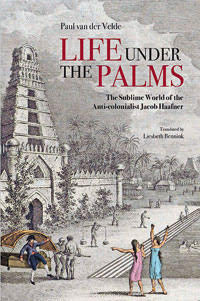
Book facts: Life Under the Palms: The Sublime World of the Anti-Colonialist Jacob Haafner- by Paul van der Velde Translated by Liesbeth Bennink Reviewed by Richard Simon
Source:Pressreader
In 1926, a translation of Reize te voet door het eiland Ceilon (Travels on Foot through the Island of Ceylon) by Jacob Haafner was published in the Journal of the Dutch Burgher Union. The translators, L.A. Prins and J.R. Toussaint, included in their work several passages critical of British rule in India that had been left out of the original, 1821 English translation of Haafner’s book. The Twenties were a period of intense political ferment in colonial Ceylon, and the author’s fulminations against the British were very much the point of the project.
Paul van der Velde’s biography of Haafner for general readers, translated into English by Liesbeth Bennink for the National University of Singapore Press, goes further. Generously quoting Haafner’s animad versions against Europeans in the Indies (a good half of the book consists of quotes from Haafner’s own published works), it describes its subject as an ‘anti-colonialist’. This is, to say the least, a questionable judgement. Jacob Haafner’s career in the Indies was typical, in every respect, of many eighteenth-century European imperialists. No evidence is offered in this book to show that he was philosophically or morally opposed to the European colonial project as such; he merely objected, as many others did, to its rapacity. Haafner endorsed the French possession of the isle of Mauritius and argued urgently in print against the cession of Ceylon by the Netherlands to Britain at the Treaty of Amiens; in later life, finding himself short of funds, he tried vigorously (but unsuccessfully) to obtain a position with the successor of the bankrupt Dutch East India Company, his old employer. These are not the actions of an anti-colonialist.
The argument need not concern us overly. To the Sri Lankan reader, what is most interesting about Haafner’s account of his sojourn in ‘Ceilon’ is his portrayal of the rank and file of Dutch colonial society in the island, and in particular the lives of the mixties or mestizos. Most writing on Sri Lanka from this period is found in official or ecclesiastical records, or in accounts of the country produced by officials and ecclesiastics. In such works, we catch only fleeting glimpses of the large, disorderly but thriving society of lower-class Europeans and half-castes struggling to make their fortunes under the rule of the Dutch East India Company and find their way back ‘home’ (an ever-diminishing prospect) before drink, debt and tropical disease end their careers for good.
Such was the society to which Haafner, by natural inclination, gravitated. He admired and envied the carefree lives of the Burghers with their native common-law wives and half caste, barefoot children. He loved the ease and informality of their manners, the laxity of their morals, their love of ‘Portuguese’ dance music, hot curries, round-the-clock half-undress and all-day drinking. Despite having ‘gone native’ with a vengeance, many of these men remained in the employ of the Dutch East India Company; others were vrije burgers who had set up as settlers and traders on their own account. They were, in fact, the ancestors of the Dutch Burghers of Sri Lanka, and Haafner’s frank portrayal will make uncomfortable reading for some of their present-day descendants.
We followed the sergeant to his hut and met a large company… four young girls, three mestizo women with their husbands sitting under a large tamarind tree in front of the door and entertaining themselves with the sound of an Indian zither embellishing their voices. The sergeant told me that he gave a family party on the occasion of his daughter’s visit.
Much bibulous revelry ensues. In his cups, the ‘sergeant’ reveals to his guests that he was only a corporal with the pay of a sergeant, with six Topass soldiers under his command, and that his work consisted only of monitoring a few salt pans that were situated before the village and the collection of fees and taxes for the VOC… he was called Jan Voet, and his father and grandfather had spent their entire lives at this [same] post.
In a different place, he describes a former VOC soldier, now down on his luck in Jaffna:
He spoke a mixture of broken Dutch and High German, lavishly laced with cursing and in the accent of Strasbourg… He was married to four women in different cities in Europe (and) as far as he knew they were all still alive when he left for the East… (In Nagapatnam) he had married his fifth wife, a black Roman Catholic girl from the pariah caste. She was a pretty thing and worked as a maid for a European woman named Barbara…
We are a world away, here, from the tidy, spotlessly European genealogies that share the pages of the JDBU with Haafner’s book.
Jacob Haafner did not spend much time in Sri Lanka and it cannot be said that he knew the country well. The portions of his work quoted here are full of geographical and historical errors, which are reproduced without comment by his biographer. Most are relatively minor, but a reference to ‘the Vanni’, whom Haafner calls ‘the native inhabitants of the island,’ is likely to raise a few hackles. He probably means the Vanniyar, a South Indian caste who first arrived in Lanka in historical times and settled in the largely forested no-man’s-land between the areas of Sinhalese and Tamil settlement that is now known as the Vanni. Errors of this kind do the credibility of Haafner’s biographer no favours.
* * *
It’s good to see the National University of Singapore Press building up a historical and cultural catalogue aimed at non-academic readers, similar to the exemplary catalogues of Western academic publishers like the Oxford University Press. The educational duties of a national university go beyond the mere instruction of those formally enrolled as students, and producing material for general audiences that is both entertaining and instructive is surely an important part of the work. Going by this book, however, Singapore still has some room for improvement. The geographical and historical errors mentioned here are admittedly Haafner’s own, yet van der Velde should have taken the trouble to note them as such. The translation, too, leaves a good deal to be desired; the style is arid, the syntax at times positively Teutonic, and the native English speaker is hard put to decipher such turns of phrase as ‘a funk of 22 years’ and ‘at the pen in Nagapatnam’. The accents of the Straits of Malacca also seem to enter the picture when the Sinhala word for ‘python’ is not rendered as pimbura but as a Malay-sounding pimbera. But these are quibbles, and will not detract greatly from your enjoyment of this biography of an unusually – often shamelessly – candid European imperialist.
(The book is available at the Barefoot bookshop, Colombo)
A portrait of Keyt the genius
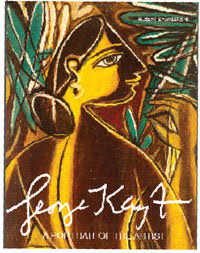
‘George Keyt – A Portrait of the Artist’ by Professor Albert Dharmasiri has just been released, the third in the series “Seven Artists of an Era” published by the National Trust, Sri Lanka.
The book is a portrait of Keyt, the inexhaustible genius blessed with an extraordinary creative imagination, who was one of Sri Lanka’s greatest painters of the 20th century with an absolute dedication to art, illuminated by his Bohemian personality. The images of his pictorial narratives are powerful, vibrant and erotically charged.
Author Professor Albert Dharmasiri is the first Sri Lankan Emeritus Professor of Painting of the University of Visual and Performing Arts in Colombo (UVPA).
The book is sponsored by the Softlogic Holdings Group.
Please call 0778081214 for further information.