



A synthesis of native craft and European design-by RANDIMA ATTYGALLE
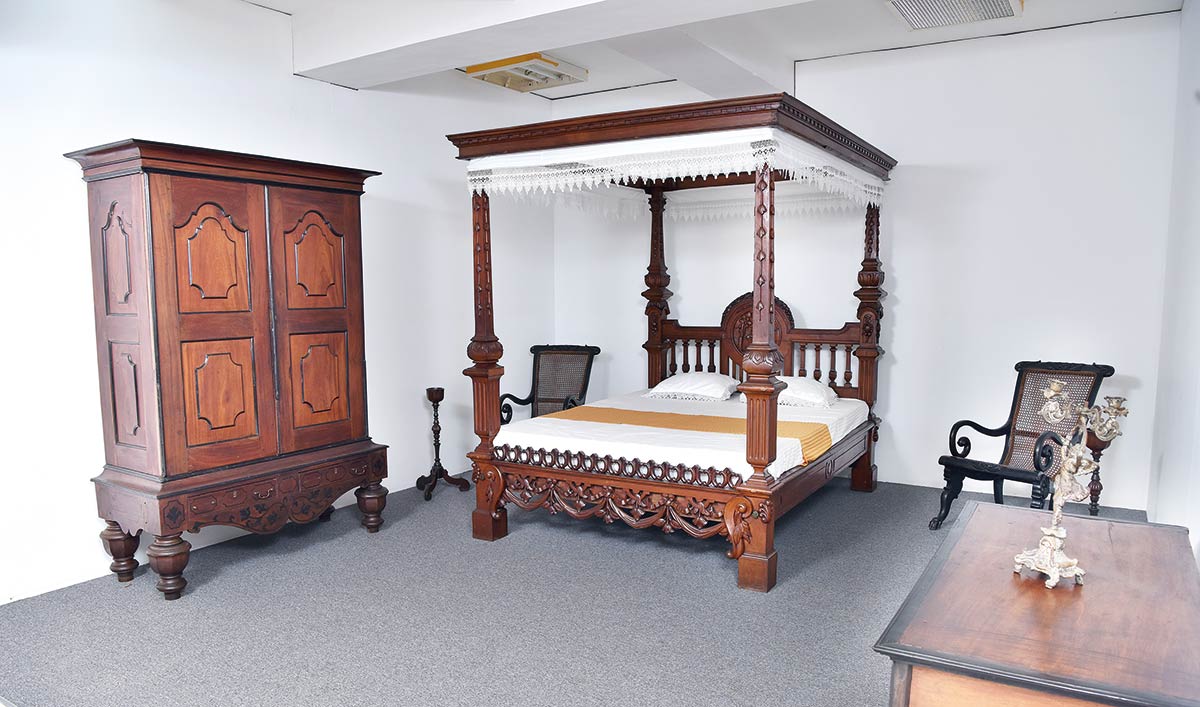
A replica of a colonial time bedroom
Source:Island
Colombo National Museum’s new Furniture Gallery which displays a fine collection from the Kandyan kingdom and the colonial times, is soon to be opened to the public. We had a sneak-peak at the new gallery’s intricately designed ebony almirahs, four-posters, palanquins from the Kandyan times, cradles and Burgomaster chairs from the Dutch times and much more…
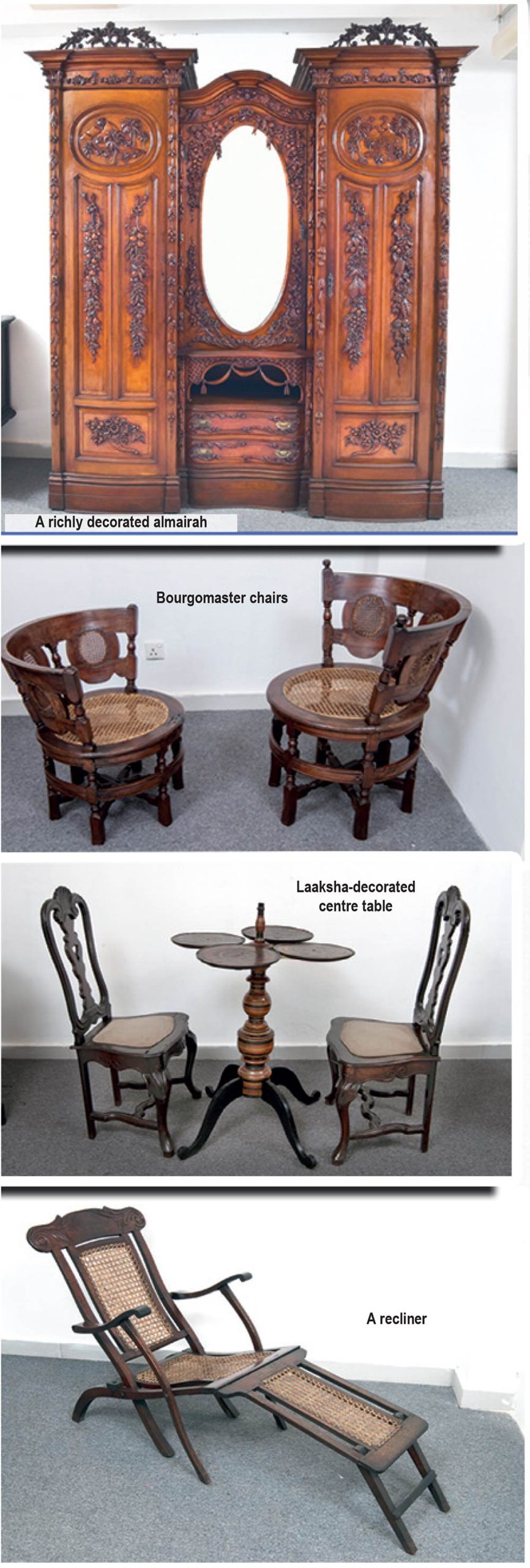
The first impression of the Colombo National Museum’s new Furniture Gallery is that it’s a synthesis of the indigenous craft and that of the European genus. The 17th century Dutch grandfather clock which stands tall at the entrance to the gallery is juxtaposed with the traditional Kandyan laaksha-embelished centre tables. The richly ornamented Kandyan palanquins and finely crafted chairs inspired by the Dutch tradition, equally speak for the skills of the Lankan artisan who could navigate different schools of art with ease.
A luxury of the nobility
Until the mid-20th century, the use of furniture in Lankan homes was minimal. Except for small three-legged benches, there were hardly any pieces of furniture found in ordinary households. Even guest seating was arranged by laying a mat on the outside verandah. The use of furniture was accepted as a luxury by the royalty, nobility and the priests. Ananda Coomaraswamy in his work Mediaeval Sinhalese Art notes that, ‘none but the king was allowed to sit upon a chair with a back.’ The chairs that we are familiar with today did not exist here at home in the early 16th century. Coomaraswamy further writes of a beautiful chair dedicated by Kirti Sri Raja Sinha preserved in the Asgiriya pohoya-ge which is painted and inlaid with ivory. Paintings at Degaldoruwa also depict a number of types of stools and chairs. ‘Ordinary tables, were not in general use, though mentioned by Knox (Robert Knox) among the King’s private treasures, most of which he had obtained from wrecks or were gifts brought by ambassadors,’ says Coomaraswamy.
Colonial influence
Most of the furniture we are familiar with today such as chairs, tables, bedsteads and wardrobes were first introduced to the island by the Portuguese in the 16th century. The native words putuwa and almariya (derived from the Portuguese word armario) are of Portuguese origin. Later, the Dutch colonization of the coastal areas of the island gave birth to a rich furniture-making legacy.
In the article, ‘Colonial Dutch Furniture’ by E. Reimers published in the Journal of the Ceylon Branch of the Royal Asiatic Society (RAS) of 1937 (Vol XXXIV), the writer states that the ‘Dutch with their characteristic caution and attention to details should have provided for their domestic needs in their Eastern colonies’ and have probably brought some of their master carpenters to the island. Local carpenters probably became their understudies.
R . L Brohier in his book, Furniture of the Dutch Period in Ceylon documents: ‘Large number of Porto-Sinhalese and others from the Sinhala community whose ancient trade was carpentering found employment in the Dutch winkels or workshops in Ceylon. It was from the Dutch that the ‘Moratuwa Carpenter’ and the Low country Sinhalese generally learnt the art of furniture-making and even up to the British period of occupation in Ceylon duplicated the genuine Dutch models and preserved many of the Dutch patterns.’
Superior Ceylonese furniture
Brohier further notes that, ‘the period which the Dutch were in Ceylon synchronized with this golden age of furniture development in Europe-claimed by authorities to have been a period of artistic activity never equaled before or since in the history of furniture.’ The assortment of chairs, settees, book cases and wardrobes found in the Colombo Museum’s new gallery is a testimony to this legacy the Dutch.

Grandfather Clock believed to be that of the last Dutch Governor in Ceylon
The Burgomaster chair type which was first made in the Netherlands in about 1650 and the subsequent Queen Anne Style type and those of the rococo style (which are found in the Wolvendaal Church in Colombo) are among the interesting chairs found in the gallery. Jan Veenendaal in his book, Furniture from Indonesia, Sri Lanka and India during the Dutch Period, observes the distinction between the chairs from Sri Lanka and Indonesia in the 1740s. ‘The difference between chairs from Sri Lanka and Indonesia is very marked during this period. In Sri Lanka, the Dutch style was followed more assiduously, Chinese and of course Indonesian influences on methods of ornamentation are completely absent.’ Dr. Joseph Pearson in his writing in RAS (Ceylon) Vol XXXI, 1938 makes a distinction between old Javanese and Ceylonese furniture: ‘Generally speaking, the types of old furniture in Java has characters of its own…. The furniture is frequently overloaded with rough carving and as a rule is inferior to Ceylon furniture which is dignified in style and restrained in motif.’
Clock of the last Dutch Governor
The grandfather clock in the gallery is indeed a show-stealer. Brohier in his work provides an extensive account of it. Dating back to 1710, the clock it claimed to have been the property of the last Dutch Governor of Ceylon, John Gerard van Angelbeek. Subsequently, it passed into the possession of Leslie de Saram who was a connoisseur of antiques in 1936. He then gifted it to the University of Ceylon in memory of his mother. Brohier recalls having seen this iconic article on a visit to the university in 1963 when the clock was still intoning ‘tick-tock’. This valuable antique was ‘indecorously destroyed beyond repair together with other articles of furniture in the student riots of December 1965,’ records the historian.
Local timber and art
The laaksha or traditional Sri Lankan lacquer work has a deep-rooted history. Matale is the best-known region in the island for this art. The legend has it that this art was introduced to the island with the arrival of Theri Sangamitta who brought the sapling of the sacred ‘Sri Maha Bodhi’ tree, accompanied by numerous artisans who introduced their respective traditions to the island. Ananda Coomaraswamy describes the Sinhalase lac-work to be of ‘great brilliancy and gaiety of colouring.’ He also notes that most of the work is from a decorative point of view. The laaksha-adorned centre tables found in the gallery mirror this brilliance and add colour to the place.
In the selection of material for their earliest 17th century furniture, the Dutch appear to have shown a marked preference for dark or coloured woods, mainly ebony, records E. Reimers in his contribution to RAS (Ceylon) of 1937 (Vol XXXIV). ‘We may imagine that the Hollander’s imagination ran riot when he first came out to the East and saw rich varieties of woods which the virgin forests of Ceylon and Mauritius afforded.’ Among the other local timbers sought after by the Dutch were Calamander, (which was found in the wet forests of the Southern provinces and in the wilderness of Sri Pada, recklessly felled by the Dutch and the British and is almost extinct today), Nedun, Satinwood, Tamarind, Kumbuk, Jak, Halmilla, Suriya, Kohomba and Mara.
Public participation
The soon to be opened new Furniture Gallery at the Colombo National Museum is a fine representation of the cultural intersection of Sri Lanka, says the Director General of the Department of National Museums, Sanuja Kasthuriarachchi. “The fine collection of furniture we have as exhibits ranging from the Kandyan era to the British period in the island reflects not merely the colonial influence on the furniture-making in the island but also the fact that our traditional carpenters and artisans were naturally endowed with the skill, given their long-standing association with wood crafts.
“The Kandyan Kingdom in particular is associated with an architecture and crafts dominated by wood. This inherent skill would have probably driven our carpenters of the colonial times to ably grasp the European styles,” remarks Kasthuriarachchi who invites history-lovers to enjoy the exhibits and revisit a rich tradition. “We also welcome unique articles of furniture as gifts from the public to the gallery as means of enabling a richer experience to museum visitors,” she added.
(Pic credit: Department of National Museums)