AI-Powered Digital Humans: The Future of Customer Service
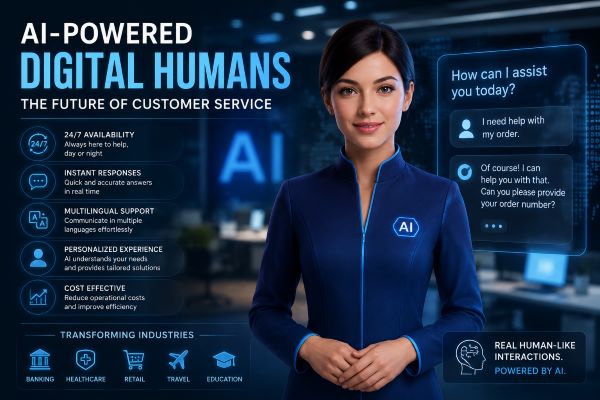
Artificial Intelligence (AI) continues to reshape industries around the world, and one of the most exciting developments is the emergence of AI-powered digital humans. These virtual beings combine artificial intelligence, natural language processing, realistic facial expressions, and voice technology to interact with customers in ways that closely resemble human communication.
From banks and airlines to healthcare providers and retail businesses, organizations are increasingly adopting digital humans to enhance customer experiences, reduce operational costs, and provide round-the-clock support. As technology advances, digital humans are poised to become a significant part of the future customer service landscape.
What Are AI-Powered Digital Humans?
AI-powered digital humans are virtual characters designed to communicate with people using natural conversations. Unlike traditional chatbots that rely primarily on text, digital humans can speak, listen, display emotions, and respond with realistic facial expressions.
These systems typically combine several technologies:
- Artificial Intelligence (AI)
- Natural Language Processing (NLP)
- Speech Recognition
- Text-to-Speech Technology
- Computer Vision
- 3D Character Animation
- Machine Learning
By integrating these technologies, digital humans can understand customer inquiries and provide personalized responses in real time.
How Digital Humans Work
The process begins when a customer asks a question through a website, mobile application, kiosk, or video interface.
The digital human:
- Receives the customer’s input.
- Uses AI to analyze and understand the request.
- Searches relevant information from databases or knowledge systems.
- Generates an appropriate response.
- Delivers the answer using a realistic voice and facial expressions.
The entire interaction often takes place within seconds, creating a natural conversational experience.
Why Businesses Are Embracing Digital Humans
24/7 Customer Support
One of the biggest advantages of digital humans is their ability to operate around the clock. Customers no longer need to wait for business hours to receive assistance.
Faster Response Times
Digital humans can instantly answer frequently asked questions, reducing waiting times and improving customer satisfaction.
Cost Efficiency
Organizations can significantly reduce customer service costs by automating routine inquiries while allowing human staff to focus on complex cases.
Consistent Service Quality
Unlike human agents who may vary in performance, digital humans provide consistent responses based on approved information.
Multilingual Communication
Advanced digital humans can communicate in multiple languages, enabling businesses to serve global audiences more effectively.
Real-World Applications
Banking and Financial Services
Banks are using digital humans to assist customers with account inquiries, loan information, financial guidance, and digital banking support.
Healthcare
Healthcare organizations deploy virtual assistants to help patients schedule appointments, answer common medical questions, and provide healthcare information.
Retail and E-Commerce
Online retailers use digital humans to guide customers through product selections, recommend items, and assist during the purchasing process.
Travel and Hospitality
Hotels, airlines, and tourism operators use digital humans to provide booking assistance, travel information, and customer support.
Education
Educational institutions are utilizing digital humans as virtual tutors, helping students access learning resources and academic guidance.
The Human-Like Experience
Modern digital humans are becoming increasingly realistic. Advanced systems can:
- Maintain eye contact
- Display facial expressions
- Recognize emotional cues
- Adapt communication styles
- Remember previous interactions
These capabilities create a more engaging and comfortable experience for users compared to traditional automated systems.
Benefits for Customers
Customers often benefit from:
- Immediate assistance
- Reduced waiting times
- Personalized recommendations
- Consistent information
- Convenient self-service options
For many routine inquiries, digital humans can provide answers faster than traditional customer service channels.
Challenges and Limitations
Despite their advantages, digital humans still face several challenges.
Lack of True Human Empathy
Although digital humans can simulate emotions, they do not genuinely understand human feelings in the same way people do.
Privacy Concerns
Organizations must carefully manage customer data and ensure compliance with privacy regulations.
Technical Limitations
Complex or unusual customer issues may still require intervention from human agents.
Implementation Costs
Developing sophisticated digital humans can require substantial investments in technology and infrastructure.
The Future of Customer Service
As AI technology continues to evolve, digital humans will become more intelligent, realistic, and capable. Future systems may:
- Understand emotions more accurately
- Offer highly personalized assistance
- Integrate seamlessly with business systems
- Support advanced problem-solving
- Deliver near-human conversational experiences
Industry experts predict that digital humans will increasingly work alongside human employees rather than replace them entirely. Routine tasks will be handled by AI, while complex situations requiring empathy, judgment, and creativity will remain the responsibility of human professionals.
Conclusion
AI-powered digital humans represent a significant advancement in customer service technology. By combining artificial intelligence, realistic visual representation, and natural communication capabilities, these virtual assistants are helping organizations deliver faster, more efficient, and more engaging customer experiences.
While challenges remain, the rapid pace of technological innovation suggests that digital humans will play an increasingly important role in the future of customer service. Businesses that embrace this technology today may gain a competitive advantage as customer expectations continue to evolve in an increasingly digital world.