Ancient City of Sigiriya, Sri Lanka – (taken from TrueCeylonCinnamon.LK Linked In)
(Integrated ancient engineering and world heritage significance)
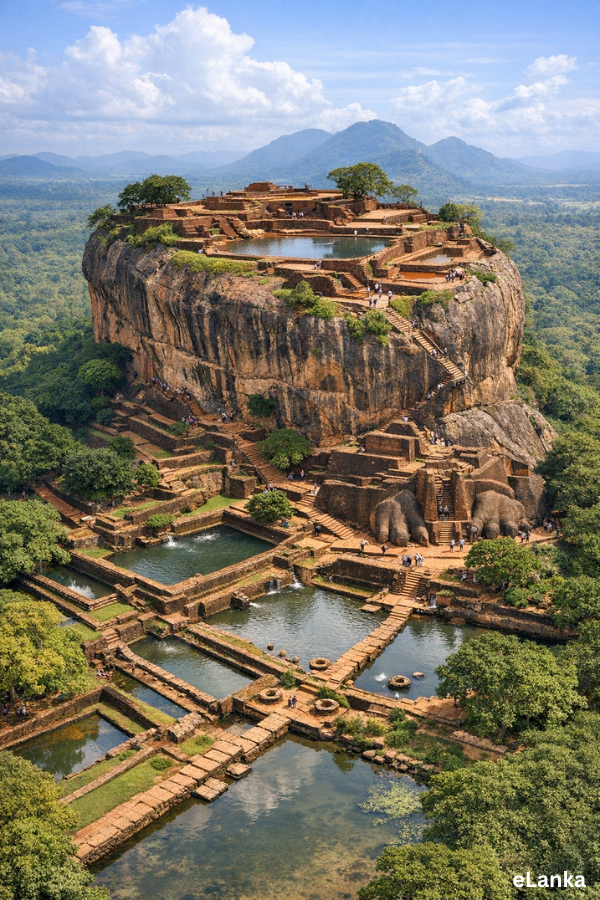
Source: TrueCeylonCinnamon.LK LinkedIn
Sigiriya, constructed in the 5th century CE in Sri Lanka’s dry zone, represents an exceptional convergence of ancient engineering, landscape architecture, and cultural symbolism. Recognized as a UNESCO World Heritage Site in 1982, the “Ancient City of Sigiriya” is valued not only for its historical importance but also for its scientifically demonstrable engineering sophistication.
Archaeological and engineering research identifies Sigiriya as an intentionally designed gravity-driven hydraulic landscape. Water management relied on a hierarchical system of reservoirs, moats, surface channels, and underground terracotta conduits. Elevated tanks enabled controlled water distribution without mechanical pumping, while perforated limestone fountain bases used pressure differentials to generate water displays during monsoon seasons, some of which remain functional today (Cooray, 2010). Summit habitation was sustained through rainwater harvesting via rock-cut cisterns, contradicting popular myths of water being lifted mechanically from the base (Bandaranayake, 1990).
The site demonstrates advanced environmental engineering and terrain adaptation. Terraced gardens, axial symmetry, and integrated drainage channels were designed to regulate runoff, reduce erosion, and stabilize soil under heavy seasonal rainfall. Rather than reshaping the landscape extensively, engineers exploited natural slopes and rock formations, achieving minimal ecological disturbance and long-term structural stability.
Structurally, Sigiriya’s palace complex reflects optimized load distribution and material efficiency. Brick superstructures were selectively placed on the monolith, reducing dead load, while circulation systems, stairways, galleries, and transitional terraces, balanced security, accessibility, and safety. These features reveal a systemic understanding of geology, stress management, and human movement.
From a heritage science perspective, Sigiriya fulfills UNESCO criteria (ii), (iii), and (iv) by demonstrating an outstanding interchange of human values, bearing testimony to a vanished royal urban tradition, and exemplifying monumental engineering integrated with natural terrain. Its authenticity and integrity, evident in preserved layouts, materials, and hydraulic principles, make Sigiriya a critical reference site for studying pre-modern engineering adapted to climate and environment.
References
Bandaranayake, S. (1990) Sigiriya: City, Palace and Landscape. Colombo: Central Cultural Fund.
Cooray, P.G. (2010) ‘Hydraulic engineering and water management at Sigiriya’, Architecture and Built Environment. Delft University of Technology.
Paranavitana, S. (1957) Sigiriya: The Lion Rock Fortress. Colombo: Archaeological Survey Department.
UNESCO (1982) Ancient City of Sigiriya. Paris: UNESCO World Heritage Centre.