Book Review: The Historian As Bridge-by Jehan Perera
Source:Colombotelegraph
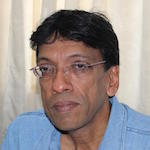
Jehan Perera
Glimpses of an Ancient Civilisation: Society and Culture in Jaffna (300 BC to AD 500) by Professor S. Pathmanathan. SSSR Investments Pty Ltd, Australia, 2026. Pp. 370.
In reflecting on the work of Professor S. Pathmanathan, my mind goes back to the difficult years of war, when fear and mistrust had entered almost every sphere of national life. Those were times when it was easier, and often safer, to remain on one side than to reach across to the other. Yet what I remember most about him from those years is not only the depth of his scholarship, but the steadiness of his convictions and the generosity with which he engaged those who differed from him. At a time when history was often invoked to divide, he remained committed to using it to illuminate and connect. It is with that memory in mind that I read his latest work, Glimpses of an Ancient Civilization.
Glimpses of an Ancient Civilization by Professor Sivasubramanium Pathmanathan is an important book, which examines the society and culture of Jaffna from 300 BC to AD 500. It marks a significant milestone in the historical research undertaken on Sri Lanka. It is the work of a scholar who has laid a firm foundation on which future generations of researchers can build with confidence. The special value of the book lies in the way it invites us to see Sri Lanka’s past differently. At a time when history continues to be drawn into contemporary political contestation, Professor Pathmanathan offers a disciplined and rigorous approach. His method reflects a high standard of historical inquiry in its scientific sense, as a continuing refinement of understanding in the light of fresh evidence, better methods and wider comparative perspectives.

The book is organised into eighteen chapters across five thematic sections. The structure is carefully conceived and enables the reader to move from broad historical frameworks into increasingly focused analyses of settlement patterns, economic systems, belief structures and the cultural life of early Jaffna. The progression is measured and logical, moving from foundational formations to more complex expressions of society and culture. At the centre of the study is Professor Pathmanathan’s analysis of the Early Iron Age cultural complex shared between Sri Lanka and South India. Drawing on burial sites, ceramic assemblages, iron artefacts, settlement evidence and inscriptions, he reconstructs a world in which new forms of social organisation emerged while older continuities remained visible.
A major strength of the book is its refusal to confine early Sri Lankan history within the island’s present-day geography. Instead, Professor Pathmanathan situates northern Sri Lanka within the wider civilisational world of the Indian subcontinent, what older traditions understood as Jambudvipa, and within the more specific historical-cultural regions of Bharata that shaped the life of South India and Sri Lanka alike. This avoids the distortions that arise when modern territorial assumptions are projected backwards onto the ancient past. The result is a more historically grounded picture of interaction across the Palk Strait, in which the north of Sri Lanka appears not as an isolated frontier but as part of a larger zone of movement, exchange and cultural formation.
Rather than restricting the inquiry to northern and eastern Sri Lanka alone, the book extends the search across South India, where early historiography, Chola-era expansions and classical Tamil texts preserve references to places such as Manipallavam. Particularly significant is his fresh and systematic re-examination of Tamil Brahmi inscriptions, which have often been treated in a fragmentary manner in earlier scholarship. By restoring them to the centre of inquiry, he opens new perspectives on literacy, social hierarchy, exchange networks and the gradual formation of identities. The archaeological record, including Iron Age megalithic burials and earlier Neolithic sites, spans both Sri Lanka and South India.
Comprehensive Approach
History in Sri Lanka has often been used to separate rather than connect. The broader evidentiary field, as identified in research, helps address longstanding historical gaps without yielding to narrow nationalist claims that seek to attach the Nagas exclusively to any single present-day ethnic ancestry. The evidence points to a more complex and shared civilisational inheritance shaped by movement, overlap and layered belonging. As was noted at the launch by the chief guest, the well-known lawyer Dr K. Kanag-Isvaran, PC, history is usually taught in ways that divide, whereas this book is animated by the opposite purpose. It seeks to unite. That unifying quality is grounded in evidence rather than sentiment.
Professor Pathmanathan’s work shows that the peoples of this country did not live in sealed silos or as separate civilisations. The identities that today appear fixed were shaped through long centuries of interaction, migration, adaptation and coexistence. Both Tamil-speaking and Sinhala-speaking peoples emerge in his work as products of local historical evolution on the island, though from different linguistic streams. Tamil-speaking communities in the north are shown as local peoples who gradually adopted a South Indian Dravidian language through sustained contact. Sinhala-speaking communities in the south and centre are understood as local populations who reshaped an Indo-Aryan Prakrit into a uniquely Sri Lankan language. The roots differ, but the civilisational soil is shared.
This same framework must also include the Muslim community, whose history in Sri Lanka cannot be reduced to coastal settlements alone. Professor Pathmanathan’s broader work on ports, trade routes, mercantile settlements and maritime exchange reminds us that Sri Lanka was shaped not only by inland kingdoms but also by the sea. The seas around the island did not divide its peoples. They connected them. Through the ports of Jaffna, Mannar, Trincomalee, Colombo, Galle and the eastern coast came traders, scholars, sailors, spiritual traditions and communities from South India, the Arab world and the wider Indian Ocean. Over time these communities settled, intermarried, adopted local languages and became deeply rooted in the life of the island. Their story strengthens Professor Pathmanathan’s larger insight that Sri Lanka’s civilisation was formed through meeting rather than isolation, through exchange rather than exclusion.
The book’s treatment of religion deepens this unifying perspective. His discussions of Nāga worship, Saivism and Buddhism in Nāgadīpa, and of the symbolic continuities between Jaffna and Anuradhapura, reveal a religious world in which sacred spaces and symbols were often shared. The five-headed cobra associated with Nāga traditions reappears as a guardian figure in Buddhist architecture, while Saivite shrines preserve older serpent cults. These continuities point to a shared moral and symbolic universe that cuts across later divisions. Professor Pathmanathan’s work on Buddhism in Nāgadīpa, on Nāga worship, on Saivism, on shared symbols across Anuradhapura and Jaffna, all point to the truth that the north is not outside the story of Sri Lanka. The south is not outside the story of Jaffna. A shared future becomes possible when we accept that the lands we inhabit, the places we revere, the languages we speak and the memories we cherish have all been shaped through encounter.
It is in this sense that the book becomes an intellectual resource for national reconciliation. For too long, Sri Lanka’s past has been narrated through frameworks that emphasised separation. Communities were encouraged to see themselves as bearers of distinct destinies and exclusive historical claims. Professor Pathmanathan’s work helps correct this by showing the histories of the island’s peoples are intertwined. This has direct relevance to the present. Political solutions remain necessary. Constitutional arrangements, devolution, dignity and equality matter deeply. But such arrangements become long lasting only when supported by a social understanding that coexistence and shared belonging are natural and legitimate. Scholarship of this kind helps create that moral and cultural ground.
Complementary Aspects
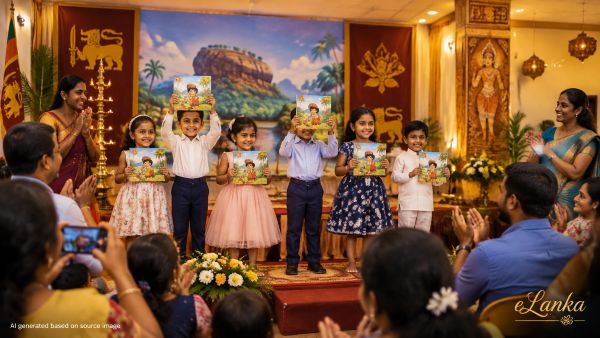
At the launch of the book, one of the reviewers, Professor B. A. Hussainmiya, a member of Sri Lanka’s National Archaeology Advisory Committee, observed that the book deserves the respectful and critical attention of historians and academics across all backgrounds and traditions. It deserves equally the attention of those concerned with the larger national task of how a country with multiple memories can still move towards a common future. Another important point raised at the launch, by Dr J. M. Swaminathan of the Reparations Commission, was that history is not given an adequate place in the education of today’s youth. A post-war Sri Lanka requires a broader historical curriculum, one that includes the latest archaeological findings, reaches back to the Yakshas and Nagas of prehistory, and extends forward into the internal wars of the post-Independence period and their causes. Professor Pathmanathan’s work offers precisely the evidentiary depth needed for such a reorientation.
An additional feature of significance surrounding this publication is the role played by Jitto Arulampalam, a member of the Sri Lankan diaspora in Australia, whose sponsorship made both the publication and launch of the book possible. His own life journey gives this support a meaning that goes beyond patronage. He left Sri Lanka in 1983 as a schoolboy with his parents in the aftermath of the anti-Tamil riots, and has since gone on to build a career in Australia in banking, investment and, more recently, in the field of artificial intelligence and corporate leadership. That someone whose formative life experience included one of the darkest ruptures in Sri Lanka’s ethnic relations should choose to support the wider dissemination of a work such as this is itself significant. It points to the constructive role that the Sri Lankan diaspora can play in the country’s future, not only through economic investment and international linkages, but also through the strengthening of intellectual and cultural resources that help rebuild trust across communities.
Glimpses of an Ancient Civilization, therefore, offers a way of thinking about Sri Lanka itself. What emerges from its pages is not a story of separation, but of interaction, mobility, overlap and shared evolution across regions and communities. Professor Pathmanathan shifts the conversation away from exclusive claims and towards a recognition of shared inheritances. The significance of the diaspora support that helped bring this book into wider public view adds a further layer of meaning. It suggests that the bridges recovered through scholarship can also become bridges in contemporary life, linking Sri Lanka to its global communities through memory, investment, ideas and goodwill. For that reason, as well as all the others outlined above, this is a book that deserves to be read not only by historians and archaeologists, but by those in Sri Lanka and beyond who are concerned with the difficult but necessary work of building trust across ethnic, religious and regional divides, strengthening international linkages, and moving towards a common future.