Evolution towards the Sinhala language, transitioning from an English-based educational system in our homeland-by Harold Gunatillake

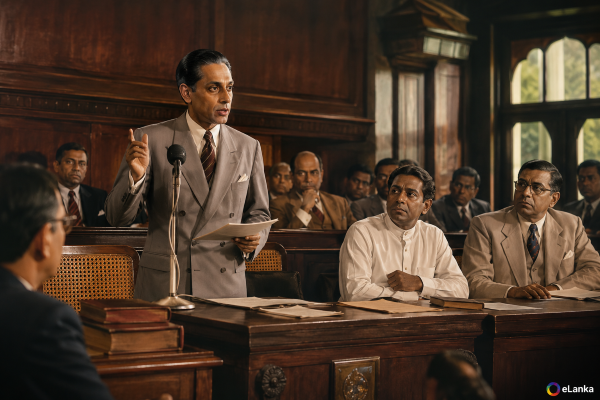
J.R. Jayewardene commenced his role in the State Council of Ceylon in 1943, following his victory in the Kelaniya by-election, thereby inaugurating his significant legislative career. Shortly thereafter, on May 24, 1944, he presented a historic motion to the State Council advocating for Sinhala to supplant English as the official language of instruction across all educational institutions. Although his initial proposal was solely focused on Sinhala, an amendment was subsequently introduced by his colleague,
S.W.R.D. Bandaranaike, to incorporate Tamil as well. This legislative milestone established a foundational step toward the nation’s transition from English-medium colonial education.
Please review my preceding article on ‘Burgher Emigration’ published on July 17th of this year. The current continuation has
been prepared following corrections made by Rajiva Wijesinha to certain events.
He states that the policy of making education in Sinhala and Tamil compulsory for students of these respective ethnic groups was implemented by J R Jayewardene shortly after he acceded to the State Council. Initially, he proposed that instruction be conducted exclusively in Sinhala for all students; however, this proposal was later amended to include Tamil after objections from senior members. This requirement applied solely at the primary education level. The expansion to secondary education was effected in 1951 through an ordinance introduced by Eddie Nugawela, then Minister of Education.
The Sinhala Only Act had nothing to do with Education.
Burghers, Muslims, and individuals of mixed parentage were permitted to pursue education in English if they so desired. An English-medium educational system was in place during the 1960s and persisted until the late 1970s, with English-medium instruction being formally discontinued in the mid-1970s.
The exodus of Burghers commenced well before that, shortly after independence, when the White Australia Policy led to the separation of some families, and the movement further expanded with the implementation of Sinhala-only policies.
Kindly peruse my publication regarding English and Education, obtainable through Godage. Continuing to propagate these myths serves no beneficial purpose.
It should be noted that the reintroduction of the English medium was initiated at my request. I instructed Tara de Mel, who was the Secretary to the Ministry, to commence the programme. She initially suggested implementing it in two schools, which I advised against. Subsequently, she proposed introducing it nationwide if I assumed responsibility for the initiative. Consequently, I had no alternative but to proceed. However, Ranil opposed the programme upon assuming power. Fortunately, the Minister of
Education at the time supported its continuation, ensuring its persistence.
(Dr. Tara de Mel’s proposal from mid-2001 to expand English-medium education within Sri Lankan government schools. As the Secretary to the Ministry of Education at the time, she initially intended to implement a pilot program in two schools—one located in Colombo and the other in Kandy.
Key Context of the Programme: The Core Initiative: While Dr. de Mel had already introduced Advanced Level Science classes in English, this specific expansion aimed to restart broader English-medium instruction at the secondary school level. Expanding the Scope: Educational experts, including academic Rajiva Wijesinha, advised her against limiting the programme to just a couple of elite schools. They pushed to make English-medium education more widely available to prevent it from becoming exclusive to a privileged few)
I regret that you persistently disregard the facts on this subject, Rajiva.
(Rajiva Wijesinha (born 1954) is the author of ‘Servants’ (1995) and ‘An English Education’ (1996). He is best known in Sri Lanka’s English literary sphere as an editor of multiple literary anthologies and an advocate for domestic writing both nationally and internationally. His diverse contributions span education, literature, diplomacy, and politics, and his classical scholarship frequently emerges through his writings, reflecting a Renaissance-like presence across these fields.
To proceed with my inquiry, the following information will elucidate the topic.
- R. Jayewardene’s 1944 Resolution
Subsequently, after assuming membership in the colonial legislature, the State Council, J.R. Jayewardene submitted a motion on May 24, 1944. This motion advocated replacing English with Sinhala as the sole official language and medium of instruction.
As observed, senior and minority representatives raised objections. Notably, V. Nalliah, the representative for Trincomalee, proposed an amendment to substitute “Sinhala” with “Sinhala and Tamil.” Jayewardene approved this amendment, resulting in the passage
of the resolution by the State Council, which designated both vernacular languages to supersede English.
2. The Primary Level Scope
This initial transition was strictly confined to primary school education, beginning in 1945. English remained the dominant medium for administration, higher competitive examinations, and secondary schooling.
- The Expansion Undertaken by Minister Eddie Nugawela in 1951 The extension to secondary education occurred precisely as you delineated. Major Edward “Eddie” Nugawela, who served as the inaugural Cabinet Minister of Education, issued a significant white paper and subsequent education ordinances and regulations in These measures mandated a gradual, year-by-year transition of the medium of instruction from English to Swabhasha (Sinhala and Tamil), beginning at the junior secondary school level (Grade 6).
The C.W.W. Kannangara Report (1943): Establishing the Foundation for Swabhasha
The journey toward vernacular education was initially characterised not by ethnic conflict but by an anti-colonial, egalitarian movement aimed at democratising education. Christopher William Wijekoon (C.W.W.) Kannangara, who served as the Chairman of the Executive Committee of Education in the State Council, led the efforts on the Special Committee on Education Report of 1943.
- Abolishing the Two-Tiered System: Colonial Ceylon maintained an unequal dual-track educational A small, elite-financed English-medium instruction, thereby monopolising esteemed civil service roles. Conversely, the majority were relegated to underfunded vernacular schools that offered Sinhala and Tamil curricula.
- The Swabhasha Mandate: The 1943 report established Swabhasha (mother-tongue instruction) as a fundamental It mandated that primary education be taught in a child’s native tongue (Sinhala or Tamil), with English introduced as a compulsory second language.
- Weapon of Social Mobility: Kannangara famously conceived this policy, in conjunction with his landmark Free Education Scheme of 1945, as a means to provide access to secondary and university education for talented rural youths who had previously been excluded due to the language barrier of At this point, “Swabhasha” explicitly signified equality. Both indigenous languages were regarded as equal tools to challenge the dominance of the English-educated elite.
2. The 1956 Sinhala Only Act: Overthrowing Parity
By the mid-1950s, the idealistic, cross-ethnic solidarity of the Swabhasha movement disintegrated along communal boundaries. S.W.R.D. Bandaranaike achieved a decisive victory in the 1956 general election by leveraging increasing Sinhalese nationalist concerns.
Nationalists contended that Sri Lankan Tamils were disproportionately represented in the elite civil service, various professions, and universities in comparison to their population size—a heritage stemming from colonial-era missionary schools in the North.
In July 1956, the newly elected parliament enacted the Official Language Act No. 33 of 1956, widely recognised as the Sinhala-Only Act. This legislation designated Sinhala as the state’s sole official language, thereby abandoning the previously advocated principle of linguistic parity with Tamil.
3. The Immediate and Long-Term Political Fallout
The enactment of the bill immediately transformed a constitutional, anti-colonial language debate into an existential ethnolinguistic fracture. Institutional marginalisation of Tamils ensued, rendering it practically impossible for non-Sinhala speakers to engage with government machinery, seek justice through the courts, or attain public employment without requisite language proficiency. Tamil civil servants faced a severe ultimatum: acquire Sinhala proficiency within a strict timeframe or face forced retirement without pension benefits. This effectively dismantled their primary pathway to economic advancement and middle-class security.
Concurrently, a surge of communal violence emerged. The Tamil political leadership, headed by S.J.V. Chelvanayakam and the Federal Party, organised a peaceful satyagraha (civil disobedience) protest outside the Parliament building on Galle Face Green. The 1956 anti-Tamil riots involved nationalist mobs attacking peaceful protesters with rocks and clubs, while state police forces largely remained passive under directives not to intervene. The violence escalated further with the Gal Oya massacres, which ignited the Gal Oya riots; during this period, approximately 150 Tamils were killed, marking the first significant post-independence ethnic pogrom.
In response to the country’s volatile situation, Prime Minister Bandaranaike endeavoured to attain a compromise by signing the Bandaranaike–Chelvanayakam Pact of 1957. This agreement pledged regional autonomy for the North and East and acknowledged Tamil as an administrative language within those provinces. However, substantial opposition from Buddhist monks and political opponents—most notably a march to Kandy led by
J.R. Jayewardene—pressured Prime Minister Bandaranaike to disavow the pact in 1958 publicly. This act of repudiation incited even more severe anti-Tamil riots across the nation, resulting in the declaration of a state of emergency.
A particularly detrimental consequence was the segregation within the education system. As Swabhasha reached secondary levels, schools were physically divided into Sinhala and Tamil streams. Children who once studied together in English were now separated along ethnic lines, leading successive generations to grow up unable to communicate effectively, fostering deep mutual suspicion.
Radicalisation and the Path Towards Civil Conflict
The systemic exclusion of Tamils from state apparatuses, combined with the failure of peaceful political pacts, entirely delegitimised moderate Tamil politicians advocating for constitutional federalism. Frustrated and marginalised Tamil youth subsequently distanced themselves from parliamentary politics, perceiving the state as an inherently majoritarian entity.
This situation directly contributed to the emergence of armed militant separatism in the 1970s, thereby paving the way for the Liberation Tigers of Tamil Eelam (LTTE) and the ensuing devastating civil war that commenced in 1983.
The migration of Burghers from Ceylon (Sri Lanka) primarily took place between the late 1950s and the 1970s. The primary motivating factors encompassed:
- The abolition of English as the official language through the 1956 Sinhala Only Act significantly contributed to the The Burghers, whose language, education, and professional identity were closely linked to English, regarded themselves as being at a disadvantage. They expressed concerns that their children might face challenges within a Sinhala-medium educational setting.
- Cultural insecurity: Numerous Burghers believed that the emerging linguistic nationalism was incompatible with their hybrid European–Sri Lankan cultural They expressed concerns regarding the diminishing visibility of their community’s traditions, language, and social mobility.
- Employment concerns: A growing trend has been observed where governmental roles increasingly mandate proficiency in the Sinhala Burghers, primarily engaged in clerical and professional sectors, faced a decline in their career prospects.
- Post-independence nationalism: A broader trend towards majoritarian cultural policies elicited concerns about long-term affiliation among minority communities, including
- Australia’s open immigration pathways: Australia actively sought skilled, English-speaking migrants. Burghers who fit this profile found migration both appealing and
Migration history of the Burghers
The first significant group of Burgher families migrated to Australia in the late 1940s, immediately after Ceylon’s independence in 1948. Although individual Ceylonese labourers and gold prospectors had previously arrived in Australia as early as the 19th
century, the pronounced, large-scale exodus of the Burgher community transpired in two principal historical waves.
The First Wave (Late 1940s–1950s): Initiated by the shift in political power following Ceylon’s independence in 1948, Burgher families commenced migration to Australia. They effectively mitigated Australia’s restrictive White Australia Policy through the presentation of genealogical documentation verifying their European heritage.
The Second Wave (Post-1956): This significantly larger migration influx was instigated by the enactment of the Sinhala Only Act of 1956. As the Act replaced English with Sinhala as the exclusive official language, it adversely affected English-speaking Burghers in sectors such as government employment, banking, and higher education, thereby leading to an increased emigration to Australia.
Are the Burghers who migrated from Ceylon to Australia satisfied with their new circumstances of settlement?
Overall, the Burgher community originating from Ceylon (currently Sri Lanka) has attained significant success, well-being, and a high degree of integration within their new homeland. Although the initial first-generation migration entailed considerable sacrifices, emotional hardships, and the navigation of stringent racial policies, subsequent generations have prospered. Presently, Australia—especially cities such as Melbourne and Sydney—is home to the largest Sri Lankan Burgher diaspora globally.
The End