Hail VICTOR MELDER …. Serving Sri Lanka As Bibliophile Extraordinary-by Dr Srilal Fernando
Source:Thuppahis
Dr Srilal Fernando, whose essay dated 2o26 is entitled “Victor Melder turns 90: Railwayman and bibliophile extraordinary”
Victor Melder is a household name in Melbourne. He is one of the best known Srilankans living in Australia. This came about because of the unique library that he has accumulated over many years with a combination of perseverance, determination and self-sacrifice. The Victor Melder Srilankan Library, (VMSL) is unique and has been of great service to Australians, SriLankans and many in different parts of the world. It is used by researchers pursuing a master’s degree or a doctorate, by other writers to various magazines, newspapers and websites, judging by the various accolades that the library has received over the years.
Another area it has been used is in genealogy. It has been a boon for those looking up their family tree. The eminent genealogist, Kyle Joustra acknowledges the data he has gathered from the VMSL. International writers on such topics as Cricket, Tea, Coffee, Plantations in general have drawn from this fount of knowledge. It has a full set of the journals of the Dutch Burger Union among the various rare publications.

The Melder clan in Australia
The number of what it holds has grown to about 7,000 books, magazines and journals. Thus, it records not only historical material, but of the passing scene. The ephemera that form part of the social scene are preserved for posterity. The contents have been painstakingly catalogued by Victor. The service is provided free of charge. This is in keeping with the spirit of service that characterizes Victor.
The son of an engine driver of the Ceylon Government Railway (CGR), Victor followed his father into the profession and drove steam locomotives (later diesel engines) until he resigned in 1968 to join the rest of his large family in Australia. What follows he recounts chapters of a fascination life in the CGR and in Australia where he built his valuable library freely available to researchers and others interested.
Late last year, the Sri Lankan community in Melbourne entertained two special people who turned ninety. The event was graced by the Consul General for Sri Lanka in Melbourne and many distinguished personalities. The nonagenarians both had a love of books. Victor Melder is a household name in Melbourne, well known for the Victor Melder Sri Lankan Library and Hugh Karunanayake, a man of letters with encyclopedic knowledge of men and matters.

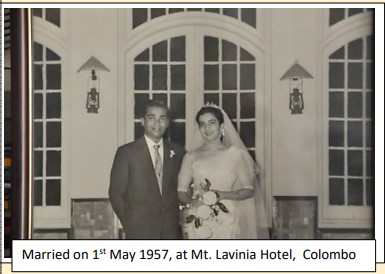
Victor Melder wedding
Victor Melder and wife, Esther, pictured in front of their home. (Photo by Dominic Sansoni)
This article is about the former. Many articles have appeared in the press and digital media about Victor and his many achievements over a long period of time. The present focus is on Victor Melder, the man. There are multiple aspects to his personality. His background, His love of family, his passion for books, endearing interest in the Ceylon Railway, and his deep faith in the Catholic church. Underlying all this is the spirit of service, which is evident in whatever he has done.
Victor was born in Kandy, on September 16, 1935 to a Railway family. Father Randolph was an engine driver and grandfather too worked for the railway, His mother was born in Bangkok, Siam. His maternal grandparents met while working in Bangkok. In 1909, they had responded to an advertisement for young people to work in Bangkok. Grandfather worked for the Royal Siamese Railway as store man and his grandmother taught needlework at the King’s palace. After their marriage and the birth of three children they returned to Ceylon in 1919.

Victor Melder at Galle in 1967 when he quit the CGR
Victor was the eldest of 11 children. His father was a strict disciplinarian. Life was routine with school and back, working in the garden with dad who excelled in gardening and had a collection of rare plants. Due to his father working in a transferable service, Victor spent his childhood in Kandy, Matale, Nanu Oya, Kadugannawa, Bandarawela, and Nawalapitiya. This explains his wide knowledge of the hill country. In between he spent time with his maternal grandparents who had a six-acre property at Peradeniya. Mother was a “tower of strength” and one look from her was sufficient to convey that “all was well”. Father was a man of strong principle and immense faith in God.
Let me quote Victor in his own words about his life in the Railways. “When Dad was transferred to Kadugannawa, I was almost 18 years of age, and began to be treated as an adult, there was no pressure to work in the garden, and for the first time sat with him on equal terms as any adult father and son would do. The following year I began working at the Kandy Municipality as a clerical officer, which I continued until joining the railways as an apprentice engine driver.
I joined the CGR in October 1956 and was appointed engine driver in October 1962. The apprenticeship, though tough and strenuous, was something I enjoyed the most. As an apprentice, we had to serve nine months at Nawalapitiya, performing what was termed “Upper Section Firing”, (working the Garratt locomotives). Dad was stationed there then. Whilst working with him on a few occasions, I had the opportunity to learn much, as he excelled in putting the theoretical side into practice by demonstrating how to perform running repairs and other day-to-day requirements on a working locomotive.
My crowning moment was, when one day working as an engine driver, I was able to salute my father from ‘my’ locomotive, and he saluted me back from ‘his’ locomotive. I feel he felt quite proud that day of himself as I was of myself. My working on the railways brought me much close to my father, we would sit for hours discussing and swapping yarns about everything railway whenever we met.”
The following excerpt from Victors, writing on Oh to be an engine driver highlights the rigorous training that engine drivers underwent before they received the Indenture from the Government.
“Once upon a time, when steam was King, it was every young boy’s dream to become a steam locomotive driver. Mine was no different, it was heightened by the fact that my father was an engine driver too. Unfortunately, with dieselization and the disappearance of the steam loco, this dream has now vanished for most young boys.
“My grandfather, Victor Melder, was a Guard on the Ceylon Government Railway and served from 1897 to 1926, when he passed away prematurely of a heart attack. My father, Randolph Melder, served the railways as an Engine Driver from 1923 to 1963.
“It was a colonial tradition that sons of employees in many services were given preference to employment in the field of their father’s occupation. This was also true with the railways, where sons of railway men had preference. It was argued that with their father being a railway man they would be aware of the vagaries of the job and therefore be more suited to it.
“I had to wait until 1956 before I realized my dream but was able to get in by about three months, as the cutoff point was 21 years and had the recruitment program been initiated three months later, I would have missed out on the age criteria.
“The recruitment notice specified the candidates should have passed the Senior School Certificate, (English) its equivalent or higher, but for sons of past or present employees of the Ceylon Government Railway (CGR) the Junior School Certificate (English) or higher. Railway Firemen with adequate experience, Seventh Standard (English) or higher.
“Other criteria were that applicants must be of good physique, height not less than five feet five inches (without shoes or socks) and chest measurement not less than 33 inches (normal). Appointment was subject to a medical examination and eyesight test.
“Selected applicants would be on probation for three months. Provided their work and conduct during this period are satisfactory, they will be retained in service and indentured for five years apprenticeship. Written tests will be held at the end of eight months training and again at the end of the second year of training to assess the suitability of the trainees.
“During the period of apprenticeship, they must attend instruction classes and perform whatever duties may be detailed. They are subject to the authority of the drivers whom they are booked to work with.
“Rate of Pay of the apprentices were:
First year Rs 2.20 per day
Second year Rs 2.60 per day
Third year Rs 3.00 per day
Fourth year Rs 3.40 per day
Fifth year Rs 3.80 per day
“On completion of training, apprentices will be required to pass a theoretical and practical test to prove their suitability for appointment to the grade of Engine Driver, Class III, to fill any existing vacancies. Those who fail the test will be re-examined at the end of another year. Failure in the second test will tender an apprentice liable for discontinuation.
“Applications for apprenticeships closed on June 21, 1956. I was interviewed by a panel of three (which included Mr Maxwell Sparkes, C.C.S, who was seconded for Railway service) on September 18, 1956 at the General Managers Office, C.G.R., Colombo. A fortnight later I was informed by post that my application and interview had been successful and that I reported for duty at 9.00 am on October 16,1956.
“As I lived at Nawalapitiya at the time of application, I had to attend a medical examination and eyesight test at the Kandy General Hospital, prior to taking up duties. This was successful. And so began an arduous and rigorous training schedule, which in my case was extended by eight months, since I was eight months off work, having contracted Infective Hepatitis in 1958, after drinking contaminated water off a steam locomotive tender. The department was kind enough to allow me to do three months’ light duty (off the footplate) giving me time to recover further.
“There were 50 apprentices recruited and we were given the title Special Apprentice Driver (SAD), we were numbered from 51 to 100 (don’t ask me why), and my official position was SAD 63. The title Special Apprentice was because we were being trained on both steam and diesel locomotives. A normal steam apprenticeship was of four years duration, in our case an extra year was tagged on for diesel locomotives.
“Of the 50 apprentices appointed, one was a complete outsider, 22 were sons of railway men and 27 were firemen promoted from the ranks. Before appointment as Engine Driver, one went Absent Without Leave (AWOL), two (from the ranks) were demoted for falsifying education certificates and one failed the eye test, whilst three immigrated to UK and Australia, leaving only the balance 44 to pass out as engine drivers.
“The first three months were quite a novelty indeed, working in the sprawling Dematagoda Running Shed, acquainting ourselves with the various steam locos in service. The daily grind consisted mainly in cleaning the boilers and tenders of the locos and also checking the under carriages of the bogie tables by working in the pits, as this was the only way to access them. It was a mundane 7.00 am to 4.00pm job, with an hour off for lunch from 11.00 to 12 noon. We worked a five-day week, plus half day Saturday. All the apprentices were deemed fit to carry on their training and had to sign the indenture papers.
“THE PITS were dangerous places to work in, they were about four to five feet deep, had a few inches of water running through them constantly and plenty of oil that had drained off the locos, whilst being serviced so one had to step very gingerly. As these were locos that were in steam, one had to be wary of falling embers. The bogie tables generally had ash and other grit that had to be scraped off and oiled. Occasionally one would find pieces of putrefying flesh from animals hit by the locos whilst ON THE RUN.
“The next three months was working with an assigned fitter on the various locos, carrying minor repairs, again this was a day job, with Sunday’s off. The following three months were indeed an eye opener as we were assigned as fireman on the steam shunting locos working round the clock, seven days a week at both Maligawatte Yard and Colombo Goods Yard (between Maradana and Fort Stations).
“The shunting locos at Maligawatte Yard worked in the carriage stabling yard, where passenger trains were formed and got ready for service. Colombo yard was mainly a goods or freight wagon yard again where goods trains left from and also arrived from the outstations. As such there was an inwards yard and an outwards yard. There was constant movement in these yards both day and night. It was interesting firing these shunting locos, where the pace of movement was slow and easy, preparing one for the hectic pace on the footplate for the passenger services.
“The next three months, saw us once again in the Dematagoda Running Shed working with the fitters on heavy and large repairs. This section of the work was with locos that were out of service, unlike the second three months, which were mainly running repairs. This was again a mundane job of five and a half days. All of sudden the first year had come to an end, combined with the practical work, the lectures and demonstrations, one had by now a working knowledge of steam locos and was trained to carry out minor repairs, so much so, as to be able to nurse a disabled loco home, rather than seek assistance en route.
“At the start of the second year, saw work on the footplate of passenger trains begin. The first four months was in the role of the second fireman on the open line. The duties were mainly to ensure the head fireman had an adequate supply of coal readily available on hand for firing whilst on the run (all coal had to be broken down to the size of one’s fist for easy firing and ignition).
“The duties also included assisting in watering the locos at watering points enroute and checking when possible that the lubrication points (outside the loco) were in order and topping up with lubricants when and where necessary. One was also expected to keep a sharp lookout whilst on the run, which included the position of signals etc.
“The next four months saw us graduating to the role of head fireman. In the case of the lower steam link, this was a one fireman position, for short distance trains. The duties were combined roles of both head fireman and second fireman. The next four months, saw us in the role of head fireman on long distance trains, with an allocated second fireman. This was a responsible task, always maintaining a steady head of steam and water, and maintaining a presentable footplate. Another year had gone by.
“The beginning of the third year saw us firing on the long-distance trains and fast good trains, which seemed to always run at night. One had an assigned Engine Driver to work under and an assigned second fireman, which resulted in teamwork, to ensure the trains arrived at their destinations on time. A head fireman and second fireman, come on duty at least an hour before the driver did. By the time the driver comes on duty, the loco would have its boiler cleaned or brushed down, watered and ready for take-off, with a full head of steam. The driver would carry out a cursory inspection of the loco and be ready to whistle at the appointed time.
“FIRING TRAINS on both Upper and Lower sections, were different to each other. In the Colombo area, where the railway did not encounter much hilly terrain, one had to fire infrequently compared to the constant climbing which required frequent firing of the loco to maintain a steady head of steam and water. On the lower section, express trains were much easier to fire, than stop and start trains, as they did not need that much firing.
“On the Upper section, due to the frequency of the firing that took place, the firebox tends to fill up quickly and halfway up the incline, one would have to clean out the excess ashes from the fire box, by rocking the firebox grate to drop the ashes off. This was necessary to ensure good ignition and to maintain a bright fire, required for steaming qualities. It was very strenuous and demanding WORK.
“The next four months, saw the 50 apprentices temporarily stationed at Nawalapitiya, for upper section service. This was where the Beyer Peacock Garrat locos were in service. Mercifully they had been modified from coal burners to oil burners and only required one fireman, as there was no stoking of the firebox, but a regulator lever operated to control the flow of furnace oil that fired the loco. What looked like a laborious task was quite simple indeed, if one maintained a steady head of steam for the journey.”
PART II,……………. ‘Sunday Island’, March 1, 2026.

Victor Melder in Library
He celebrated his 90th birthday recently, never returned to his homeland because he’s a bad traveler
THE GARRAT LOCOS, were monstrous machines that were able to haul trains on the incline, that normally two locos did. Whilst a normal loco hauled five carriages on its own, a Garrat loco could haul nine. When passenger traffic warranted it and trains had over nine carriages or had a large number of freight wagons, then a Garret loco hauled the train assisted by a loco from behind.
When a train was worked by two normal locos (one pulling, the other pushing) and they reached the summit level at Pattipola (in either direction), the loco pushing (piloting) would travel around to the front the train and be coupled in front of the loco already in front and the two locos took the train down the incline. With a Garraat loco this could not be done as the bridges could not take the combined weight. The pilot loco therefore ran down single, following THE TRAIN.
My father was stationed at Nawalapitiya as a senior driver at the time, and it wasn’t a picnic working with him. He believed in the practical side of things and always had the apprentices carrying out some extra duties or the other to acquaint themselves with the loco. I had more than my fair share.
After the four months upcountry, we were back at Dematagoda on the K. V. steam locos. From the sublime to the ridiculous, I would say after the Garret locos upcountry. Here the work was much easier and at a slower pace, as the trains did not run at speed like their mainline counterparts. The last two months of the third year saw us on the two types of diesel locos on the K.V. line, the Hunslett and Krupp diesels, which worked the passenger trains. For once this was a ‘cushy, sit-down’ job, doing nothing exciting, but keeping a sharp lookout and exchanging tablets on the run. The third year had come to an end and ‘the light at the end of tunnel was getting closer’.
Victor M’s Sri Lanka Ranjana medal
The fourth year saw us all at the Diesel loco shed at Maradana, which was cheek by jowl with the Maradana railway station. The first three months we worked with the diesel mechanical fitters and the following three months with the electrical fitters. Heavy emphasis was placed on a working knowledge of the electrical circuits of the different diesel locos in service, to ensure the drivers were able to attend to electrical faults en-route and bring the train home. This was again a period of lectures and demonstrations
We also spent three months at the Ratmalana workshops, where the diesels were stripped down to the core and refitted after major repairs, to ensure we had a look at what went on inside the many closed and sealed working parts. This was again a 7.00am to 4.00pm day job. Back again at the Diesel shed, Maradana, saw us riding as assistants for the next three months on all the diesel locos in service – The Brush Bragnal (M1), General Electrical (M2), Hunslett locos (G2) and Diesel Rail Cars.
After the final written test on Diesel locos, we began our fifth and final year, which was that of shunting engine driver. The first six months were spent at Maligawatte Yard on steam shunting locos and the next three months shunting drivers on the diesel shunting locos at Colombo goods yard. The final three months were spent as assistants on the M1 and M2 locos working all the fast passenger and mail trains.

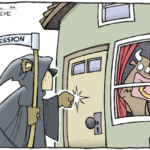
Cartoon to celebrate Victor’s 60th wedding anniversary
I was finally appointed Engine Driver Class III on July 6, 1962, as mentioned earlier I lost eight months of my apprenticeship due to being ill and had to make up the time. This appointment was on three years’ probation, on the initial salary of the scale Rs 1,680 – 72 – Rs 2,184, per annum.
Little did the general traveling public realize that they had well trained and qualified engine drivers working their trains to time Victor was stationed in Galle until December 1967, when he resigned from the railway to migrate to Melbourne, Australia to join the rest of his family. He was the last of 11 siblings to leave Ceylon. Their two elder children were born in Galle. Victor and Esther had three more children in Australia. The children, three boys and two girls) were brought up with love and devotion. They have seven grandchildren and two great grandchildren. They meet often as a family.
He worked for the Victorian State Public Service and retired in 1993 after 25 years’ service. At the time of retirement, he worked for the Ministry for Conservation & Environment. He held the position of Project Officer in charge of the Ministry’s Procedural Documents.
He worked part-time for the Victorian Electoral Office and the Australian Electoral Office, covering State and Federal Elections, from 1972 to 2010. From 1972 to 1982 and was a Clerical Officer and then in 1983 was appointed Officer-in-Charge, Lychfield Avenue Polling Booth, Jacana which is my (the writer’s) electorate.
As part of serving the community Victor participated in a number of ways, quite often unremunerated. He worked part-time for the Department of Census & Statistics, and worked as a Census Collector for the Census of 1972, 1976, 1980 and then Group Leader of 16 Collectors in his area for the 1984, 1988, 1992, 1996, 2000, 2004, 2008 and 2012.
In 1970, Victor began this library, now known as the ‘Victor Melder Sri Lanka Library’, for the purpose of making Sri Lanka better known in Australia. On looking back he has this to say: “Forty-five years later, I can say that it is serving its purpose. In 1993 President Ranasinghe Premadasa of Sri Lanka bestowed on me a national honor – ‘Sri Lanka Ranjana’ for my then 25 years’ service to Sri Lanka in Australia. I feel very privileged to be honored by my motherland, which I feel is the highest accolade one can ever get.”
There were many more accolades over the years:
15.10. 2004, Serendib News, 2004 Business and Community Award.
4.2.2008, Award for Services to the SL Community by The Consulate of Sri Lanka in Victoria (by R. Arambewela)
2024 – SL Consul General’s Award
In 2025 , Victor was one of the ten outstanding Sri Lankans in Australia at the Lankan Fest.
An annual Victor Melder Appreciation award was established to honour an outstanding member by the SriLankan Consulate.
The following appreciation by the late Gamini Dissanayake is very appropriate.
Comment by the late Minister Gamini Dissanayake, in the comment book of the VMSL library.
A man is attached to many things. Attachments though leading to sorrow in the end
are the living reality of life. Amongst these many attachments, the most noble are the attachments to one’s family and to one’s country. You have left Sri Lanka long ago but “she” is within you yet and every nerve and sinew of your body, mind and soul seem to belong there. In your love for the country of your birth you seem to have no racial or religious connotations – you simply love “HER” – the pure, clear, simple, abstract and glowing Sri Lanka of our imagination and vision. You are an example of what all Sri Lankan’s should be. May you live long with your vision and may Sri Lanka evolve to deserve sons like you.
With my best Wishes.
Gamini Dissanayake, Minister from Sri Lanka.
15 February 1987.
The Victor Melder Lecture
The Monash council established the Victor Melder Lecture which is presented every February. It is now an annual event looked forward to by Melbournians. A guest lecturer is carefully chosen each year for this special event.
Victor and his library has featured on many publications such as the Sunday Times in 2008 and LMD International in 2026.
“Although having been a railway man, I am a poor traveler and get travel sickness, hence I have not travelled much. I have never been back to Sri Lanka, never travelled in Australia, not even to Geelong. I am happiest doing what I like best, either at Church or in this library. My younger daughter has finally given up after months of trying to coax, cajole and coerce me into a trip to Sri Lanka to celebrate this (90th) birthday.
I am most fortunate that over the years I have made good friends, some from my school days. It is also a great privilege to grow old in the company of friends — like-minded individuals who have spent their childhood and youth in the same environment as oneself and shared similar life experiences.”
Victor’s love of books started from childhood. Since his young years he has been interested in reading. At St Mary’s College, Nawalapitiya, the library had over 300 books on Greek and Roman history and mythology and he read every one of them.
He read the newspapers daily, which his parents subscribed to, including the ‘Readers Digest’.His mother was an avid fan of Crossword Puzzles and encouraged all the children to follow her, a trait which he continues to this day.
At his workplace in Melbourne, Victor encountered many who asked questions about Ceylon. Often, he could not find an answer to these queries. This was long before the internet existed. He then started getting books on Ceylon/SriLanka and reading them. Very soon his collection expanded and he thought of the Vicor Melder SriLanka Library as source of reference. It is now a vast collection of over 7,000 books, magazines and periodicals.
Another driver of his service to fellow men is his deep Catholic faith in which he follows the footsteps of the Master.
Victor was baptized at St Anthony’s Cathedral, Kandy by Fr Galassi, OSB. Since the age of 10 he have been involved with Church activities both in Sri Lanka and Australia. He remains a devout Catholic and this underlies his spirit of service to fellowmen.
He began as an Altar Server at St Mary’s Church, Nawalapitiya, and continued even in his adult life. In Australia, Esther and Victor have been Parishioners at St Dominic’s Church, Broadmeadows, since 1970.He started as an Adult Server and have been an Altar Server Trainer, Reader and Special Minister He was a member of the ‘Counting Team’ for monies collected at Sunday Masses, for 35 years.
He has actively retired from this work since 2010, but is still ‘on call’, to help when required. To add in his own words
“My Catholic faith has always been important to me, and I can never imagine my having spent a day away from God. Faith is all that matters to Esther too. We attend daily Mass and busy ourselves with many activities in our Parish Church.
For nearly 25 years, we have also been members of a religious order ‘The Community of the Sons & Daughters of God’, it is contemplative and monastic in nature, we are veritable monks in the world. We do no good works, other than show Christ to the world, by our actions. Both Esther and I, after much prayer and discernment have become more deeply involved, taking vows of poverty, obedience and chastity, within the Community. Our spirituality gives us much peace, solace and comfort.”
“This is not my CV for beatification and canonization. My faith is in fact an antidote for overcoming evil, I too struggle like everyone else. I have to exorcise the demons within me by myself. I am a perfect candidate for “being a street angel and home devil” by my constant impatience, lack of tolerance and wanting instant perfection from everyone. “
The above exemplifies the humility of the man who admits to his foibles.
More than 25 years ago The Ceylon Society of Australia was formed in Sydney by a group of Ceylon lovers led by Hugh Karunanayake. Very soon the Melbourne chapter of the organization was formed, and Victor was a crucial part of this. At every Talk, Victor displayed books relevant to the topic. For many years he continued to do so carrying a big box of books and driving a fair distance to the meeting place. Eventually when he could no longer drive his car, he made certain that the books reached the venue through his close friend, Hemal Gurusinghe.
He also was the guest speaker at one of the meetings and he regaled the audience with railway stories.
Victor has dedicated his life on this mission, and we can be proud of his achievements. His vision is to find a permanent home for his library where future generations can use it and continue the service that he commenced. The plea is to get like-minded individuals in the quest to find a suitable and permanent home for the Victor Melder Srilankan Library.
by Dr. Srilal Fernando
ARRIVING DOWN UNDER …….Extra Item, ‘Sunday Island’, March 8, 2026.

Melder home in Melbourne
We (my wife Esther, two children, Frances (two yrs six months) and Richard (six months), and myself left Katunayake airport for Australia at 4.30 pm on March 12, 1968, flying UTA French airlines.
The final day in Sri Lanka was quite a busy one, receiving our foreign exchange allocation only at 11.00 am that morning, then rushing back home for the trip to the airport. Having long worked as an engine driver for the CGR, it was my intention that our final trip in then Ceylon would be by train; as such we took the 12.45 pm train from Maradana and detrained at Katunayake station.
I had pre-arranged with the Station Master at Katunayake to have a fleet of taxis stand by to convey us (friends, relatives and ourselves) to the airport. The plane departed on schedule and from the moment it took off I was air sick all the way.
At Singapore there was a break of a few hours and I managed to get off into the transit lounge for a breath of fresh air which seemed to revive me. Esther and the children however, stayed on board the aircraft. Once the plane took off, I was again a victim to air sickness. Fortunately the seats behind had fallen vacant and I was able to bed down for the night. It was Esther who had a torrid journey, minding the two kids all the way.
I was woken up whilst the plane was flying over Central Australia and did see the morning glow light up the land. We arrived at Sydney in the morning and I was amused to see that as soon as the plane landed a man entered the plane carrying an aerosol can, the contents of which he sprayed around the interior of the plane. He was, I am told, the Quarantine Officer, carrying out his duties to ensure no ‘nasties’ entered the country.
Before we disembarked a pleasant surprise awaited us – a telegram from a pen friend of mine in Queensland welcoming us to Australia, was delivered to us. We had a two hour break at Sydney Airport before we caught our connecting flight to Melbourne (Essendon Airport).
Victor Melder and wife, Esther, pictured in front of their home. (Photo by Dominic Sansoni)
It was a hot sunny day, the children were tired and grumpy and I called over at a food outlet to buy some drinks. All I had with me was a British pound sterling note. I gave them that and was given the change in Australian currency, which I had never seen before. I kept looking at it for a while, when the lady at the counter wanted to know what was wrong.
I told her I was migrating to Australia with my family and had never seen Australian currency before and was looking at it. She said, ‘please give it all back to me’, which I did. She then gave me back the pound note and said, “Welcome to Australia. I came here from Poland 10 years ago, I hope you settle in happily”. An auspicious start indeed to our life ‘Down Under’.
The family (my parents, brothers and sisters) were all gathered to meet us as I was the last member to migrate. The drive home was fascinating to say the least, the roads, bridges, lack of people on the roads, quiet traffic (with no cacophony of horns) made it all the more pleasant.
We were seeing television for the first time, and I thought to myself, how wonderful to ‘see the cinema come home’ as the day unfolded and we began to discover more delightful Australian customs and way of life. The following day, accompanied by a brother, I visited the local factories and businesses – Yakka, Ericsson’s, Nabisco Biscuits, Ford Motor Company – in search of employment.
I was flabbergasted to hear each one of them say I was too qualified for them and as such they could not employ me. This was indeed a new one for me. My brother explained, that they knew I was a new migrant and was looking for any type of employment to get settled, and then later on would obtain better employment commensurate with my qualifications. Thus all their training would have been in vain, not to mention the costs involved.
The following day I went to the City, accompanied by another brother. The train journey there and back, the ‘big smoke’ had me enthralled. We called at the recruitment office for both the Federal and State Public Services where forms were filled in and an application for employment lodged. Both agencies stated that it would be some months before I heard from them.
We next called in at the Australia Post recruitment centre as they were recruiting mail sorting officers and signed up with them to begin work the following Monday. The three months at the Postal Training School was interesting; one had to familiarize oneself with the various postal towns in districts and learn speed sorting. At the end of the three months I was given a bundle of 25 letters and had to sort it in a minute into postal districts, with only three errors allowed.
I was smart enough to work on the names in districts, in line with railway stations in various areas of the CGR – Matara, Badulla, Trinco, Batticaloa, KKS lines, thus being able to acquaint myself with the names quicker, and in the final test had only two mistakes.
As son as I had passed out from Postal School, I had a letter from the State Public Service offering me a clerical position (the choice was mine) at any of the following – the Department of Agriculture, Department of Health, Motor Registration Board, Grain Elevators Board and Fisheries & Wildlife Department. The last seemed very interesting and I picked it.
The postal authorities were unhappy to say the least when I resigned my position immediately after three months training (I now understood why I was earlier told that I was too qualified for employment). And so began a 25 year carrier with the State Public Service, which saw me serve in the same ministry, but various divisions – Fisheries & Wildlife, Conservation, Environment Protection Authority, Conservation & Natural Resources, Forest Commission, National Parks and Conservation & Environment.
Due to needs of supplementing my income, I obtained part time employment as an office cleaner with Brown’s Office Cleaning Services and worked for them for 15 years. They had contracts for cleaning offices in the City of Melbourne. A number of Sri Lankan immigrants worked for them supplementing their income. Thus began an extra stint of duty, leaving one’s day job, which ended t 4.30 pm.
Whilst the work was not too arduous the long hours were very demanding. I worked three hours each weekday evening, beginning at 5.00pm. By the time I reached home on public transport, it was well past 9.00pm and I was completely exhausted, especially during the summer months. Fortunately although it was part time work, I was also entitled to sick leave and annual leave.
Esther always wanted to remain at home and look after the kids. This was indeed a most demanding role for her, in that at one time we had the five kids attend five different Catholic schools in the area, which were graded senior, junior, high school (college) and then also segregated between boys and girls. She spent some 15 years driving them to the various schools and back.
One of the first things my father got me to do on arrival in Australia, was to fill in an application form with the Housing Commission of Victoria for a home of our own. This they told us would take anything up to three years before we were allocated one.
After an initial stay of four months with my parents at Broadmeadows, we decided to look for our own accommodation (a flat or house), but found that no one was keen to rent houses to people with children or pets. Finally we were able to locate a large flat (over a small shopping centre) in East Thornbury, where my parents lived when they moved to Australia.
The Estate Agent amazed me when I told them we had children saying, “we love children, yours are welcome.” When I said I had no Australian references, which everyone wanted, they said “If you were good enough for the Australian Government, you are good enough for us”. They were truly amazing and people with a heart.
We lived at East Thornbury for three years before we were given a choice of selecting a house from one of six being built at Broadmeadows West. This we did and this has been our home for the past 38 years. Initially it was difficult as it was a new area, with no street lighting and away from most shopping amenities, but over the years much development has taken place in and around the area.
At the early stages, we had most services delivered to the door – bread, milk, dry cleaning, fruit & vegetables, newspapers, the onion & potato man, mail etc. Over the years the services have dwindled (with progress) and today only the mail and newspapers are delivered.
After 25 years service with the State Public Service, I took the opportunity of ‘early retirement’ being offered by the public service and retired in April 1993.
by Victor Melder
The Melder clan in Australia