How multicultural is your suburb? – By Charis Chang, Ken Macleod
Source : sbs
Australia is becoming even more multicultural. Search for where your neighbours were born, what language they speak and what religion they follow.
In today’s Australia, about 28 per cent of people were born overseas and almost half have a parent who was born overseas – but in some places, that percentage is much higher.
The
, released this year, revealed more than one million new migrants have been welcomed into Australia since 2017, and around 220,000 came from India – the largest increase in country of birth outside of Australia. India has now overtaken China and New Zealand to become the third largest country of birth behind Australia and England.
This map shows the top countries of birth by suburb, excluding Australia. Search for your location or click on the map to find out more.
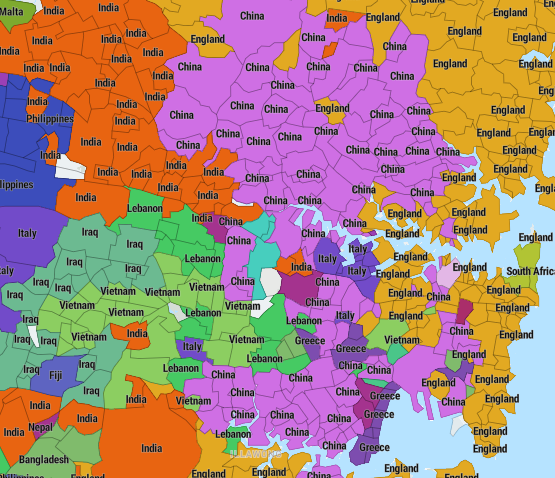
When it comes to the number of different nationalities, the Melbourne suburb of Point Cook tops the list as the most multicultural, recording people born in 146 different countries. It is followed by the inner city suburb of Melbourne (137 countries), and the Sydney suburbs of Blacktown and Maroubra (133 countries).
Many Sydneysiders would not be surprised that the inner city suburb of Haymarket – known for being the location of the city’s Chinatown and home to a large number of university students – records the highest proportion of overseas-born people among areas with more than 1,000 residents. Around 78 per cent of people in Haymarket were born overseas and come from a variety of countries, including 21 per cent from China, 17 per cent from Thailand, 11 per cent from Indonesia, and three per cent each from Malaysia and Korea.
By contrast, the areas with the smallest proportion of overseas-born people (in areas of more than 1,000 people) include Aboriginal communities Cherbourg and Yarrabah in Queensland, and Milingimbi in the Northern Territory.
It must be noted that not including people born in Australia in the map doesn’t account for the 812,728 people (or 3.2 per cent of the Australian population) who identify as Aboriginal and/or Torres Strait Islander.
When it comes to language though, more than 350 different languages are spoken across Australia, including 167 Aboriginal and Torres Strait Islander languages identified by the Census, some of which appear in the map below.
The number of people who use a language other than English at home has increased by nearly 800,000 since 2016 to more than 5.5 million people. Around 850,000 people in Australia say they do not speak English well, or at all.

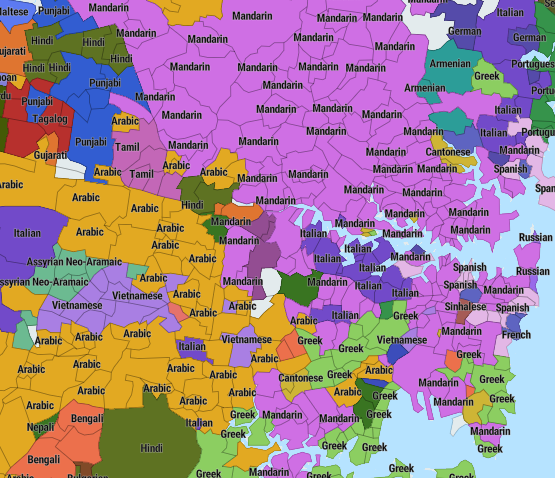
Mandarin continues to be the most common language other than English used at home in Australia and is spoken by nearly 700,000 people. This is followed by Arabic with just over 367,000 speakers.
The most recent Census was also an interesting one for religion, finding 38.9 per cent of people in Australia now report having “no religion” (compared with 30.1 per cent in 2016) while 43.9 per cent record their religion as Christianity (it was 52.1 per cent in 2016), followed by Islam on 3.2 per cent, Hinduism on 2.7 per cent and Buddhism on 2.4 per cent.
Almost all of Australia’s top 10 most religious suburbs are located in remote areas, or in parts of Western Sydney with higher-than-average migrant populations.
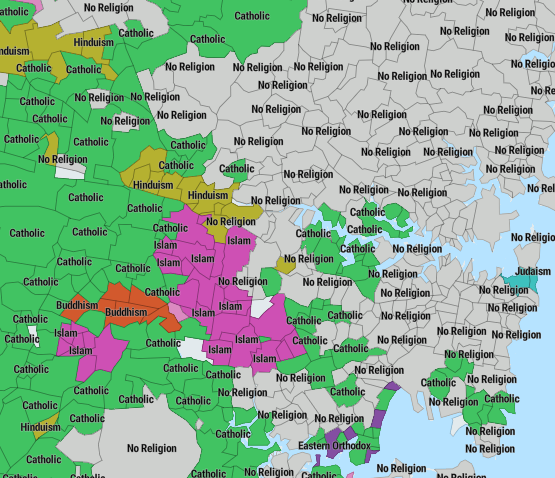
The island of Galiwinku, off the coast of Arnhem Land in the Northern Territory, tops the list for the most faithful, with 90 per cent of people reporting they are religious. A Methodist mission was established in the area in 1942, with around 47 per cent now following the Uniting Church but a high proportion (26 per cent) saying they follow Aboriginal traditional beliefs.
Many Western Sydney suburbs also show a strong commitment to faith, including Bungarribee, where 34 per cent practice Hinduism, Elizabeth Hills (44 per cent Catholic), Mount Lewis (40 per cent Catholic), Girraween (52 per cent Hindu), Abbotsbury (53 per cent Catholic), Mount Vernon (58 per cent Catholic) and Carnes Hill (37 per cent Catholic). All of these suburbs except Mount Vernon have overseas-born populations higher than the Australian average of 27.6 per cent.
Diversity within ‘communities’
In Harris Park, the Australian suburb with the second-highest percentage of overseas-born people, the Indian-born community now makes up 45 per cent of the population, with 47 per cent also saying they practice the Hindu religion. Overall 75 per cent of residents were born overseas.
Demographer Dr Liz Allen from the Australian National University says the variety of languages shows how communities that some may think of as one group could be very diverse.
“What’s so interesting about the diversity that we see in places, particularly in Western Sydney, is that even people from a particular country or a particular region, differ from each other.”
“So there’s a diversity, even among population groups that might, on the outside look very similar, there’s quite a lot of difference.”
Dr Allen says it’s also worth noting some people might say they practice or identify with a particular religion but in reality, this may not be the case.
What we cite in that religion question might reflect our upbringing; it may not reflect our ‘now’.– Liz Allen, Demographer
“Where our religion is closely bound up with our culture, we might more often experience a feeling of compulsion that we need to say that we are a particular religion when we don’t practice it.”
The people behind the statistics
Girraween resident Goverdhan, who was born in India, says he does not think religion plays a huge role in his community, although he does attend a nearby Hindu temple in Westmead. He says the large Indian community was one of the reasons why he was drawn to the area seven years ago but the main attractions were the suburb’s proximity to Parramatta (Sydney’s second CBD), transport, shopping and good schools.
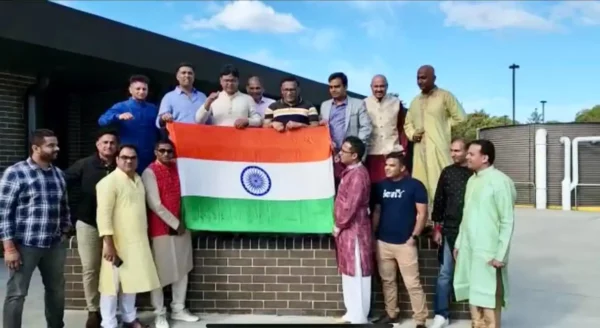
Goverdhan is one of the 7 per cent of locals who speak Telugu, a classical language of India still spoken in certain states, although he also understands and speaks Hindi, the common language of India.
Goverdhan says he started a Facebook page for the local Indian community because he wanted to share information on education, festivals and other news.
“We all come from one place and we have common thoughts, and good things to share.”
He has lived in Australia for 14 years and said he has been able to further his career in information technology.
“I have a good career here, it’s a nice community, a beautiful country and people, and a nice economy,” he said.
England and English still dominant
Across the country, England is the most common place of birth outside Australia, accounting for up to 4 per cent of people, followed by India (3 per cent), and China and New Zealand (both 2 per cent).
Other popular countries, making up 1 per cent of the population each, are the Philippines, Vietnam, South Africa, Malaysia, Italy and Sri Lanka.

Professor James Raymer from the Australian National University says many English migrants have been in Australia for a long time and are different to those from China and India, who were more likely to be more recent arrivals.
“If you look at the age composition of migrants by country of birth, England has a lot of people in their 60s, 70s, 80s and 90s, whereas India and China have hardly anyone in that age group.”
The future of multiculturalism in Australia
Another popular source of migrants has been Nepal, which recorded the second-largest increase in numbers in the most recent census. Almost 70,000 extra people from Nepal have arrived in Australia since 2017, more than doubling the size of the population since 2016.
Dr Allen says historically there has only been a small number of Nepali in Australia and this made the increase seem more substantial, but the increase may also reflect better economic conditions in Nepal which allow people to travel overseas and send their children to Australian universities. Members of the community are spread quite widely but there are larger groups in the Sydney suburbs of Auburn, Hurstville and Strathfield.
“It was a big issue when Catholics started coming to Australia… To me, it’s this kind of repeating story, migration groups, the flows, they change over time, they go up and they go down.
He says in the future it might be people born in countries in Africa who make up stronger waves of migration to Australia because they are still growing rapidly, while other countries including China and other East Asian nations are starting to experience population decline.