Invest (in) Sri Lanka While promises abound will the diaspora respond?- By Aubrey Joachim

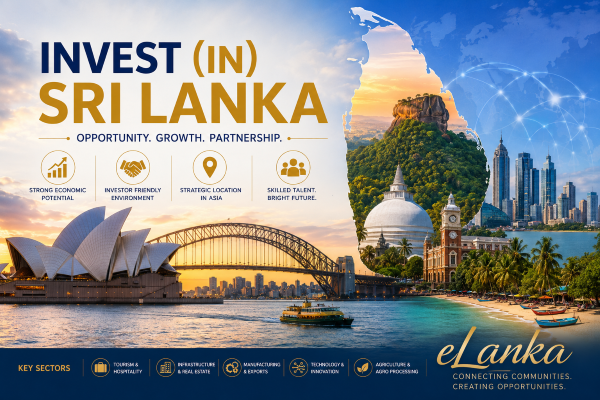
Last Monday a high powered delegation from Sri Lanka descended on Sydney and thereafter spent more days in Melbourne to promote to the Sri Lankan diaspora the virtues of supporting their motherland by investing in various ventures as well as in what is considered to be a well performing stock market.
The delegation comprised the Deputy Minister of Industry and Entrepreneurship Development, The Governor of the Central Bank, Director of the Colombo Stock Exchange, Chairman of the Securities and Exchanges Commission as well as leaders from the Wealth Management and Banking sectors. Also present was the Deputy MD of the Port City. The event was held at the prestigious Grand Sheraton Hyde Park.
The event was well attended by mostly Sri Lankans domiciled in Sydney. While many may not fall under the umbrella of genuine direct investors it is hoped that they could play a part in promoting the benefits of engaging with Sri Lanka in helping lift the economic fortunes of the country. A more strategically targeted list of invitees might have been more appropriate rather than those who merely arrived for a 5-star lunch. It might serve Sri Lanka well if for future events lists of relevant invitees are compiled by the High Commission.
The very attractive touristy opening visual presentation was followed by the Welcome Address articulately delivered by the High Commissioner for Sri Lanka in Australia H.E. Ms. Yasoja Gunasekera, who painted a very positive and encouraging perspective of Sri Lanka. As was to be expected from the economists and bankers who followed, a plethora of waterfall graphs, pie charts and financial tables were beamed on the screens while the respective speakers presented their positive and inspiring messages.
Some of the key take-aways coming from the Governor of the Central Bank are that the economy is on a positive trajectory having revived significantly following the economic crisis and the change in government. The IMF is pleased with the economic management of the country and the last tranche of the IMF rescue package is expected by the year end. Sri Lanka’s credit rating is still at CCC or slightly above as per the major rating agencies – not an ideal situation but an improvement since the 2022 default. The Lankan rupee has been flatlining and slight improvement is expected going forward. Foreign currency reserves are at a reasonable level buoyed by foreign employment remittances. The Governor also clarified that although debt repayments would commence in 2028, this is not expected to cause any serious issues.
Deputy Minister Chaturanga Abeysinghe presented the initiatives that the government is embarking on to drive economic growth in the country. Besides of course enticing investment in various areas including manufacturing, agriculture, AI and digital pursuits and the like he also explained how the government is driving digitalisation across government processes including the setting up of new businesses. In respect of developing the country’s human capital, the deputy minister indicated that beginning next year the entire education system from pre-school to vocational training and higher education is to be revamped. While this is perhaps a decade long initiative it promises to improve the human capability of the country which is so important to deliver the returns on investment in other areas. The Deputy Minister also indicated that a number of State Owned Enterprises (SOE’s) will be listed on the stock exchange in the not too distant future as soon as relevant legislation is passed in the parliament.
The Director of the Colombo Stock Exchange promoted the positives of his bourse providing data to demonstrate that the long term performance of the CSE has consistently outperformed even the Australian market. The challenge faced is that the Sri Lankan market needs to grow significantly if it to be attractive to overseas investors
The Bankers and the wealth managers on the podium were promoting the enticing of investors in the various investment products that seem to be attractive to the Sri Lankan diaspora. It appears that regulatory controls allow for guardrails around the foreign currency investments and outward transfers at any time.
The Deputy MD of the Port City painted a very glowing picture of the development which is hoped will rival similar ventures in the region. While essentially looking to become a financial hub to rival others in the region a number of other initiatives such as the setting up of regional offices of global multinationals, high-end residential developments, the best marina in South Asia as well as schools, hospitals and the like are on the cards. A large number of commitments have been secured and the UAE tops the international investor interest. Further, investors are assured of tax holidays as well.
While the sales pitch looks rosy only the response of the diaspora will be the proof of the pudding. Such promises have been made in the past and the diaspora has had their fingers burnt. However, this time the government and its leaders seem to be genuine in their intent to move the country to the next level and thereby improve the lives of all Sri Lankans. On the surface it appears that those in power seem to be driving initiatives in the interest of the country and people rather than vested interest.
However, genuine as the intent – and leadership – may be the major concern for the genuine diaspora investors is if the country has the capacity to deliver the ROI benefits. The very fact that the financial coffers are being replenished by overseas remittances mean that much of the country’s talent has left its shores. Engineers, IT experts, accountants, technicians and the like providing their knowledge, skills and expertise to other countries. It is well known that a many of the brighter brains are in countries like Australia, UK, Canada and the USA pursuing Masters degrees and PhD’s. How many will come back?
Thus the question remains – does the country have the skills, competence, knowledge and expertise to put to good use the investments that can be attracted? Can an investor setting up a manufacturing concern be assured of high quality labour to produce the outcomes? Are the systems and processes for setting up and helping business investors in place? Can the banking and finance systems be trusted? These are the worries at the back of the minds of prospective investors.
Therefore, are there other complementary initiatives that the government should also consider. While the diaspora are encouraged to only invest their dollars should they also be encouraged to invest their skills, competencies, knowledge and expertise? Could such rich Sri Lankan diaspora talent help to run some of the planned privatised SOEs? And perhaps even help government agencies implement controls and processes to increase productivity and the like? When India was working on rebuilding its economy it turned to its pool of diaspora and invited them to the party. This is what the government of Sri Lanka should do. Will it take the cue?
Sri Lanka needs all the support it can get and there is no better time for the Sri Lankan diaspora to lend a genuine helping hand. At the same time the government must also recognise the opportunity beyond merely stretching out their hands for the dollars. The diaspora has much more to offer.
The author is an Australian citizen of Sri Lankan descent and is a past Global President of CIMA