Musical instruments – Tamil heritage- BY DR. SUBASHINI PATHMANATHAN
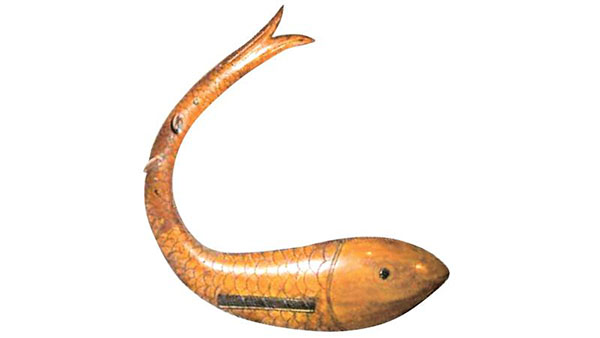
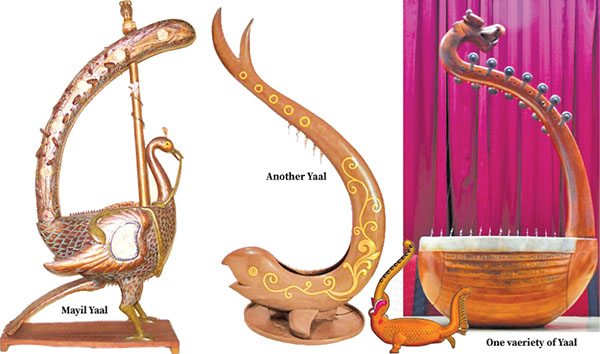
Makara Yaal
Source:Sundayobserver
In the Tamil cultural history, the instruments were divided into four main categories Thatha, Shasesra, Avanththatha and Gana.
Thatha was string instruments, Shsesha was wind instruments, Avanththatha was leather instruments and Gana was metal based instruments, such as the hand cymbals. Many ancient Tamil musical instruments are now not in use. With the passage of time, many new musical instruments take the place of old ones. Earlier the musicians were called Paawalar and the dancers Koothier.
In ancient times, male musicians were known as Paanar and female musicians Paanathiyar. Those who danced to their music were called Koothar. Female dancers were called Koothiyar or Vraliyar.
During those days, even the lands were divided into five categories, according to the landscape, climatic conditions and the nature of the land.
The five categories were Kurinchi, (mountain and mountainous area), Mullai (forest and forest area), Marutham (paddy field and paddy field area), Paalai (desert and desert area), Neithal (sea and seaside area). The categories of lands had each distinct (Pun Isai) music, as well as different musical instruments, including leather drums, string instrument and wind instruments.
According to the ancient Tamil cultural history, the Yaal instrument implies the historical link of Yaal with the flat land. However, the string instrument is no longer in use today. One reason for its disappearance is that it was a heavy instrument. Later, the Veena and Violin replaced the Yaal.
Ancient instruments
 Earlier, there were many varieties of the Yaal in use. They were Sakoda Yaal, Senkodi Yaal, Makara Yaal, Peeri Yaarl, Athi Yaal and Ariya Yaal. Each Yaal instrument had a number of strings. The total number of strings for Sakoda Yaal was about 14. Senkodi Yaal had 17 strings. Peeri Yaal had three varieties of strings. It was stated that Peeri Yaal had 21 strings. The Chenkottai Yaal had seven strings. Besides it was stated that two more Yaal varieties were in use, one was Mayil Yaal resembling the a peacock shaped Yaal and other was Vil Yaal, representing bow, or in other words, this particular variety of Yaal was shaped as bow.
Makara Yaal was often referred to in the literature as Makara Veena. It had its origin in Greece and was later introduced to the East. The shape of the Makara Yaal is that of a fish. Numerous ancient temple pillars of South Indian temples depict the Yaal instrument.
The Tamil poet Thiruvalluvar in his great work Thirukkural highlighted the Tamil classical string instrument Yaal. The second-century Silapathikaram of Illango Adikal is the oldest Tamil epic which contained numerous references to dance, drama, and other literary works. He also highlighted the four varieties of Yaals.
The commentator of Sillapathikam Adiyarkunallar of the 13th century also wrote about the Ariya Yaal.
According to historical evidence of famed Maduri Meenakshi, Amman Temple had highlighted the female musicians (Paanathiyar) who played Yaal in temple performances.
Famed Sri Lankan scholar Vipulanada Adikal did major research about the instrument. According to him, the Ariya Yaal had 1,000 strings. The size of the Yaal was over six feet.
His research on the Yaal was published in Yaal Noo. Kailayamalai reveals many facts about Yaalin relation to Yarlpanam.
String instruments
The strings were divided according to their thickness. Each string had only one particular pitch. But today’s string instruments can produce many pitches on one string. But today, many modern electronic instrument produce numerous pitches.
The ancient Yaal instrument is the main cause to name Jaffna as Yaalpanam in Tamil and Yapanaya in Sinhala.
In ancient Tamil literature, the musician was called Pannan. According to ancient Tamil history, a blind Pannan Veera Raghavan came from Chola to the North of Sri Lanka during the reign of King Jeyathunga Veera Singhan. As there was a tradition that the ruling king did not meet blind people, Pannan Veera Raghavan was not allowed to perform before the king.
However, a curtain was drawn between the king and the blind musician. The king gave him a plot of land known as Manatri.
Thereafter, Pannan Weera Raghavan came to be known as Yaalpadi (Yaal instrument musician). The land gifted to him was known as Yaalpanam. During the Portuguese period, the land was renamed as Jaffna. Even today, Jaffna is often referred to in Tamil as Yaalpanam or Yaal.
A few years before the battle against terrorism, the symbol of Yaal was depicted on top of the Town Hall building. At night, the Yaal instrument was beautifully decorated with colourful lights.
Yaalpana Vaipava Malai, the history of Jaffna, was written by Mayilvagana Pulavar, a Tamil poet. The Tamil encyclopedia Kalaikalanjeyam has confirmed this fact.
However, Yaalpana Vaipava Malai contained some crucial historical facts of the ancient Tamil city of Jaffna. It was translated from Tamil into English by C. Brito and published in 1879.