


News & Community eLanka

eLanka

Saturday, 23 May 2026
  • Home
  • Read History
  • Articles
    • eLanka Journalists
  • Events
  • Useful links
    • Obituaries
    • Seeking to Contact
    • eLanka Newsletters
    • Weekly Events and Advertisements
    • eLanka Testimonials
    • Sri Lanka Newspapers
    • Sri Lanka TV LIVE
    • Sri Lanka Radio
    • eLanka Recepies
  • Gallery
  • Contact
Newsletter
Sri lankan news
  • eLanka Weddings
  • Property
  • eLanka Shop
  • Business Directory
eLankaeLanka
Font ResizerAa
Search
  • Home
  • Read History
  • Articles
    • eLanka Journalists
  • Events
  • Useful links
    • Obituaries
    • Seeking to Contact
    • eLanka Newsletters
    • Weekly Events and Advertisements
    • eLanka Testimonials
    • Sri Lanka Newspapers
    • Sri Lanka TV LIVE
    • Sri Lanka Radio
    • eLanka Recepies
  • Gallery
  • Contact
Follow US
© 2005 – 2026 eLanka Pty Ltd. All Rights Reserved.
Home » Goodnews Stories Srilankan Expats » Articles » Symptoms of the Dawn Phenomenon-by Harold Gunatillake
ArticlesDr Harold Gunatillake

Symptoms of the Dawn Phenomenon-by Harold Gunatillake
eLanka admin
Last updated: May 23, 2026 12:32 pm
By
eLanka admin
ByeLanka admin
Follow:
Share
5 Min Read
SHARE
Views: 28

Symptoms of the Dawn Phenomenon-by Harold Gunatillake

Dr Harold Gunatillake

Many people with type 1 or 2 diabetes notice that their fasting sugar levels can be high when tested. It’s natural to worry about this, but there’s no need to. Just like blood pressure can be higher in the early hours—even when medications are working well—these fluctuations are normal.

In this article, I’ll explain why all of this happens, so you can understand it better and feel reassured. Your body follows a 24-hour Circadian Rhythm, which is controlled by an internal biological clock. During the early hours of sleep, your organs—especially the liver—become quite active. They work hard to clear out waste, produce proteins, and repair tissues. This nighttime work helps prepare you for the busy daytime that lies ahead.

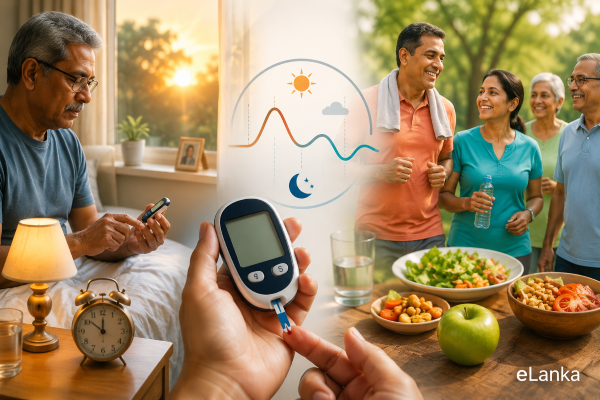
One clear sign of dawn phenomenon is when your blood sugar stays high in the morning. To check, try waking up a bit earlier, around 3 a.m., and use a glucometer to see your levels. If you have a continuous glucose monitor, you can also review its data to spot patterns. If you have diabetes, it’s quite normal for your blood sugar to sometimes be higher in the mornings—it’s nothing to worry about. But if you notice this happening several mornings in a row, reaching out to your doctor is a smart move to ensure everything’s okay.

This observation, known as the dawn phenomenon, happens when your body doesn’t release additional insulin to match the gradual increase in blood sugar during the early morning hours. It usually occurs between 3 a.m. and 8 a.m., especially if you have diabetes. This is when your body repairs the wear and tear from the day’s activities, especially if you’ve been active.

You can help reduce the dawn effect by avoiding carbohydrates before bedtime. Consider taking your insulin right before bed instead of earlier in the evening. Don’t hesitate to talk with your doctor about possibly adjusting your insulin dose or other diabetes medications to find the best plan for you.

Let’s talk about the Somogyi effect, which happens during the early hours and can cause your fasting blood sugar to be high. It often occurs when the insulin you take before bed is either too much or too little, or if you skip your nighttime snack.

Understanding this can help you manage your blood sugar better and feel more in control of your health.

When that happens, your blood sugar might dip significantly overnight. Your body reacts by releasing hormones that oppose insulin, which can lead to higher morning blood sugar levels. This is also known as rebound hyperglycemia. The Somogyi effect is more often seen in people with type 1 diabetes.

Recent research using continuous glucose monitors (CGM) has shed new light on the Somogyi effect. These wearable devices, which monitor blood sugar levels throughout the night, help us better understand what happens during sleep. They show that the sharp overnight drop in blood sugar, followed by a sharp morning spike, is less common than we once thought. Many experts now believe that high morning blood sugar may be more closely linked to the dawn phenomenon, inconsistent insulin doses, or insulin resistance, rather than the Somogyi effect. Ongoing findings continue to fuel the debate around the Somogyi effect, and scientists are eager to learn more through further studies.

The main thing to remember is that if you’ve maintained good blood sugar control over time and your HbA1C is within the normal range, there’s usually no need to worry if your fasting blood sugar is a bit high in the morning. Keep up your great work and stay positive!

It’s usually better to skip the morning fasting blood sugar test, as it doesn’t really help you monitor or manage your blood sugar levels throughout the day.

It’s a good idea to check your blood sugar level around 5 p.m. This timing can provide valuable insights to help you better manage your daily blood sugar levels.

I hope I have made some sense of this topic. End



Click here to receive your free copy of the eLanka Newsletter twice a week delivered directly to your inbox!
TAGGED:continuous glucose monitorsSymptoms of the Dawn Phenomenon
Share This Article
Facebook Whatsapp Whatsapp LinkedIn Email Copy Link Print
Previous Article The Brad & Kiara Show The Brad & Kiara Show
Next Article SUNDAY CHOICE - TEARS ARE A LANGUAGE GOD UNDERSTANDS – by Charles Schokman SUNDAY CHOICE – TEARS ARE A LANGUAGE GOD UNDERSTANDS – by Charles Schokman
FacebookLike
YoutubeSubscribe
LinkedInFollow
eLanka Wedding
- Advertisement -
Ad image
Most Read
International Tea Day-eLanka

International Tea Day-by Kalani-eLanka

SUNDAY CHOICE - TEARS ARE A LANGUAGE GOD UNDERSTANDS – by Charles Schokman

SUNDAY CHOICE – TEARS ARE A LANGUAGE GOD UNDERSTANDS – by Charles Schokman

The Brad & Kiara Show

The Brad & Kiara Show

Newsletter – Hindu Council of Australia

Sri Lanka Remitly 2026 Report

Sri Lanka Ranked 4th Best Country Globally for Families to Relocate: Remitly 2026 Report

Related News
Negombo
Articles

Educators Meet in Negombo to Transform International Education for a Dynamic Sri Lanka on 24th May

Rockland Spirits
Articles Savithri Rodrigo

Today – The magic of Rockland, Ren I Tang, festival of fireflies and more!

Trump
Articles Dr Harold Gunatillake

Sri Lanka’s Perspective: Why the Trump–Xi Meeting is More Important Than We Usually Think-by Harold Gunatillake

Melbourne Airport 01
Articles Lawrence Machado

Melbourne Airport to scrap kerbside pick-up and drop-off – By Cara Waters/The Melbourne Age

Articles Dr. Gamini Kariyawasam

සිනිමාලිනිය දිවි සිනිමාවෙන් සදහටම සමු ගෙන වසරක් සපිරේ-by Gamini Kariyawasam

  • Quick Links:
  • Articles
  • DESMOND KELLY
  • Dr Harold Gunatillake
  • English Videos
  • Sri Lanka
  • Sinhala Videos
  • eLanka Newsletters
  • Obituaries
  • Sunil Thenabadu
  • Dr. Harold Gunatillake
  • Tamil Videos
  • Sinhala Movies
  • Trevine Rodrigo
  • eLanka Newsletter
  • Photos

eLanka

Your Trusted Source for News & Community Stories: Stay connected with reliable updates, inspiring features, and breaking news. From politics and technology to culture, lifestyle, and events, eLanka brings you stories that matter — keeping you informed, engaged, and connected 24/7.
Kerrie road, Oatlands , NSW 2117 , Australia.
Email : info@eLanka.com.au / rasangivjes@gmail.com.
WhatsApp : +61402905275 / +94775882546
  • About eLanka
  • Terms & Conditions

Disclaimer:
eLanka is committed to sharing positive and community-focused stories. We do not publish or endorse political, religious, or ethnic viewpoints. The content published on eLanka, including articles and newsletters, reflects the opinions and views of the respective authors and not those of eLanka. eLanka accepts no responsibility or liability for the accuracy, completeness, or consequences of any content provided by contributors.

(c) 2005 – 2025 eLanka Pty Ltd. All Rights Reserved.