News & Community eLanka

eLanka

Tuesday, 2 Jun 2026
  • Home
  • Read History
  • Articles
    • eLanka Journalists
  • Events
  • Useful links
    • Obituaries
    • Seeking to Contact
    • eLanka Newsletters
    • Weekly Events and Advertisements
    • eLanka Testimonials
    • Sri Lanka Newspapers
    • Sri Lanka TV LIVE
    • Sri Lanka Radio
    • eLanka Recepies
  • Gallery
  • Contact
Newsletter
Sri lankan news
  • eLanka Weddings
  • Property
  • eLanka Shop
  • Business Directory
eLankaeLanka
Font ResizerAa
Search
  • Home
  • Read History
  • Articles
    • eLanka Journalists
  • Events
  • Useful links
    • Obituaries
    • Seeking to Contact
    • eLanka Newsletters
    • Weekly Events and Advertisements
    • eLanka Testimonials
    • Sri Lanka Newspapers
    • Sri Lanka TV LIVE
    • Sri Lanka Radio
    • eLanka Recepies
  • Gallery
  • Contact
Follow US
© 2005 – 2026 eLanka Pty Ltd. All Rights Reserved.
Home » Goodnews Stories Srilankan Expats » Articles » New wildlife underpass at Galgamuwa – solution for Human-Elephant Conflict – By Arundathie Abeysinghe

ArticlesArundathie Abeysinghe

New wildlife underpass at Galgamuwa – solution for Human-Elephant Conflict – By Arundathie Abeysinghe

eLanka admin
Last updated: March 28, 2026 5:55 am
By
eLanka admin
ByeLanka admin
Follow:
Share
5 Min Read
SHARE
Views: 214

New wildlife underpass at Galgamuwa – solution for Human-Elephant Conflict – By Arundathie Abeysinghe

Arundathie Abeysinghe

New wildlife underpass at Galgamuwa – solution for Human-Elephant Conflict By Arundathie Abeysinghe According to scholars, the new wildlife underpass at Galgamuwa in North Western Province which will be completed this month, will be a solution for the Human-Elephant Conflict (HEC). Galgamuwa is part of the Mahaweli Development Programme, the largest multipurpose national development programme in the country. Currently, construction of the elephant underpass is being completed beneath the railway line at Kasikote, between Galgamuwa and Ambanpola, an area well-known for frequent elephant crossings. A tunnel is constructed beneath the railway track to allow wild elephants to move safely from one side to the other, reducing the risk of train collisions as well as HEC. In 1977, when the Accelerated Mahaweli Development Scheme was launched, vast extents of forest lands were logged to facilitate new settlements. This led to elephants losing their habitats. According to senior engineers working on the project site, “construction work is expected to be completed in March 2026. The project would have been completed in early March, yet, the design phase of the project could not be finalised as there were challenges in controlling the movements of elephants towards the villages. During the rainy season, the slope that had already been cut was filled with water. Hence, those issues had to be addressed prior to its completion.” Galgamuwa residents are of the view that “this is a key project that should have been completed several decades ago as over 300 people have died in the area due to HEC, while over 50 people are handicapped as a large number of houses were damaged by elephants in search of food. For many years, we have spent sleepless nights due to fear of elephants roaming villages at night. One or two officers of the Department of Wildlife Conservation (DWC) cannot handle several elephants at once.” According to environmentalists “due to new settlements, there is lack of food in existing elephant migratory routes. To prevent elephant encounters, majority of villagers have set up electric fences which are useless as elephants cross the fences by felling large trees over them.” “Kahalla-Pallekele sanctuary was declared in 1989 with the objective of declaring the area up to Kala Wewa and Balalu Wewa as a national park. Yet, after this declaration, illegal land grabbing and human activities have disturbed migratory routes that elephants have been using for many years. Subsequent governments dug trenches, thinking that it would discourage elephants from coming towards villages. But that too was unsuccessful. Elephants now destroy electric fences because there’s lack of maintenance. It is difficult for just one or two wildlife officers to manage these elephant fences. When there’s lack of fodder, they go to people’s backyards in search of vegetables and fruits grown in home gardens.” In certain areas of Galagamuwa, community-based seasonal paddy field fences are constructed to avoid HEC. These are very successful as there is a direct incentive for the farmers to maintain and monitor the fence as their crops may be raided by elephants. In 2024, there were around 300 seasonal paddy field fences erected by Farmer Organisations supported by the Department of Agrarian Development. These seasonal paddy field fences contributed significantly to the number of elephant deaths decreasing from 488 in 2023 to 386 in 2024 as people kill elephants mainly when they raid their paddy or vegetable crops. Scholars are of the view that “although, the project would be completed this month, it is necessary to monitor, at least for a period of one year, if elephants may get used to using the underpass, even though they may not use it immediately.”


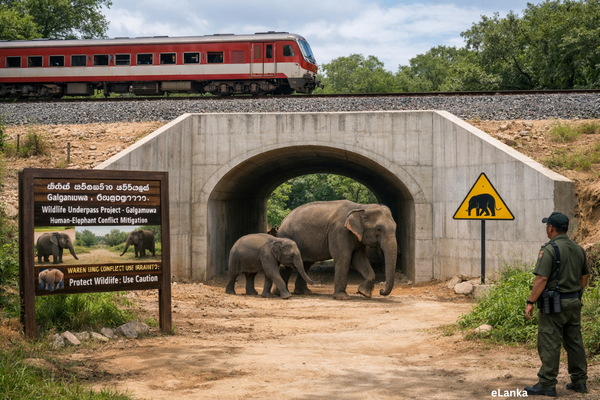
According to scholars, the new wildlife underpass at Galgamuwa in North Western Province which will be completed this month, will be a solution for the Human-Elephant Conflict (HEC). Galgamuwa is part of the Mahaweli Development Programme, the largest multipurpose national development programme in the country. Currently, construction of the elephant underpass is being completed beneath the railway line at Kasikote, between Galgamuwa and Ambanpola, an area well-known for frequent elephant crossings. A tunnel is constructed beneath the railway track to allow wild elephants to move safely from one side to the other, reducing the risk of train collisions as well as HEC.

In 1977, when the Accelerated Mahaweli Development Scheme was launched, vast extents of forest lands were logged to facilitate new settlements. This led to elephants losing their habitats.

According to senior engineers working on the project site, “construction work is expected to be completed in March 2026. The project would have been completed in early March, yet, the design phase of the project could not be finalised as there were challenges in controlling the movements of elephants towards the villages. During the rainy season, the slope that had already been cut was filled with water. Hence, those issues had to be addressed prior to its completion.”

Galgamuwa residents are of the view that “this is a key project that should have been completed several decades ago as over 300 people have died in the area due to HEC, while over 50 people are handicapped as a large number of houses were damaged by elephants in search of food. For many years, we have spent sleepless nights due to fear of elephants roaming villages at night. One or two officers of the Department of Wildlife Conservation (DWC) cannot handle several elephants at once.”

According to environmentalists “due to new settlements, there is lack of food in existing elephant migratory routes. To prevent elephant encounters, majority of villagers have set up electric fences which are useless as elephants cross the fences by felling large trees over them.”

“Kahalla-Pallekele sanctuary was declared in 1989 with the objective of declaring the area up to Kala Wewa and Balalu Wewa as a national park. Yet, after this declaration, illegal land grabbing and human activities have disturbed migratory routes that elephants have been using for many years. Subsequent governments dug trenches, thinking that it would discourage elephants from coming towards villages. But that too was unsuccessful. Elephants now destroy electric fences because there’s lack of maintenance. It is difficult for just one or two wildlife officers to manage these elephant fences. When there’s lack of fodder, they go to people’s backyards in search of vegetables and fruits grown in home gardens.”

In certain areas of Galagamuwa, community-based seasonal paddy field fences are constructed to avoid HEC. These are very successful as there is a direct incentive for the farmers to maintain and monitor the fence as their crops may be raided by elephants. In 2024, there were around 300 seasonal paddy field fences erected by Farmer Organisations supported by the Department of Agrarian Development. These seasonal paddy field fences contributed significantly to the number of elephant deaths decreasing from 488 in 2023 to 386 in 2024 as people kill elephants mainly when they raid their paddy or vegetable crops.

Scholars are of the view that “although, the project would be completed this month, it is necessary to monitor, at least for a period of one year, if elephants may get used to using the underpass, even though they may not use it immediately.”





 

Click here to receive your free copy of the eLanka Newsletter twice a week delivered directly to your inbox!


TAGGED:Ambanpola elephant corridorDepartment of Wildlife Conservation Sri Lankaelectric fences elephants Sri Lankaelephant habitat loss Sri Lankaelephant migration routes Sri Lankaelephant underpass railway Sri LankaGalgamuwa elephant crossingshuman elephant conflict solutions AsiaHuman Elephant Conflict-Sri Lankahuman wildlife conflict solutionsKahalla Pallekele sanctuaryKasikote railway underpassMahaweli Development Programme Sri Lankapaddy field fences elephant conflictrailway elephant accidents Sri LankaSri Lanka elephant conservationSri Lanka wildlife managementsustainable wildlife solutions Sri LankaWildlife conservation Sri Lankawildlife underpass Galgamuwa
Share This Article
Facebook Whatsapp Whatsapp LinkedIn Email Copy Link Print
Previous Article Australia to host U19 women’s tri-series in April Australia to host U19 women’s tri-series in April
Next Article Dilruk Jayasinghe is Sri Lanka's pride at the Australian Comedy Festival. - BY TREVINE RODRIGO IN MELBOURNE. Dilruk Jayasinha is Sri Lanka’s pride at the Australian Comedy Festival.- BY TREVINE RODRIGO IN MELBOURNE.
FacebookLike
YoutubeSubscribe
LinkedInFollow
eLanka Wedding
- Advertisement -
Ad image
Most Read
Qld Sri Lankan Newsletter - Dæhæna - June 2026

Qld Sri Lankan Newsletter – Dæhæna – June 2026

WHY ELDERLY PERSONS FEEL LONELY - By N.S.Venkataraman

WHY ELDERLY PERSONS FEEL LONELY ? – By N.S.Venkataraman

ABSC Inc. Hosts Annual Gala Dinner and Launches EKONOMOS Issue 7, 2026

ABSC Inc. Hosts Annual Gala Dinner and Launches EKONOMOS Issue 7, 2026

Ministry of Foreign Affairs, Ministry of Foreign Affairs

Pure Ceylon Tea Shines Globally: Celebrating International Tea Day 2026

Asian Junior Athletics, Asian U20 Athletics Championship 2026, Athletics in Sri Lanka, Dilanma Ransini Gold Medal, Dilanma Ransini Perera,

History Made! Dilanma Ransini Perera Sprints to Gold at 2026 Asian U20 Athletics

Related News
Alzarri Joseph, Sabina Park Jamaica, Shai Hope, Shimron Hetmyer, Sri Lanka Cricket Team, Sri Lanka Tour of West Indies 2026
Articles

Cricket Update: West Indies Name Strong Squad for ODI Series Against Sri Lanka

Households urged to test life-saving devices on Smoke Alarm Action Day
Articles

Households urged to test life-saving devices on Smoke Alarm Action Day | NSW

Sri Lanka Visa Fee Waiver
Articles

Travel Just Got Easier! Sri Lanka Scraps Visa Fees for Australians

Sri Lanka Open 2026
Articles

Golfing Greatness: N. Thangaraja Dominates to Win Sri Lanka Open 2026

Articles Michael Roberts

Vihares & Verandahs: Sansoni Book on the Market in UK-by Michael Roberts

  • Quick Links:
  • Articles
  • DESMOND KELLY
  • Dr Harold Gunatillake
  • English Videos
  • Sri Lanka
  • Sinhala Videos
  • eLanka Newsletters
  • Obituaries
  • Sunil Thenabadu
  • Dr. Harold Gunatillake
  • Tamil Videos
  • Sinhala Movies
  • Trevine Rodrigo
  • eLanka Newsletter
  • Photos

eLanka

Your Trusted Source for News & Community Stories: Stay connected with reliable updates, inspiring features, and breaking news. From politics and technology to culture, lifestyle, and events, eLanka brings you stories that matter — keeping you informed, engaged, and connected 24/7.
Kerrie road, Oatlands , NSW 2117 , Australia.
Email : info@eLanka.com.au / rasangivjes@gmail.com.
WhatsApp : +61402905275 / +94775882546
  • About eLanka
  • Terms & Conditions

Disclaimer:
eLanka is committed to sharing positive and community-focused stories. We do not publish or endorse political, religious, or ethnic viewpoints. The content published on eLanka, including articles and newsletters, reflects the opinions and views of the respective authors and not those of eLanka. eLanka accepts no responsibility or liability for the accuracy, completeness, or consequences of any content provided by contributors.

(c) 2005 – 2025 eLanka Pty Ltd. All Rights Reserved.