Noel News

“Leave children enough so they can do anything,
but not enough that they can do nothing.”
WARREN BUFFETT
Welcome to our December Newsletter
It’s the last month of the year and there’s plenty to think about. We survived the Division 296 proposal, where the government wanted to tax unrealised gains inside super, and we’re now bedding in the massive aged-care changes that kicked in on 1 November. I talk more about aged care later in this newsletter, but keep in mind it’s a minefield and expert advice is essential. If you don’t have an adviser, I can help you connect with one.
Interest rates have dominated the news all year. Back on 1 January the cash rate was 4.35%, and unemployment was just over 4%. The RBA then cut rates three times – 0.25% on 18 February, another 0.25% on 20 May and a further 0.25% on 12 August – taking the cash rate to 3.60% today. As I’ve written many times, inflation is still not under control, and I doubt we’ll see another cut in the next 12 months. Some commentators think rates may even rise, but I don’t believe that will happen.
A major issue this year has been the growing barriers to entry for first-home buyers. It’s now almost impossible to find anything under a million dollars, leaving many people shut out of the market. To make matters worse, rents have gone crazy. Potential tenants now face two challenges: first, finding a rental at all, and second, being able to afford it.

My daughter and her family recently had to find a rental while they build their new home, and I saw firsthand the stress involved. Prospective tenants lodge applications and bids, then wait a week or more while the landlord decides who the ‘lucky winner’ is. It’s a crazy system that creates huge uncertainty. If I were the landlord, I’d take the first strong application rather than waste two weeks’ rent trying to sort through them.
The situation has been worsened by the government’s scheme that lets buyers get into the market with a 5% deposit and no mortgage insurance. It’s driven prices up and lured many young people into potential financial trouble. APRA has now stepped in and tightened lending requirements, but it feels like closing the gate after the horse has bolted. It’s a sad situation, and I don’t see any easy fixes in sight.
Super Made Simple
The response to my new superannuation book has been overwhelming, and I thank you all for your support. The books left McPherson’s printers late last week, and we now have stock at last. Neil Hudson and his team are working flat out to ship all the orders.

The Book that turns confusion into confidence
If you’ve ever felt uncertain about super, this book is designed to give you clarity and confidence. The 7th edition has been fully updated to reflect current superannuation rules and thresholds, and I’ve aimed to explain everything in plain English, without jargon or sales spin.
Whether you’re still working, approaching retirement, or already drawing an income from super, the principles in Super Made Simple will help you make better long-term decisions. It also makes a thoughtful and practical Christmas gift for a partner, adult children, or anyone who wants to better understand how their super really works.
Super Made Simple (7th edition) is available now in both print and ebook formats.

|
Note: eBook discounts are applied at checkout: |

Grab a Bundle & Save!
FREE SHIPPING ON ORDERS OVER $35 IN AUSTRALIA

Taxation
Now that Treasurer Jim Chalmers has put reducing intergenerational inequality on his bucket list, everybody’s talking about inheritance tax again.
But Australia already has death taxes in place – effectively. Let’s start with superannuation. The super pot now exceeds $4 trillion, and much of it will be passed on over the next 20 years as the baby boomers – the first of whom were born in 1946 – pass on. Super funds typically consist of a taxable component and possibly a tax-free component. When a super member dies, the taxable component left to a non-dependent is taxed at 17% – that’s 15% plus the Medicare levy.

|
This tax doesn’t affect couples while both are alive, but when one member of the couple dies, usually in their seventies or eighties, the survivor – often the widow – will leave the balance to non-dependants, such as adult children. If the fund is worth $500,000, there could be a death tax of around $85,000. Call it what you like – inheritance tax, death duty or ‘closing the wealth gap’ – the effect is the same: a sizeable bite out of a family’s legacy.
What else serves as a de facto death tax? Capital gains tax (CGT). While death does not trigger CGT, it passes the liability on to the beneficiaries, who will pay CGT based on the deceased’s cost base if and when they dispose of the asset. Given that some beneficiaries can hardly wait for their parents to die, you can bet your bottom dollar that many of those assets will be sold soon after the funeral.
Good estate planning can help here. Remember, capital losses die with the owner – they can’t be carried forward, so use them while you can. If you’ve got a decent share portfolio and three beneficiaries, one may want to keep the shares long-term while the others want cash; it may be more tax-effective to sell some shares before death and leave the proceeds in cash.
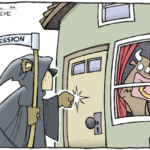
So when politicians talk about ‘closing the wealth gap’, remember the taxman already gets a slice when you go. The trick is to make sure it’s not a bigger slice than it has to be. And if you bring in an inheritance tax, you also need a gift tax – once governments start sniffing around inheritances, there’s no telling where it will end.
What many advisers I spoke to complain about is the inflexibility of the large super funds, which restrict members to just one accumulation and one pension account. This rule – which has nothing to do with government – stops members using a clever strategy to reduce the death tax. Advisers often suggest that clients withdraw money from an existing fund, then re-contribute it to a new accumulation account made up mostly of tax-free money. Later withdrawals can be taken from the older account, leaving the tax-free balance untouched. It’s a simple move that can make a big difference over time – but it’s impossible if the fund refuses to allow three accounts.
|


|
|
|
It reminds me of a story about Winston Churchill. One morning his butler realised he’d forgotten to press Churchill’s shirt. To distract him, he polished Churchill’s coins and laid them out in a perfect, gleaming row. When Churchill entered the room, he was so struck by the brilliance of the coins that he never noticed the creased shirt. It’s a timeless lesson in distraction – when you don’t want people to see your mistake, shine something else instead.
When large funds demand sweeping legislative change in the name of ‘simplicity’, it looks suspiciously like those polished coins – a shiny distraction from their own shortcomings. If death benefits take months or years to pay out, phones go unanswered, and members can’t get clear guidance, the problem isn’t the architecture of super but the way it’s being managed. |
PODCAST
Making Money Made Simple
with Noel Whittaker
Renowned broadcaster John Deeks and I discuss all the big topics covered in this newsletter in detail each month

Welcome employer superannuation changes |

These are long overdue.
The new Payday super legislation requiring employers to make superannuation contributions for employees at the same time as their salary and wages are paid has passed Parliament and is now law. The new legislation applies from 1 July 2026 and will require employers to contribute super into employee accounts within seven business days of paying salary/wages.
If the fund doesn’t receive the employee’s super contributions within this time, employers will be liable for superannuation guarantee charge. The new system will also help the ATO to more quickly identify employers that are not making contributions, including differentiating between low and high-risk employers.
From the Mailbox

Image by rawpixel on Freepik
In the last newsletter, I asked feedback from readers who had experience as landlords. These are just two of the many I have received:
ONE
Earlier this year I sold a home unit I had owned in Sydney for 48 years. While the tax-free capital gain was great, the annual net rental return was less than 2% pa. As well as the usual tenant and repair hassles, I had to take the Owners Corporation to NCAT to get a simple, less than $10k repair to common property. Also, a few years ago the ATO disallowed travel expenses for rental properties, so from then on I had to pay others for repairs I used to do myself after driving down from the Sunny Coast.
Another stimulus to sell was something I found out while doing my father’s estate. When you pass on and own real property in another state, the executor needs to apply for probate in that state as well as the state you reside in, which can double the paperwork, time required and legal costs of the estate.
My unit was sold to a young woman using the Bank of Mum and Dad. Good luck to her, but another property missing from the affordable rental pool. It was a great investment and the long-term return was similar to the All Ords. But the hassles just became too much. I am now enjoying the stress-free benefits of share investments both inside super and in ETFs.
TWO
I recently sold my beach house for a number of reasons, due primarily to the catastrophic state that Victoria is in at present. I was told that Airbnb bookings were down because Covid was no longer considered to be a problem and people were travelling overseas instead of locally.
The local council’s grab from owners renting their properties, the recently introduced Airbnb tax and land tax (which increased from $800 a few years ago to more than $5000), didn’t help the situation, but by selling (and paying the capital gains tax) I can invest the proceeds and rent a beach house at Christmas for my kids, grandkids and great-grandkids.
So I no longer have any worries about maintenance, cleaning, tenants or any other charges that the broke Victorian government will think up to charge property owners.
Beware the new aged care laws
For years, the golden rule of entering aged care was: Think twice before selling the family home. But Rachel Lane of Aged Care Gurus says new rules and exit fees can change the financial picture dramatically, and it’s now time to think three times. Since 1 November, the system has become more nuanced, and families who don’t take time to understand the implications can easily make decisions that cost them far more than they realise.

Image by Freepik
Many people assume that selling the family home is the only way to fund aged care. After all, the Refundable Accommodation Deposit – or RAD – is usually hundreds of thousands of dollars. It’s easy to see why people panic. If you don’t pay the RAD in full, the unpaid balance attracts interest at the maximum permissible interest rate (MPIR), which is currently 7.61% a year. On a $750,000 RAD, that’s $57,075 in annual interest – enough to make selling seem like a ‘no-brainer’. But now that the rules have shifted again, selling your home can often be the worst move you could make.
Keeping your home offers substantial financial advantages that no other asset can provide. One of the biggest misconceptions is that the home is fully assessed for aged-care fees. It’s not. Under current rules, only a capped amount – $210,555 – is counted in the aged-care means test. If your home is worth $1.2 million, that means roughly $1 million is effectively ignored for aged-care purposes. This single concession can transform what looks like an impossible situation into one that is entirely manageable.
Contrast that with what happens if you sell. Every dollar you put into the RAD becomes assessable, and any money left over adds to both your pension and aged care means tests. So you could lose valuable pension entitlements and pay higher care fees, all for the sake of ‘simplifying’ things. And once the money is assessed, there’s no turning back – you can’t undo the impact of that decision.
Keeping your home offers substantial financial advantages that no other asset can provide.
The age pension rules also favour keeping your home. If you move into aged care and retain ownership, the property is exempt from the pension assets test for two years. And if you’re part of a couple, that two-year clock doesn’t start until the second person leaves the home. That’s a major benefit, often overlooked, that can provide crucial breathing space at a stressful and emotional time.
What’s changed since 1 November is the introduction of an exit fee on the RAD. Previously, the deposit was fully refundable when you left aged care. Now, if you stay five years or more, you could forfeit up to 10% of it. On a $750,000 RAD, that’s a $75,000 hit – money that once came straight back to your estate. Suddenly, paying the RAD looks far less attractive, and many advisers are reworking strategies that once seemed straightforward.
Of course, keeping your home isn’t free. There are rates, insurance, maintenance and possibly rent or care costs to consider. But if the property grows in value, that growth can offset these expenses. In some cases, renting the house can help cover daily care fees while keeping the capital intact.
For example, one family kept Mum’s home worth $1 million, rented it for $700 a week, and used the rent to pay daily care fees. Five years later it was worth $1.4 million, preserving both the asset and flexibility to sell later. By contrast, another family sold Dad’s home to pay a $600,000 RAD, only to realise the negative impact on aged-care costs and lost pension – a surprise that could have been avoided.
With aged care, it’s always been important to think – and get informed – before you act. With the new exit fees and shifting assessment rules, the smart money now says: think three times and get advice before you act.
And finally

I’m reading a book about anti-gravity. It’s impossible to put down!
I asked my friend to spell wonton backwards. He said not now.
What do you call a melon that’s not allowed to get married? Cantaloupe.
The invention of the shovel was a ground-breaking discovery, but the invention of the broom was the one that truly swept the nation.
I didn’t think orthopaedic shoes would help. But I stand corrected.
Thief steals wheels off police car! Cops work tirelessly to nab suspect.
I went to McDonald’s today and ate a Kid’s Meal. It was good, but his mum was furious.
My friend keeps saying, ‘Cheer up man it could be worse, you could be stuck underground in a hole full of water.’ I know he means well.
I entered ten puns into a competition to see if one would win. No pun in ten did.

A big thank you to all you good people who read my newsletter.
If you were forwarded this newsletter by a friend and you would like to subscribe, you can do so here:
Subscribe to Noel News
You can also find the subscription box in the footer of all website pages.
For more Noel News:
Download recent Noel News as a PDF

I hope you have enjoyed the latest edition of Noel News.
Thanks for all your kind comments. Please continue to send feedback through; it’s always appreciated and helps us to improve the newsletter.
And don’t forget you’ll get more regular communications from me if you follow me on X – @NoelWhittaker.
Noel Whittaker
Wishing you and your family a joyful Christmas and a happy New Year filled with peace, good health, and plenty of memorable moments.
Noel Whittaker