Old rituals; doing it their way-By Yomal Senerath-Yapa and Sajani Ratnayake
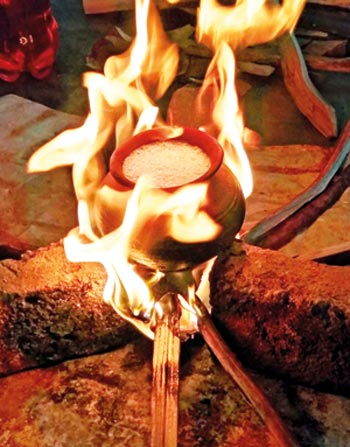
Boiling milk: One of the nine rituals associated with the Sinhala and Tamil New Year.Pic by Indika Handuwala
Source:Sundaytimes
Avurudu has been celebrated in the island for millennia, an indigenous practice that probably harks back to yaksa and naga times. The Veddahs follow it propitiating their ne yakkas, testimony to its hoary vintage.
The harvest festival, brimming with joy as the golden paddy had been reaped brings the nation together, but in recent years many have had to ‘cut corners’ given the pressures of rising costs and the daily grind.
The traditional Avurudu began with house cleaning, whitewashing, then the making of kevili. The first of the rituals was observing the new moon while the last was leaving for work. These two nekath today are mostly disregarded being impractical or – as in the case of the first – a tad too whimsical.
The harvest festival is so old that it is shorn of any Buddhistic associations, apart from visiting the temple during the inauspicious time.
The nine core rituals are observing the new moon, bathing for the old year, the dawn of the new year, the inauspicious time, boiling milk, partaking of meal and ganudenu (exchange of money wrapped in betel leaf), anointing with oil, departure for work and planting a sapling.
Anthropologists will tell you that all these rituals are prompted by the very primal drive to placate unseen powers so the coming year would be bountiful. Yet there is a medicinal aspect in the anointing of oil made of herbals; while the other rituals have their psychological raisons d’être– they are a cultural fillip; a time for rejuvenation marking a cycle – something we all need.
Says Prof. Sasanka Perera, a sociologist at the South Asian University, on Avurudu in current times: “Celebration of new year when it was not taken over by the state and private sector had far more versatility and variety. But because of standardisation, the cultural variation that Sri Lankans used to have throughout the country has become more homogeneous, and is now far less interesting. There used to be significant differences according to area, which we now no longer see. It’s simply the beginning of the new cycle of planting and crop and fertility. Cultural calculation can have more than one interpretation. Which is why this year, there is a controversy as there are two times. But there is no mathematical explanation or method to calculate such facts.
“I suggest that these matters should not be strictly followed, as it is up to individual choice. Cultural things don’t have to be looked at rationally as they are based on beliefs, which should not be forgotten.”
As The Sunday Times delved into how different individuals from different communities – Sinhalese and Tamils spread across the globe – celebrate the ‘sun festival’, it was clear that, while we may not all go the whole way, most take the trouble to at least spend some time with family and follow the core rituals.
Sumana Yapa from Akuressa, Matara makes the avurudu kevili from her own paddy harvest and follows all the rituals, including visiting the village temple and anointing with oil. She does not neglect observing the new moon (which this year falls on April 11) with family.
For Laxshamitta Jayasundera of Embagoda walauwwe, Ratnapura, Avurudu begins with observing the new moon. She does not do it on the prescribed time but any day of that week apart from kemmura days (i.e. Wednesday and Saturday- kept to propitiate Suniyam and other deities) is fine. They also bathe for the old year in water mixed with Bo leaves (this year on April 11), and clean the kitchen during the Nonagathaya (the inauspicious time).
The ritual with the well – the almost sacred source of water- is where Laxshamitta as the housewife drops a coin, some flowers and a piece of charcoal into it. Then the clay pot of water kept from last year’s avurudu is emptied and a new pot filled with water to be cast aside the next New Year.
The Avurudu Kumaraya (that handsome divine harbinger and symbol of the New Year) is not forgotten. After the traditional Avurudu meal a portion of the food is left outside on a banana leaf or decorated gokkola for the Sun prince. The festivities culminate with isa thel gema at the Kadjugaswatte temple for Laxshamitta.
Rani Wickremeratne, from New Jersey, USA, never foregoes the full table. She makes all the delicacies from her native Kurunegala – kevun, kokis, mun kevun, aggala, aasmi, naran kevun, dodol, peni walalu, thala guli – as well as muscat and milk toffee.
As the springtime sunlight filters into her living room, Rani follows the main rituals like boiling the milk (kiri uthuranawaa); ganu denu and sharing food (there being quite a cosy Sri Lankan community in the neighbourhood) with her husband, son and their daughter flying in from Minnesota.
Liyanage Susmitha Guneratne was originally from Kaduwela where the hath maaluwa is never eaten but only left out for the Auvurudu kumaaraya. In Elapatha, where his estate is and where he currently resides, the dish is eaten with rice and never kiribath, he says.
Sarojini Vasudevan, a housemaid working in Colombo but from Talawakelle, recalls wearing new clothes to go to the kovil. “Then we prepare food, visit our cousins or they come over, and we all spend the day together.”
Kusum Disanayake, writer and housewife, residing in Kohuwela but from Rambukkana originally, takes delight in the neighbourly rounds of calls sharing sweetmeats. At her village she says, she used to observe the auspicious day for bathing and other villagers even kept up with the auspicious time for setting off to work, something impossible to do today as usually it happens to be on April 18.
Niro Daniel from Nugegoda observes the boiling of milk while they adhere to the auspicious colour code. They ‘lay the table with betel’ and eat, and the children worship the parents. Niro says she used to do the isa thel gema in her childhood.
Damith Ratwatte, from Talawatta, says his family celebrates “all the traditions”, preparing the full table as well. The money exchanged during ganudenu is not used till the next year comes. When he was young and living in Kaduwela they would go to his aunt’s house and together make all the kevili. “All the cousins would colour coordinate the outfits according to the colours and grandmother would make outfits for all of us.”
Niharra Chandrasena currently domiciled in California says of her last Avurudu spent in ‘the Golden State’: “We had some kevili that we bought from a Sri Lankan store. We wore the specified colour and did the kiri uthuranawa, that’s all. The vibe wasn’t the same though. I missed home so much and like wearing sarongs and giving other people kevili and hearing the fireworks and watching all the random games that are played and stuff”.
Nisadevi Unamboowe from Kandy follows the rituals from observing the new moon and until recently even kept with the nekath of setting off for work. In their rambling old Kandyan house Avurudu comes early, and lingers pretty late, till the last of the kevun is polished off, and the pancha and other board games are stowed away for another season.
The astrologers’ battle over auspicious times this year played out over the media, is testimony to how important the hallowed rituals to do with the Sun God’s progress remain. Coaxing out the perfect konde for the kevun may not be a common art, but come Avurudu, we all feel a stirring as the koha comes a-calling and onchilli vaaram ring across golden fields…